Myocardial perfusion imaging using single-emission computed tomography (SPECT) plays a crucial role in diagnosing coronary artery disease, but lengthy scanning times can cause patient discomfort and image distortion. Zezhang Yang, Zitong Yu, and Nuri Choi, alongside colleagues at Washington University in St Louis and the Mallinckrodt Institute of Radiology, have developed SPASHT, a novel image-enhancement method that significantly reduces scanning time without compromising image quality. The team’s approach actively trains the algorithm to improve the detection of perfusion defects, a critical aspect of cardiac diagnosis, even when using considerably fewer projection views. Objective and human observer studies demonstrate that SPASHT substantially improves the accuracy of defect detection and enhances overall image clarity, paving the way for faster, more comfortable cardiac scans and potentially more reliable diagnoses.
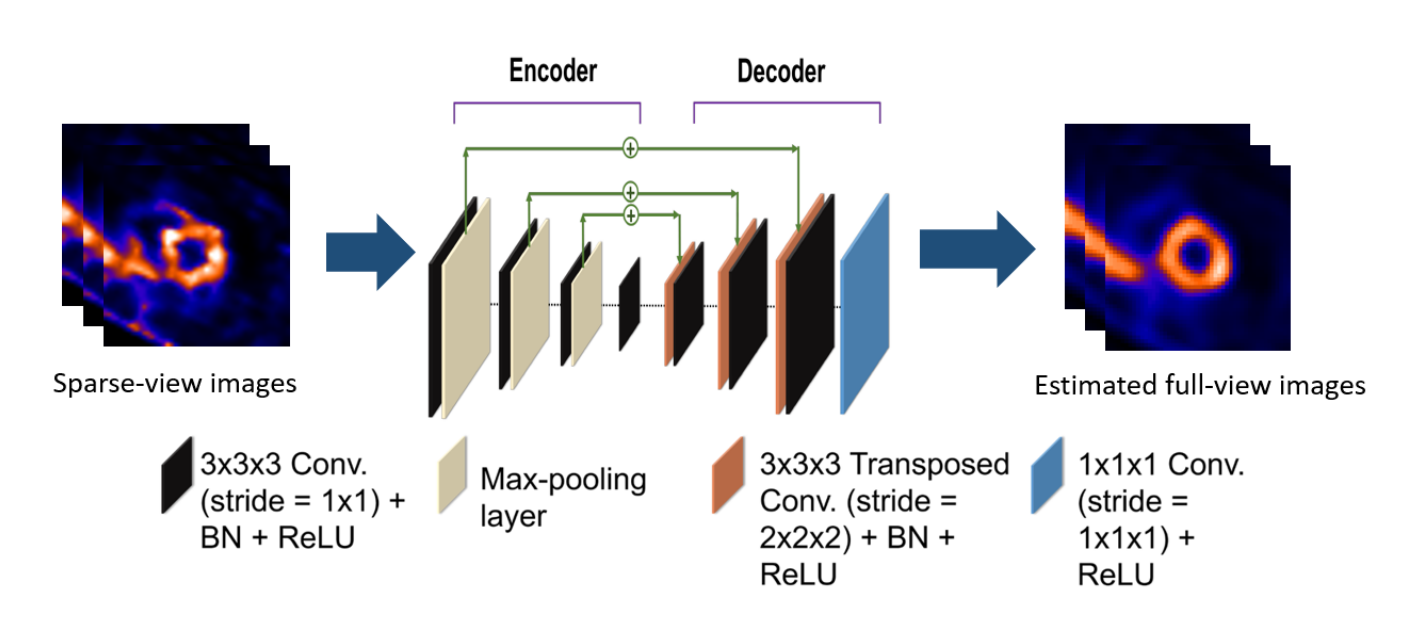
Myocardial perfusion imaging (MPI) using single-photon emission computed tomography (SPECT) is a widely used diagnostic tool for coronary artery disease. However, the procedure requires considerable scanning time, leading to patient discomfort and the potential for motion-induced artifacts. Reducing the number of projection views while maintaining image quality presents a significant challenge, as fewer views typically lead to increased noise and reduced diagnostic accuracy. To address this, researchers have developed SPASHT, a novel image enhancement method that incorporates an understanding of how humans visually perceive images within a deep-learning approach. This innovative technique aims to improve image quality despite the reduced number of projection views, potentially leading to faster and more comfortable cardiac scans for patients.
Deep Learning Improves Sparse-View MPI Defect Detection
This research investigates methods to improve the quality of myocardial perfusion imaging (MPI) SPECT scans acquired with limited projections, known as sparse-view imaging. Sparse-view acquisition reduces scan time and radiation dose, but degrades image quality. The study focuses on a deep learning (DL) approach, specifically comparing a standard DL method to a novel SPASHT method designed to enhance defect detection. The goal is to not just improve image quality visually, but to demonstrably improve the performance of a theoretical observer in detecting defects. The team employed a detailed analysis of the underlying image characteristics to understand why SPASHT performs better than other methods.
The analysis involved examining how the algorithm processes key image features, focusing on the differences between images with and without defects. Researchers used a mathematical technique called eigenanalysis to decompose the image data and identify the specific characteristics that contribute to accurate defect detection. This analysis revealed that SPASHT effectively preserves the signal related to defects while simultaneously reducing noise, leading to improved performance. The team quantified these improvements using a signal-to-noise ratio, demonstrating that SPASHT significantly enhances the ability to distinguish between healthy and diseased tissue. The findings demonstrate that SPASHT not only enhances the signal but also reduces noise and amplifies the relevant features for defect detection. This detailed analysis provides a quantitative explanation for why SPASHT performs better, offering valuable insights for optimizing future image enhancement techniques.
Defect Detection Improves With Fewer Views
Scientists have developed SPASHT, a novel image enhancement method designed to improve the quality of myocardial perfusion imaging (MPI) SPECT scans acquired with fewer projection views. Reducing the number of projection views shortens scanning time, addressing patient discomfort and potential motion artifacts, but typically introduces image degradation. The team addressed this challenge by training the algorithm to specifically improve performance on defect-detection tasks, a critical aspect of MPI SPECT analysis. Experiments involved reducing projection views to various levels and then evaluating the enhanced images using a measure of diagnostic accuracy.
Results demonstrate significantly improved diagnostic accuracy for images processed with SPASHT compared to those obtained with the sparse-view protocol. This indicates a substantial improvement in the ability to detect perfusion defects, which signify areas of reduced blood flow in the heart. To further validate the findings, a human observer study was conducted, assessing the ability of experts to detect perfusion defects in both SPASHT-enhanced images and those from the sparse-view protocol. The results from this study showed improved detection performance with images reconstructed using SPASHT, confirming the clinical relevance of the enhancement. This work delivers a promising approach to shorten scanning times while maintaining diagnostic accuracy in MPI SPECT, potentially improving patient comfort and clinical workflow.
SPASHT Improves Sparse MPI Defect Detection
This research presents a novel image enhancement technique, SPASHT, designed to improve the quality of myocardial perfusion imaging (MPI) scans obtained with reduced scanning times. Recognizing that shorter scan times can lead to image artifacts and reduced diagnostic accuracy, the team developed an algorithm that specifically improves defect detection in sparse-view SPECT images. Objective evaluation using clinical data, where defects were realistically simulated, demonstrated that SPASHT significantly improved the accuracy of identifying perfusion defects compared to standard sparse-view protocols, across various levels of scan reduction. Further validation involved human observers who also showed improved defect detection performance with images reconstructed using SPASHT.
The algorithm’s success stems from its ability to enhance images by inherently learning to improve performance on defect-detection tasks, potentially mitigating the loss of high-frequency features typically associated with reduced scan data. The researchers acknowledge that further studies are needed to evaluate the technique with a larger group of physicians and a wider range of defect scenarios. Ongoing investigations aim to refine the technique and broaden its clinical applicability.
🗞 SPASHT: An image-enhancement method for sparse-view MPI SPECT
🧠 ArXiv: https://arxiv.org/abs/2511.06203




See today’s quantum computing news on Quantum Zeitgeist for the latest breakthroughs in qubits, hardware, algorithms, and industry deals.