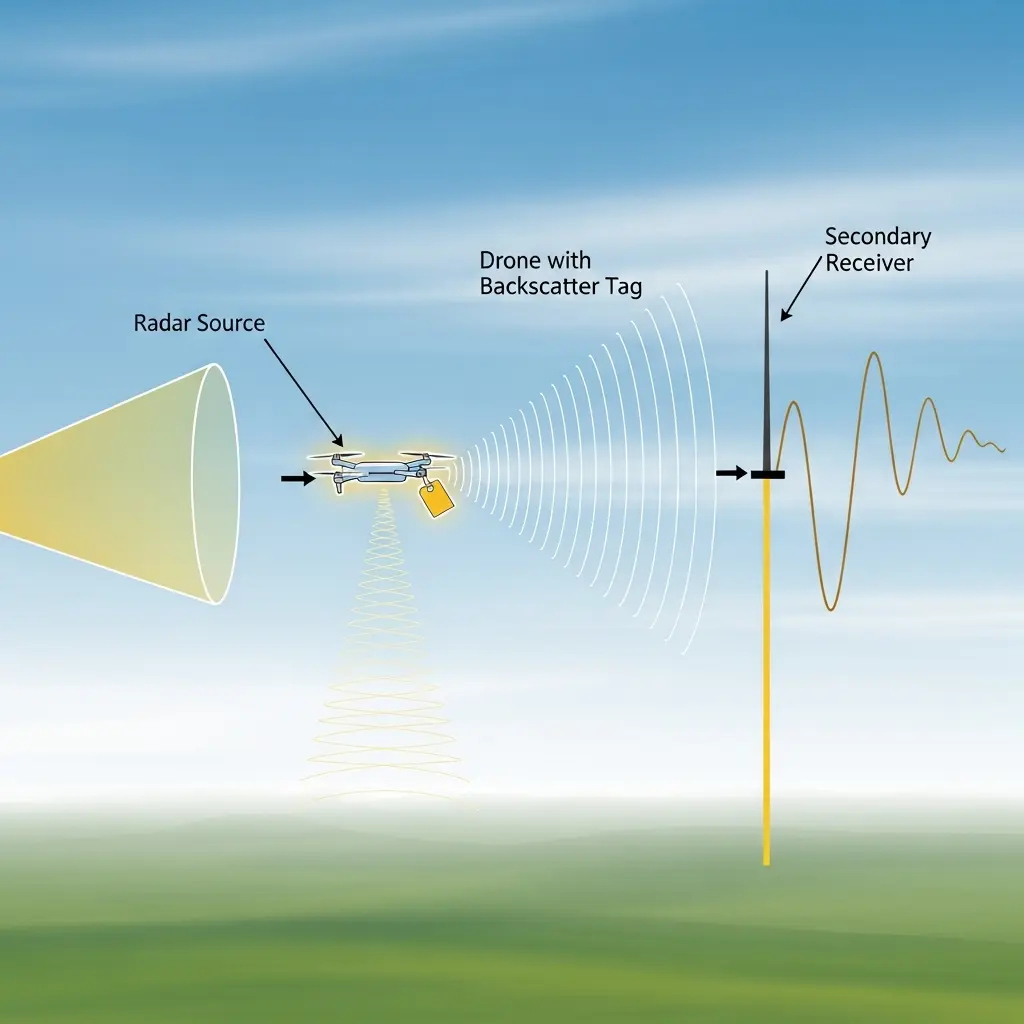
Future wireless networks increasingly rely on low-power devices, and backscatter communication offers a promising solution for connecting vast numbers of these sensors by harvesting existing radio signals. However, limitations such as signal loss and interference currently hinder the widespread adoption of this technology. Ahmet Kaplan, Diana P. M. Osorio, and Erik G. Larsson, working within the European Union’s Horizon 2020 research program, address these challenges by developing a novel system that intelligently selects the best communication pathways and focuses radio signals with a new beamforming technique. This approach significantly boosts the strength of reflected signals while minimising interference, ultimately reducing errors and achieving performance comparable to systems using much more complex and power-hungry components. The team’s work represents a crucial step towards truly sustainable and scalable wireless networks for the Internet of Things.
Bistatic Backscatter Systems for IoT Communication
This research details significant advancements in bistatic backscatter communication systems, a technology poised to enable a new generation of low-power Internet-of-Things devices. Scientists explored the fundamental principles of backscatter, where devices reflect existing radio frequency signals rather than actively transmitting them, focusing on bistatic systems where the signal transmitter and receiver are not located together. This approach offers benefits for applications requiring minimal energy consumption and low-cost connectivity. The study addresses critical challenges in system design, including mitigating interference and optimizing resource allocation to maximize network efficiency.
A major focus lies on suppressing direct path interference, where the reader’s signal bypasses the tag and reaches the receiver directly, corrupting the intended backscattered signal. Researchers investigated techniques like beamforming and precoding to shape the radio signal, improving signal quality and extending coverage. They also delved into methods for efficiently allocating resources such as power and time slots within backscatter networks, and developed algorithms for selecting the optimal access point in complex cell-free multiple-input multiple-output configurations. The study further explores advanced techniques like fractional programming and second-order cone programming for optimizing system parameters, and employs interior point methods for efficient problem solving. Researchers also investigated the potential of deep reinforcement learning for resource allocation in multiple-antenna backscatter networks, broadband backscatter communication, the application of non-orthogonal multiple access schemes, chaotic modulation for enhanced security, and the integration of backscatter communication with wireless power transfer. This comprehensive work provides a thorough overview of the state-of-the-art in bistatic backscatter communication, paving the way for a wide range of innovative IoT applications.
Distributed MIMO Backscatter for IoT Networks
Researchers have engineered a novel communication system for future Internet-of-Things networks, prioritizing low-power operation to extend battery life. The team harnessed backscatter communication, where devices reflect radio frequency signals rather than actively transmitting them, to achieve energy-efficient connectivity. To overcome limitations of conventional backscatter systems, scientists developed a distributed multiple-input multiple-output setup with multiple access points strategically deployed across a geographic area, reducing signal loss and extending communication range by leveraging macro diversity. The team addressed round-trip path loss and direct link interference by proposing a joint access point role selection method and a beamforming technique.
This approach strategically assigns roles to access points and shapes the radio signal to boost the received backscattered energy while simultaneously suppressing direct link interference. Scientists also developed a novel channel estimation method specifically designed to operate effectively under conditions of strong direct link interference, allowing for accurate signal reconstruction. Furthermore, the study pioneered a mismatch detector utilizing estimated channel coefficients to refine signal processing and improve accuracy. Researchers derived a closed-form expression for the probability of error in the detectors and modeled the quantization noise caused by direct link interference. Comprehensive simulations demonstrated that the proposed method, utilizing low-resolution 1-bit analog-to-digital converters, effectively reduces direct link interference, minimizes quantization noise, and enhances backscattered signal energy, achieving performance comparable to systems employing high-resolution 8-bit analog-to-digital converters.
Distributed Beamforming Boosts Backscatter Communication Performance
This research delivers a breakthrough in backscatter communication, a promising technology for powering the future Internet-of-Things. Scientists have developed a novel method to significantly enhance the performance of bistatic backscatter systems, where the signal transmitter and receiver are spatially separated. The team addressed key limitations of this technology, namely round-trip path loss and direct link interference, which severely degrade signal quality and range. Experiments demonstrate that a joint access point role selection and a new beamforming technique, deployed in a distributed multiple-input multiple-output setup, substantially boosts the received backscattered energy and mitigates direct link interference, reducing the probability of error in data transmission.
Researchers also designed a channel estimation method tailored to operate effectively under conditions of strong direct link interference, and a mismatch detector utilizing estimated channel coefficients to further refine signal processing. The team derived a closed-form expression for the probability of error for the detectors, and modeled the quantization noise caused by direct link interference, providing a comprehensive understanding of system limitations. Crucially, simulations reveal that the proposed method, utilizing low-resolution 1-bit analog-to-digital converters, achieves performance comparable to benchmark systems employing high-resolution 8-bit analog-to-digital converters, allowing for the development of energy-efficient and cost-effective IoT devices.
Beamforming Boosts Backscatter Communication Performance
This research presents a significant advancement in backscatter communication, a promising technique for enabling connectivity in future Internet-of-Things networks. Addressing limitations imposed by signal loss and interference in conventional backscatter systems, the team developed an approach combining intelligent access point selection with a beamforming technique designed for distributed multiple-input multiple-output setups, demonstrably enhancing the received backscattered energy while simultaneously mitigating direct link interference. Furthermore, the researchers introduced a channel estimation algorithm tailored to operate effectively under conditions of direct link interference, alongside a model to quantify the impact of quantization noise. Through comprehensive simulations, they demonstrated that their proposed system, utilizing low-resolution one-bit analog-to-digital converters, achieves performance comparable to systems employing much higher-resolution converters.
This result is particularly noteworthy as it suggests a pathway towards significantly reducing the energy consumption and cost associated with backscatter communication networks. The authors acknowledge that the performance of their channel estimation algorithm improves with iterative refinement, particularly at lower signal-to-noise ratios, and that future work could explore further optimization of this iterative process and investigate the system’s performance in more complex and realistic deployment scenarios. This research delivers a practical and energy-efficient solution for backscatter communication in multiple-antenna systems, eliminating the need for power-intensive analog-to-digital converters while maintaining high performance.
🗞 Joint Access Point Selection and Beamforming Design for Bistatic Backscatter Communication
🧠 ArXiv: https://arxiv.org/abs/2511.06866




See today’s quantum computing news on Quantum Zeitgeist for the latest breakthroughs in qubits, hardware, algorithms, and industry deals.