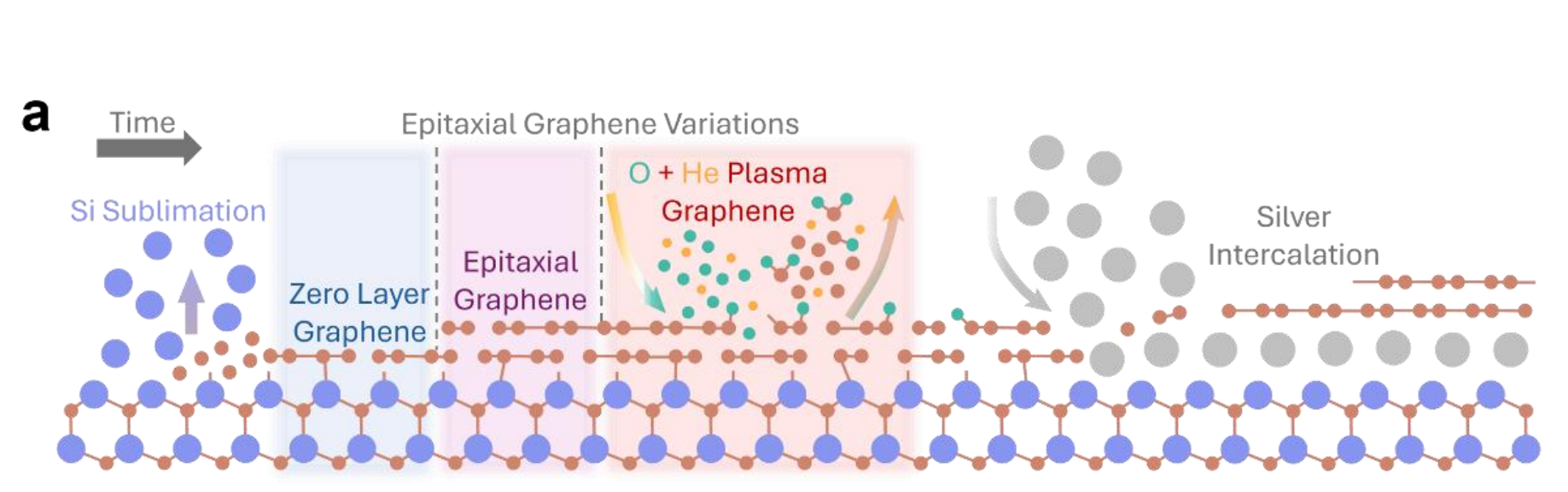
Atomically thin films of silver hold considerable promise for advances in areas like plasmonics and energy harvesting, but creating these materials with precise structural control has proven challenging. Arpit Jain, Boyang Zheng, and Sawani Datta, alongside colleagues at various institutions, now demonstrate a method for growing large-area, crystalline silver films with tailored properties at the interface between graphene and silicon carbide. The team achieves this by carefully controlling defects within the graphene layer, guiding the formation of two distinct silver phases, each with unique characteristics. This breakthrough not only yields semiconducting silver films with strong lattice alignment to the underlying substrate, but also reveals a dramatic difference in their nonlinear optical properties, paving the way for the development of reconfigurable optoelectronic devices and novel metamaterials.
Graphene-Supported Silver Monolayer Synthesis and Analysis
Scientists investigated the synthesis and properties of atomically thin silver layers grown on graphene, revealing unique electronic and optical characteristics. They employed characterization techniques, including X-ray photoelectron spectroscopy and Raman spectroscopy, to analyze the chemical composition and structural quality of the materials, while scanning electron microscopy and atomic force microscopy provided detailed surface images. Spectroscopic ellipsometry and second harmonic generation probed the optical properties of these materials. Calculations, combining density functional theory and many-body perturbation theory, revealed the electronic band structure of silver on graphene, demonstrating a shift in the bandgap compared to bulk silver.
These calculations, validated by experimental data, also highlighted the importance of excitonic effects in the material’s optical spectra, resulting in strong absorption in the visible and near-infrared regions. Furthermore, the research demonstrated that two-dimensional silver exhibits strong nonlinear optical properties, indicating broken symmetry at the interface. The study also explored heterostructures formed between two-dimensional silver and graphene, revealing charge transfer between the materials and doping effects within the graphene layer. The lattice arrangement of silver on graphene influences these properties, impacting both electronic and optical behavior. Detailed data on bandgap values, dielectric functions, and second harmonic generation measurements support these findings, demonstrating the potential of this material for optoelectronic applications.
Defect Engineering Guides Silver Film Growth
Researchers developed a novel method for synthesizing large-area, crystalline two-dimensional silver films by carefully controlling defects within an overlying graphene layer. This defect-engineered confinement heteroepitaxy technique overcomes limitations of conventional growth methods, enabling precise control over silver phase formation. Scientists tuned graphene growth conditions and employed helium plasma treatment to engineer specific defects, directing the formation of distinct silver phases on a silicon carbide substrate. Cross-sectional scanning transmission electron microscopy confirmed the lattice registry of the silver films with the underlying substrate, revealing distinct structural arrangements for each phase.
Low-energy electron diffraction and Auger electron spectroscopy further validated the formation of specific silver phases under different defect conditions. First-principles calculations corroborated these experimental observations, demonstrating that the silver phase with higher thermodynamic stability requires specific kinetic conditions for nucleation. Angle-resolved photoelectron emission spectroscopy confirmed that both silver phases exhibit semiconducting behavior, with slight differences in graphene doping. Nonlinear optical measurements revealed a significant difference in second-order susceptibility between the two phases, highlighting the potential for phase-tunable two-dimensional metals in reconfigurable optoelectronic and metamaterial platforms. This innovative approach enables precise control over silver phase selection, opening new avenues for advanced materials design and device fabrication.
Silver Phases Controlled by Defect Engineering
Scientists successfully synthesized large-area, crystalline silver films directly on a silicon carbide interface using a technique called defect-engineered confinement heteroepitaxy. By carefully controlling defects in an overlying graphene layer, they achieved two distinct silver phases, each exhibiting unique properties. The formation of these phases is influenced by both thermodynamic preference and the ease of initial nucleation, with one silver phase forming more readily despite the other being more stable overall. Both phases display semiconducting behavior, and the researchers observed a significant difference in their nonlinear optical response, with one phase exhibiting a much stronger response than the other.
This difference is attributed to stronger interactions between one silver phase and the underlying silicon carbide, which affect the electron cloud and reduce its polarizability. The ability to control these properties through defect engineering opens new avenues for designing advanced nanophotonic devices and metamaterials. Future work will focus on expanding this approach to other two-dimensional metal allotropes and exploring the potential of these materials in quantum sensing and tunable photonic systems. These findings establish intercalated two-dimensional metals as a promising platform for creating designer quantum materials and next-generation nanophotonic devices.
🗞 Defect-Mediated Phase Engineering of 2D Ag at the Graphene/SiC Interface
🧠 ArXiv: https://arxiv.org/abs/2511.07151