The search for materials exhibiting exotic magnetic behaviour has intensified in recent years, with particular interest in those governed by the principles of the Kitaev model, a theoretical framework predicting unconventional states like spin liquids and skyrmions. Kartik Panda, Chaebin Kim, and Daniel Bazyliansky, alongside Javier Taboada-Gutiérrez, Florian Le Mardelé, and Jan Dzian, now present compelling evidence for the influence of Kitaev interactions within the van der Waals material nickel iodide (NiI). Their work overcomes the longstanding challenge of directly observing Kitaev physics in a real material, demonstrating that the magnetic excitation spectrum of NiI aligns more closely with a Kitaev-based spin model than with previously proposed explanations. This achievement not only advances fundamental understanding of magnetic materials, but also opens new avenues for developing innovative spintronic and multiferroic technologies.
Layered Nickel Diiodide Exhibits Switchable Magnetism
This research details a comprehensive investigation into nickel diiodide (NiI₂), a multiferroic van der Waals material, revealing its unique magnetic and electronic properties and the discovery of electrically switchable magnetism. NiI₂ exhibits both antiferromagnetic order and ferroelectric polarization, a rare combination making it promising for novel devices. The material’s magnetic and electronic characteristics change depending on its thickness, transitioning from an insulator in bulk form to a metallic state in thinner layers, and displays a spiral magnetic order with a relatively high Néel temperature functioning as a p-wave magnet crucial for the observed electrical switching. The core finding is the demonstration of electrically switchable magnetism in NiI₂; applying an electric field reverses the direction of the magnetic moments, effectively acting as a magnetic switch.
This switching arises from the coupling between electric polarization and magnetic order; the electric field modifies the ferroelectric polarization, which in turn alters the magnetic structure. Importantly, this switching occurs at low voltages and currents, suggesting potential for low-power spintronic devices and demonstrating robustness through repeated cycles without significant degradation. Detailed characterization, including terahertz spectroscopy, identified electromagnon excitations, spin-orbit coupled magnetic excitations, providing insights into the coupling between electric and magnetic fields. Theoretical calculations and spin wave theory were employed to understand the magnetic structure and dynamics of NiI₂.
Researchers used optical spectroscopy combined with Kramers-Kronig analysis to determine the dielectric function and understand the electronic structure, and density functional theory (DFT) calculations to model the electronic structure, magnetic order, and ferroelectric polarization. Supporting this work, the research uncovered a subtle, previously unreported weak ferromagnetic moment in NiI₂, originating from Dzyaloshinskii-Moriya interactions linked to the zero-field chirality of the electromagnons, explaining the observed spin texture even without an external magnetic field. The strength of the magnetoelectric coupling varies with the number of layers in NiI₂. The research suggests NiI₂ could host magnetic skyrmions, nanoscale magnetic vortices with potential applications in data storage.
The p-wave magnetism leads to Kramers degeneracy, contributing to the stability of the magnetic order. The electrically switchable magnetism opens possibilities for developing low-power magnetic memory and logic devices, and NiI₂ could serve as a highly sensitive magnetoelectric sensor. Furthermore, the material could be used to create a new type of memory combining magnetic and electric properties, and potentially enable skyrmion-based devices for data storage and computing. This research provides a comprehensive understanding of NiI₂’s unique properties and demonstrates its potential as a key material for future spintronic and multiferroic devices.
Magnetic Excitations in Nickel Iodide Studied
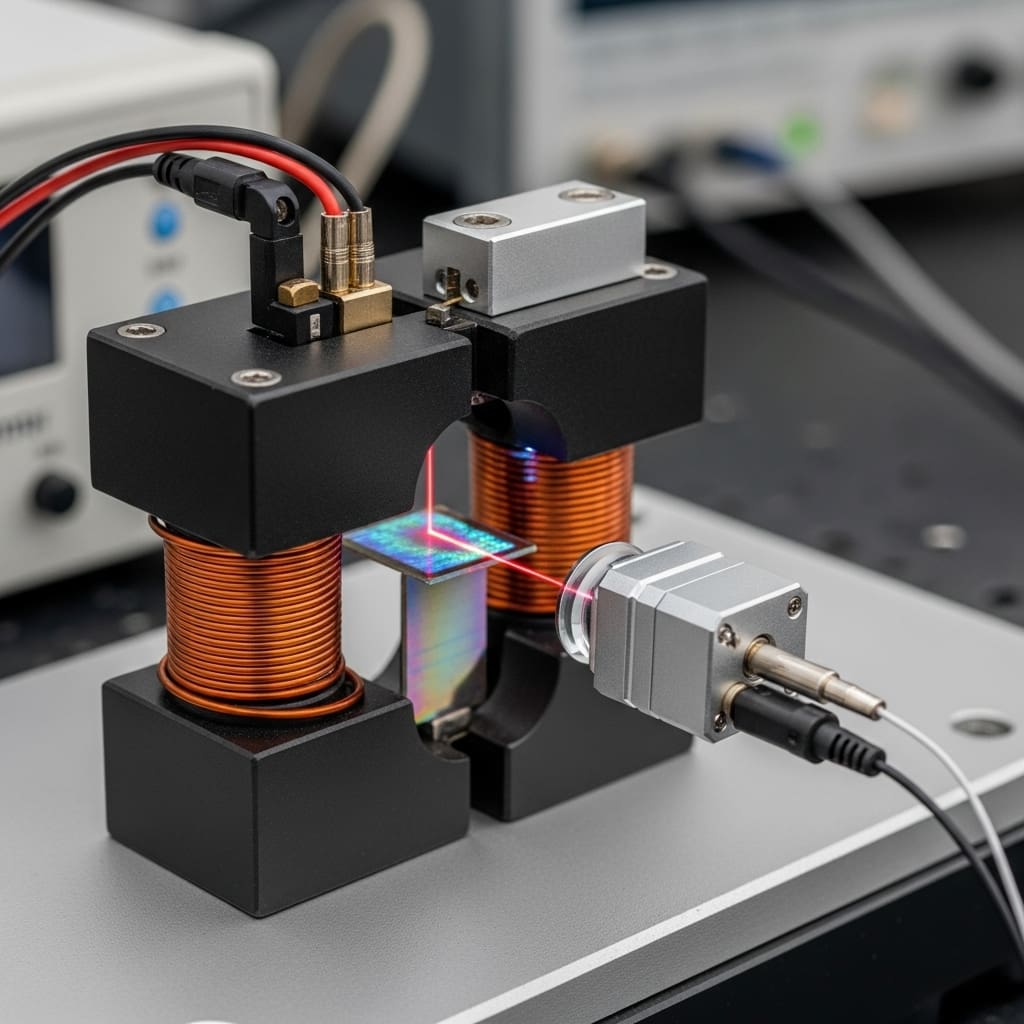
Scientists investigated the magnetic excitation spectrum of nickel iodide, a van der Waals multiferroic material, using advanced spectroscopic techniques. They pioneered the use of magneto-transmission, Faraday angle rotation, and magnetic circular dichroism measurements to characterize the material’s magnetic properties with exceptional precision. Researchers measured the transmission of light through the material while applying a magnetic field, determining the absorption characteristics of magnetic excitations, and simultaneously tracked the rotation of polarized light using Faraday rotation measurements, revealing information about the magnetic moments and their arrangement. To extract detailed information about the magnetic excitations, the team combined absolute transmission spectra with Faraday rotation spectra to calculate the optical circular conductivity of electromagnons, magnetic excitations coupled to light.
Analysis of the real part of the optical conductivity revealed a clear dichroic response near the electromagnon excitations, demonstrating that the lower mode exhibited approximately 40% more spectral weight in right-handed circular polarization, while the upper mode displayed the opposite behaviour with about 50% more spectral weight in the left-handed component. The imaginary part of the complex off-diagonal conductivity tensor, associated with the absorptive component of the optical Hall conductivity, was also calculated, confirming opposite chirality for the two modes with comparable spectral weight. To quantify the circular dichroism, scientists evaluated the spectral weight ratio using a method analogous to that for a single cyclotron mode, associating the lower and upper modes with the left- and right-polarized components. Magnetic field dependence of this ratio revealed that the dichroism of both modes increased approximately linearly with the field, though the higher-energy mode evolved more rapidly. Furthermore, terahertz magnetic circular dichroism measurements, using both left- and right-circularly polarized light, demonstrated non-reciprocal field dependence for both resonances, confirming the chiral nature of the excitations and their preferential coupling to distinct circular polarizations depending on the field direction. These measurements revealed an anomalous nonzero circular response even at zero applied magnetic field, consistent with earlier Raman observations and suggesting an intrinsic chiral component originating from symmetry breaking in the material’s helical state.
Kitaev Interactions Dominate Nickel Iodide Magnetism
Scientists have demonstrated that the magnetic excitation spectrum of nickel iodide (NiI₂), a van der Waals multiferroic material, is more accurately described by a model based on Kitaev interactions than by previously proposed helical spin frameworks. Through magneto-transmission, Faraday angle rotation, and magnetic circular dichroism measurements, the team investigated two collective magnetic excitation modes at 34cm⁻¹ and 37cm⁻¹, observing distinct blueshifts under increasing magnetic fields, occurring at a rate of approximately 2cm⁻¹ for the upper mode and 1cm⁻¹ for the lower mode at 16 Tesla, demonstrating an isotropic response independent of field orientation. Experiments revealed a finite circular dichroism at zero magnetic field, an unexpected result for a purely antiferromagnetic system, and consistent with earlier zero-field Raman observations. Further analysis of terahertz absorption under left- and right-circularly polarized light showed non-reciprocal field dependence for both magnon modes, confirming their chiral nature.
Specifically, the 34cm⁻¹ mode exhibited a different response to right-circularly polarized light compared to its left-circularly polarized counterpart, and vice versa for the 37cm⁻¹ mode. Faraday rotation measurements confirmed this inverted chirality, revealing opposite circular behaviour of optical conductivity for the two electromagnons. The data demonstrates that the observed magnetic behaviour is primarily driven by bond-dependent Kitaev interactions, while small symmetry-breaking terms contribute to the zero-field baseline of optical chirality. Researchers modeled the magnetic exchange interactions using a Kitaev Hamiltonian augmented by an easy-axis term, successfully reproducing the zero-field splitting of the magnon modes and the anomalous field dependence of the electromagnon blueshift. These findings offer compelling evidence that the spin Hamiltonian of NiI₂ is governed primarily by Kitaev exchange interactions, challenging previously proposed models and providing new insight into the interplay between helical antiferromagnetic configurations and internal anisotropies. This work carries broader significance for topological magnetism, suggesting a pathway to stabilize exotic magnetic textures, including high-.
👉 More information
🗞 Magneto-Optical Study of Chiral Magnetic Modes in NiI : Direct Evidence for Kitaev Interactions
🧠 ArXiv: https://arxiv.org/abs/2511.06093