Cathodoluminescence, a technique that analyses materials with nanometer precision by interacting an electron beam with their internal states, receives a significant boost from new research into silica microspheres. Hadar Aharon, Zahava Barkay, and Sophie Meuret, alongside Ofer Kfir and colleagues, from Tel Aviv University and CEMES, CNRS, demonstrate how these tiny spheres dramatically enhance light emission and direction. The team meticulously dissects the mechanisms behind this enhancement, revealing that light generation occurs directly on the sphere’s surface and that the spheres act as powerful lenses, focusing the emitted light with unprecedented clarity. This achievement promises to improve existing cathodoluminescence measurements and unlock new possibilities, including the creation of entangled photon pairs and advanced analysis of light emission from various materials.
Whispering Gallery Modes in Silica Microspheres
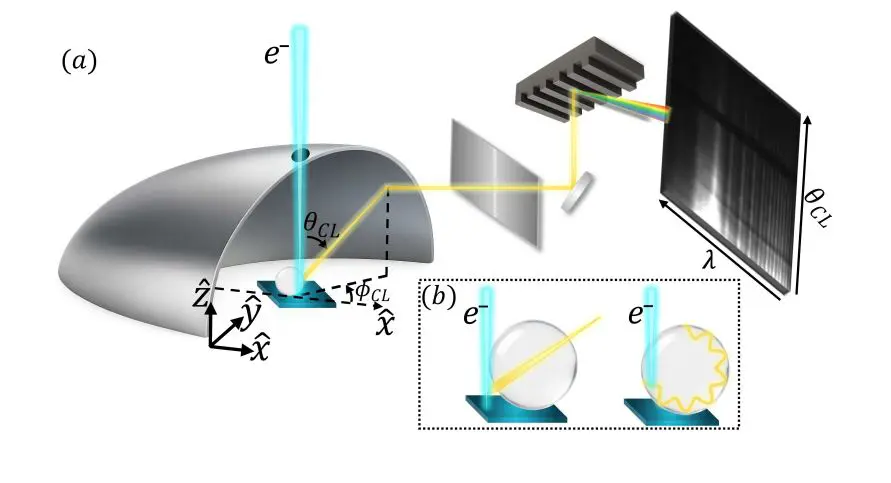
This research details an investigation of cathodoluminescence (CL) from silica glass microspheres, aiming to characterize the whispering gallery modes (WGM) excited by electron beams. The study explores how electron beams interact with these tiny spheres to produce light, offering a comprehensive look at data acquisition and analysis. Experiments utilized both transmission and scanning electron microscopes, employing electron beams with energies of 30 keV and 200 keV to excite microspheres ranging from 2. 1μm to 62μm in diameter. Researchers carefully measured the emitted light, paying close attention to its color and direction, using varying integration times from 10 to 120 seconds for precise data collection.
Results demonstrate that electron beam energy influences the CL signal, with detailed analysis of 2μm spheres revealing spatial variations in WGM excitation. Measurements across the sphere’s surface show correlated patterns in emitted light, confirming the presence and spatial characteristics of WGM, and spectrograms provide detailed information about their characteristics and distribution. These findings confirm that emitted light is not isotropic, indicating the presence of WGM where light is confined within the sphere due to total internal reflection. The study demonstrates a clear relationship between electron beam energy, sphere size, and emitted light characteristics, providing a deeper understanding of WGM physics.
Electron Beam Mapping of Silica Microsphere Luminescence
This research pioneers a detailed investigation of cathodoluminescence (CL) from silica microspheres, employing focused electron beams to analyze photon generation and emission mechanisms with nanometer resolution. Researchers systematically varied electron beam energy and sphere diameter to disentangle the interplay between photon generation, radiative efficiency, and material absorption. The team discovered that coherent CL arises from phase-matched interactions between the electron beam and optical modes, while incoherent CL originates from spontaneous emission following excitation of material defects or higher bands. By carefully controlling beam energy and sphere diameter, they isolated and characterized different luminescence processes, demonstrating that the spheres function as high numerical aperture collimating lenses, shaping emitted light into a focused beam. Researchers observed that this collimation can be harnessed to efficiently out-couple CL with a well-defined spatial mode, crucial for enhancing quantum measurements and enabling experiments such as the generation of high-rate electron-photon entangled pairs and detailed analysis of quantum emitters via homodyne techniques. The method delivers unprecedented mode quality for CL in free space, paving the way for advanced optical characterization and quantum information processing.
Microsphere Cathodoluminescence Reveals Surface Emission Mechanisms
Scientists have achieved unprecedented control over light emission from microspheres, demonstrating a method to both generate and collimate light with exceptional precision. This work decomposes the mechanisms behind cathodoluminescence, focusing on spherical resonators to understand the underlying physics, and reveals that light generation occurs directly on the sphere’s surface, enabling the observation of whispering-gallery modes in both coherent and incoherent luminescence regimes. The team analyzed silica glass microspheres with diameters of 2. 1μm, 4. 4μm, and 62μm, using a focused electron beam to induce cathodoluminescence.
Analysis of the 2. 1μm sphere revealed 17 distinct spectral peaks corresponding to whispering-gallery modes, nearly independent of emission angle, demonstrating a “WGM-regime” where these modes dominate the angular distribution. Measurements show that the angular distribution of emitted light is strongly dependent on the electron beam’s impact parameter, exhibiting a linear relationship to the impact angle, and a tendency to oppose it. Further investigation revealed a distinct transition based on the electron beam’s radial distance from the sphere’s center. For impact parameters less than the sphere’s radius, the angular distribution is broad and poorly defined. However, when the electron beam impacts the sphere’s perimeter, the emitted light becomes highly collimated, narrowly distributed. This transition defines two regimes, establishing these microspheres as high-numerical aperture collimating lenses, delivering mode quality unprecedented for cathodoluminescence in free space, and promising to enhance existing measurements and facilitate new ones, including high-rate electron-photon entangled pairs and homodyne analysis of cathodoluminescence.
Silica Microspheres Enhance Light-Matter Interaction Studies
This research establishes silica microspheres as versatile platforms for investigating light-matter interactions, functioning simultaneously as resonant cavities and collimating lenses for cathodoluminescence. Through detailed spectral, spatial, and angular analysis, scientists successfully disentangled the complex processes contributing to cathodoluminescence signals, including photon generation, radiative leakage, and absorptive loss. The team quantified key parameters, such as material absorption and radiative loss, revealing the surface sensitivity of whispering-gallery mode cathodoluminescence and demonstrating photon generation precisely on the sphere’s surface. These findings highlight the potential of silica microspheres to enhance existing spectroscopic measurements and enable new ones, particularly those requiring directed and collimated light emission, with the high-numerical-aperture collimation shaping emitted light into a low-divergence beam, offering compatibility with fiber coupling and quantum measurements. While the study focused on silica microspheres, the authors suggest the principles demonstrated could be extended to other resonant structures.
🗞 Cathodoluminescence Enhancement Mechanisms in Silica Microspheres
🧠 ArXiv: https://arxiv.org/abs/2511.04336




See today’s quantum computing news on Quantum Zeitgeist for the latest breakthroughs in qubits, hardware, algorithms, and industry deals.