Vanadium oxide materials exhibit remarkable sensitivity to even slight imperfections, offering a pathway to control their electrical behaviour, and Nareg Ghazikhanian, David J Alspaugh, and colleagues at the University of California, San Diego, and other institutions, have now demonstrated a method to dramatically enhance this control. The team discovered that carefully targeted irradiation of vanadium oxide induces unusual, stochastic oscillations in electrical current, a behaviour distinct from previously observed patterns in these materials. This research reveals that the timing of these current fluctuations becomes increasingly random with higher voltages, leading to unpredictable and nonlinear oscillatory behaviour, and importantly, requires significantly less power to initiate. Through detailed simulations, the scientists show that a small number of irradiated sites can govern the switching properties of larger devices, opening up exciting possibilities for engineering randomness into electronic systems and creating novel computational paradigms.
Vanadium Dioxide Stochastic Resonance and Switching Control
This research details the investigation of stochastic resonant (SR) switching in vanadium dioxide (VO2) devices, focusing on how external stimuli, specifically electrical pulses, can induce and control switching between insulating and metallic states. Researchers demonstrate that VO2 exhibits stochastic resonant switching, meaning the transition between insulating and metallic states is inherently random and sensitive to external influences, and that carefully tuned electrical pulses can enhance this stochasticity and control the switching behavior. The amplitude and duration of applied electrical pulses play a crucial role in modulating the randomness of the switching, with an optimal pulse amplitude maximizing the randomness of the process. The study demonstrates the potential of these VO2 devices as true random number generators (TRNGs), showing that the randomness generated by the stochastic switching process meets the stringent requirements for security-critical applications. Furthermore, the inherent stochasticity and tunable switching behavior of VO2 also make it a promising candidate for building neuromorphic computing systems, which aim to mimic the brain’s structure and function. This research highlights the potential of VO2 as a versatile material for building next-generation electronic devices that leverage stochasticity and randomness for enhanced functionality and performance, providing a comprehensive understanding of the switching mechanisms and laying the groundwork for practical applications in security, cryptography, and artificial intelligence.
Gallium-Ion Beam Induces Stochastic Vanadium Dioxide Dynamics
Scientists engineered a novel method for controlling the electrical properties of vanadium dioxide (V2O3), a material exhibiting a metal-insulator transition, by employing focused gallium-ion beam irradiation. The study pioneered a technique to induce stochastic, or random, oscillatory dynamics within simple two-terminal switching devices, moving beyond conventional switching behavior. Researchers utilized a 30 keV focused gallium-ion beam to create a 1-micrometer-wide irradiated region within a 10-micrometer-wide V2O3 thin film, only 10 nanometers thick. Simulations of ion transport in matter revealed that each ion creates approximately 200 atomic vacancies within the V2O3 layer, suggesting vacancies are the dominant defects introduced by the irradiation process.
Detailed resistance versus temperature measurements showed significant changes in electrical behavior, with the resistance-temperature curves of irradiated devices splitting into two distinct parts, reflecting the simultaneous presence of both pristine and irradiated regions acting as parallel resistors. Following irradiation, the resistance of the high-temperature metallic state increased, while the resistance of the low-temperature insulating state decreased, demonstrating a substantial modification of the material’s electrical characteristics. This method achieves a dramatic reduction in the switching power and parallel capacitance required to sustain oscillations, demonstrating the potential for energy-efficient electronics based on engineered stochasticity. The research demonstrates that selective ion beam irradiation provides a powerful tool for tuning the stochasticity of resistive switching materials, opening exciting prospects for novel electronic devices.
Ion Irradiation Creates Oscillatory Metal-Insulator Transition
Scientists demonstrated that focused ion beam irradiation induces unique oscillatory dynamics in vanadium trioxide (V2O3), a material undergoing a metal-insulator transition. Researchers selectively irradiated V2O3 devices with a 30 keV gallium-ion beam to create a 1-micrometer-wide irradiated region within a 10-micrometer device. Simulations revealed that each ion creates approximately 200 atomic vacancies within the V2O3 film, suggesting vacancies are the dominant defects introduced by irradiation. Measurements of resistance versus temperature showed a distinct split in the curve after irradiation, indicating the coexistence of pristine and irradiated regions within the device.
The team observed that irradiated devices exhibit an unusual dynamic regime where the voltage-induced metallic state momentarily collapses into an insulating state, resulting in rapid current flickering. This flickering differs significantly from the conventional current spiking observed in pristine V2O3 devices. Further analysis revealed that the timing of the current flickering becomes progressively more random and sparse with increasing input voltage, demonstrating nonlinear and nondeterministic oscillatory behavior. Importantly, the irradiated devices require significantly less power and smaller parallel capacitance to sustain oscillations compared to their pristine counterparts. The research demonstrates that selective ion irradiation is an effective method for inducing stochasticity in resistive switching materials, opening exciting possibilities for novel, scalable, and energy-efficient electronics that harness the intrinsic randomness of physical processes.
Stochastic Switching and Inverted Spiking Dynamics
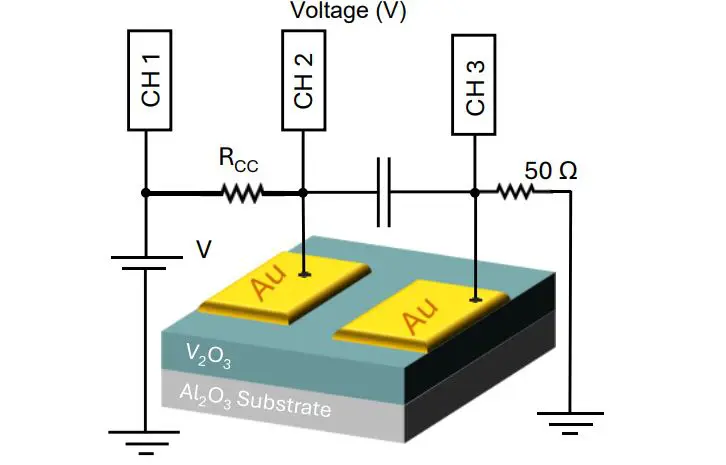
Researchers have demonstrated that focused ion beam irradiation introduces stochastic, or random, oscillatory dynamics into vanadium trioxide resistive switching devices. Implementing these irradiated materials in standard Pearson-Anson circuits reveals unusual behavior, notably significant cycle-to-cycle variations in the electrical spiking period and a non-monotonic frequency-voltage relationship, ultimately resulting in an inverted spike shape as the driving voltage increases. The team’s simulations suggest that a small number of isolated, pristine sites act as weak links within the highly defective material, controlling the overall switching behavior and enhancing the observed stochasticity. This methodology appears broadly applicable to other resistive switching systems, given reports of similar changes in equilibrium transport and electrical switching properties following ion irradiation. Controlling this intrinsic randomness opens possibilities for novel electronic applications, including multimodal oscillators, true random number generators, probabilistic bits, and complex, hardware-based neurons with programmable spiking characteristics.
🗞 Enhanced stochasticity in irradiated vanadium oxide oscillators
🧠 ArXiv: https://arxiv.org/abs/2511.04043

See today’s quantum computing news on Quantum Zeitgeist for the latest breakthroughs in qubits, hardware, algorithms, and industry deals.