Quantum key distribution offers the promise of unhackable communication, and researchers continually seek more robust and practical methods for securing data. Amir Yona from Tel Aviv University and Yaron Oz now demonstrate a novel approach to this challenge, utilising charge teleportation to establish a secure key between two parties. This new technique relies on manipulating the properties of entangled systems to transmit information, and importantly, proves significantly more resilient to the noise and imperfections present in real-world conditions than existing energy-based methods. The team’s results, obtained through both theoretical analysis and experimental validation, establish charge teleportation as a viable, low-rate solution for secure communication on emerging quantum platforms.
The research presents a charge teleportation protocol that exhibits bit-symmetric signalling and measurement in a single basis, enhancing robustness against realistic noise and imperfections. The protocol, implemented on transverse-field Ising models, including star-coupled and one-dimensional chain configurations, yields analytical results for two qubits and confirms performance in larger systems through exact diagonalization, circuit-level simulations, and a hardware demonstration. The team quantifies resilience to both classical bit flips and local quantum noise, identifying conditions where key correctness is preserved, establishing charge teleportation as a practical, low-rate quantum key distribution (QKD) primitive for near-term quantum platforms.
Quantum Key Distribution Security Under Noise
This research investigates the vulnerabilities of quantum key distribution (QKD) systems to various types of noise. The analysis meticulously examines the impact of different noise types on the protocol, revealing that errors occurring at the receiver are particularly damaging. Phase-flip errors, which invert the intended quantum state, lead to rapid key loss and are especially problematic. Careful design of the quantum channel and receiver components is therefore essential for mitigating these effects and ensuring secure communication.
Quantum Charge Teleportation Secures Communication Channels
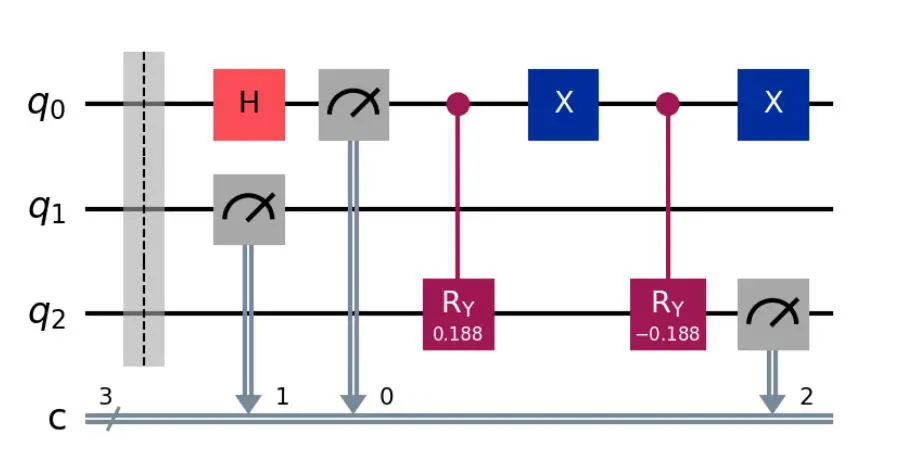
Scientists have developed a quantum key distribution (QKD) protocol based on the teleportation of electrical charge, offering a novel method for secure communication. By leveraging entanglement and local operations, Alice can steer a charge shift at Bob’s location, directly encoding a key bit through quantum charge teleportation (QCT). This approach differs from existing QKD methods by focusing on globally conserved charges. Experiments reveal that the charge signal in this protocol is bit-symmetric and measured using a single basis, significantly improving robustness against realistic noise and imperfections compared to energy teleportation schemes. Researchers instantiated the protocol using transverse-field Ising models, both star-coupled and one-dimensional chain configurations, obtaining analytical results for two qubits and validating performance in larger systems through exact diagonalization, circuit-level simulations, and a hardware demonstration. These simulations confirm the protocol’s functionality and scalability, and data shows superior symmetry and stability against statistical noise, making it a promising candidate for practical QKD implementations.
Charge Teleportation Secures Key Distribution Protocols
Researchers have demonstrated a novel quantum key distribution (QKD) primitive founded on charge teleportation, achieving a secure method for exchanging cryptographic keys. This approach leverages the principles of quantum mechanics to transmit information via the instantaneous correlation of quantum states, utilizing local operations and classical communication on entangled systems. The team successfully implemented and tested the protocol using various system sizes and interaction models, including transverse-field Ising models and one-dimensional chains, confirming its performance through both numerical simulations and a hardware demonstration. The findings reveal that charge teleportation offers distinct advantages over existing energy teleportation schemes, notably a bit-symmetric signal measured in a single basis and increased robustness against realistic noise and imperfections.
Simulations demonstrate the protocol’s resilience to both classical bit flips and local quantum noise, identifying conditions where the integrity of the transmitted key is preserved. While the energy protocol exhibits greater tolerance to variations in measurement basis, charge teleportation proves particularly effective in well-controlled scenarios. Future work will focus on bridging the gap between ideal simulations and practical implementations on quantum hardware, positioning charge teleportation as a viable, low-rate primitive suitable for near-term quantum technologies.
🗞 Quantum Key Distribution via Charge Teleportation
🧠 ArXiv: https://arxiv.org/abs/2511.04188
See today’s quantum computing news on Quantum Zeitgeist for the latest breakthroughs in qubits, hardware, algorithms, and industry deals.