The ability to accurately simulate complex physical systems remains a significant challenge in computational science, yet analog computers offer a potentially powerful alternative through Boltzmann sampling. Elijah Pelofske from Los Alamos National Laboratory and colleagues thoroughly investigate this capability, focusing on the notoriously difficult axial next-nearest-neighbor Ising model, a system exhibiting magnetic frustration. Their research quantifies the accuracy of Boltzmann sampling using quantum annealers, demonstrating surprisingly high fidelity, down to a total variation distance of 0. 01, and low temperature sampling within the model’s complex magnetic phase diagram. These results strongly suggest that current analog computing hardware can effectively tackle thermodynamic sampling problems in highly frustrated magnetic materials, opening new avenues for materials discovery and fundamental physics research.
D-Wave Quantum Annealer Characterization and Performance
This research centers on Quantum Annealing, a specialized form of quantum computation designed to solve complex optimization problems. The work explores the challenges, techniques, and experimental results associated with utilizing D-Wave systems to tackle problems involving spin glasses and frustrated magnetic systems. A significant focus lies in characterizing these quantum annealers, understanding their inherent noise, limitations, and how to best utilize their capabilities. The investigation covers several key areas, including the hardware and topology of D-Wave processors, such as the Zephyr and Pegasus architectures.
Improvements in processor topology, increasing the connections between qubits, are a recurring theme. The study also focuses on formulating problems using the Ising model and optimizing solutions to find the lowest energy state. Researchers meticulously investigate noise sources within the D-Wave system, including thermal noise and control errors, and develop techniques for calibrating qubits and improving their performance. Analyzing idle qubits provides a method for estimating the effective noise levels. The team also explores quantum dynamics and quenches, and their connection to the Kibble-Zurek mechanism.
Understanding how the system evolves towards equilibrium is also a key focus. The research employs both classical and quantum techniques for calibrating parameters and analyzing performance. The findings demonstrate that D-Wave systems are continually evolving, increasing qubit counts and enhancing connectivity. However, noise remains a significant challenge, and embedding problems onto the hardware can be a bottleneck.
ANNNI Model Sampling on D-Wave Processors
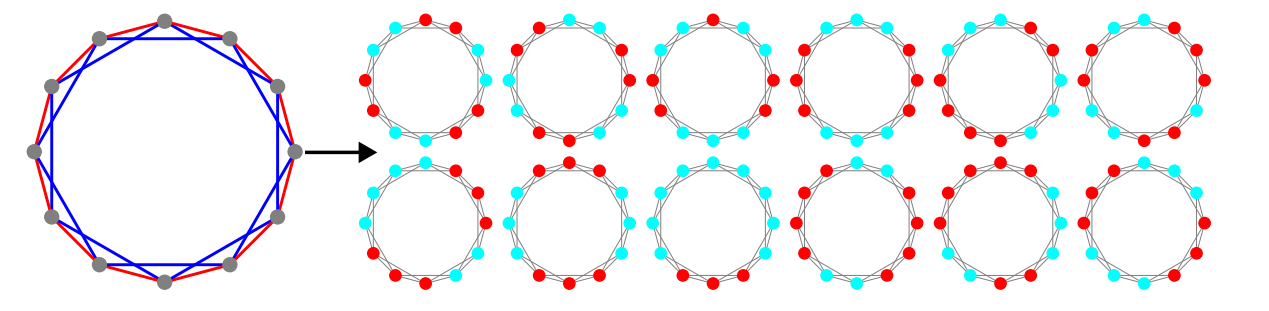
This study investigates the ability of superconducting flux qubit quantum annealers, manufactured by D-Wave Systems, to accurately sample from the Boltzmann distribution defined by the axial next-nearest-neighbor Ising (ANNNI) model, a system known for its magnetic frustration. Researchers utilized D-Wave’s Advantage system4. 1 and Advantage2 prototype1. 4 processors to simulate a 12-spin ANNNI model with periodic boundary conditions. The team employed the Glasgow subgraph isomorphism finder to identify and implement numerous disjoint embeddings of the ANNNI model onto the QPU hardware graphs, maximizing the number of independent samples.
The experimental setup involved defining a physical Hamiltonian implemented on the D-Wave processors, comprising transverse field, classical Ising, and interaction terms, controlled by parameters adjusted over time. Researchers meticulously tuned two key hardware control parameters: total annealing time and the analog coupler energy scale. This tuning was motivated by prior work demonstrating its impact on both the quality and effective temperature of Ising model sampling. To quantify sampling accuracy, the team sampled the ANNNI model at frustration parameters encompassing ferromagnetic, critically frustrated, and antiferromagnetic regions of the phase diagram. The focus on the critical frustration point allowed for a detailed evaluation of the annealer’s capabilities in regions of high frustration. By directly mapping spins to qubits and leveraging numerous disjoint embeddings, the study aimed to achieve high-fidelity sampling of a complex magnetic system.
Analog Computation Accurately Samples Magnetic Frustration
Scientists have demonstrated the ability of analog computers to accurately sample from the Boltzmann distribution, a crucial capability for simulating complex magnetic systems. This work thoroughly examines the performance of these computers when applied to the axial next-nearest-neighbor Ising (ANNNI) model, a challenging system exhibiting magnetic frustration. Experiments revealed remarkably high accuracy, achieving low Total Variation Distance (TVD) and low temperature sampling within a frustrated region of the ANNNI model’s magnetic phase diagram. These results bolster the viability of current analog computers for thermodynamic sampling applications, particularly for highly frustrated magnetic spin systems.
The researchers utilized 12-spin ANNNI models with periodic boundary conditions. The study focused on tuning two key hardware parameters: total annealing time and the analog coupler energy scale, which was artificially reduced to mitigate potential sampling issues. The team employed two D-Wave QPU systems, the Pegasus P16 and the Zephyr Z12, achieving up to 204 disjoint native embeddings of the ANNNI model on the latter. Analysis of the ANNNI model at various frustration parameters revealed accurate sampling across different magnetic phases. Specifically, the team observed ordered spin patterns at higher J2 values and demonstrated the ability to sample configurations even at the critical frustration point. These findings suggest that analog computers can effectively tackle highly frustrated regimes, potentially unlocking new avenues for simulating complex magnetic materials.
ANNNI Model Sampling with Superconducting Qubits
This study demonstrates that analog quantum computers, specifically superconducting qubit quantum annealers, effectively sample from the Boltzmann distribution of highly frustrated Ising models, notably the axial next-nearest-neighbor (ANNNI) model. Researchers achieved remarkably low error rates while sampling the ANNNI model at low temperatures. These findings bolster the viability of current analog computers for thermodynamic sampling applications involving complex magnetic spin systems.
🗞 Boltzmann Sampling of Frustrated J1 – J2 Ising Models with Programmable Quantum Annealers
🧠 ArXiv: https://arxiv.org/abs/2511.03796