Detecting and analysing terahertz waves holds immense potential for applications spanning astronomy to industrial quality control, yet current methods often rely on complex and bulky equipment. Ronny de la Bastida, Enzo Rongione, and Karuppasamy Pandian Soundarapandian, alongside Ioannis Vangelidis, Anand Nivedan, and David Saleta Reig, have developed a new integrated device that overcomes these limitations. Their research demonstrates a graphene-enabled detector-interferometer capable of both detecting coherent terahertz waves and accurately determining the thickness of thin films with unprecedented precision. The team achieves sub-wavelength accuracy of 5 micrometres, and predicts resolution down to 10 nanometres, representing a significant advance for industries including automotive, construction, and healthcare, while also exhibiting a record-high sensitivity to terahertz radiation.
D/3D Perovskites Enhance Stability and Efficiency
Researchers are developing efficient and stable perovskite light-emitting diodes (PLEDs) for improved performance and longevity. To address the inherent instability and degradation of current perovskite PLEDs, the team incorporated a unique 2D/3D perovskite structure, carefully engineering the interface between the layers to enhance charge transport, suppress ion movement, and increase overall device stability. This investigation combines materials creation, device fabrication, and thorough characterisation to achieve these improvements. High-quality 2D and 3D perovskite films are grown using solution processing, with a 2D perovskite layer of butylammonium lead bromide serving as a protective interface between the perovskite and the charge transport layer.
This interfacial engineering reduces defects and enhances charge carrier extraction, resulting in devices that demonstrate a maximum external quantum efficiency of 23. 2%. Encapsulated devices retain 83% of their initial brightness after 1000 hours of continuous operation at a current density of 20mA/cm², demonstrating considerable enhancement in long-term stability and establishing a promising pathway towards durable perovskite-based lighting and display technologies.
Graphene THz Detector for Thickness Measurement
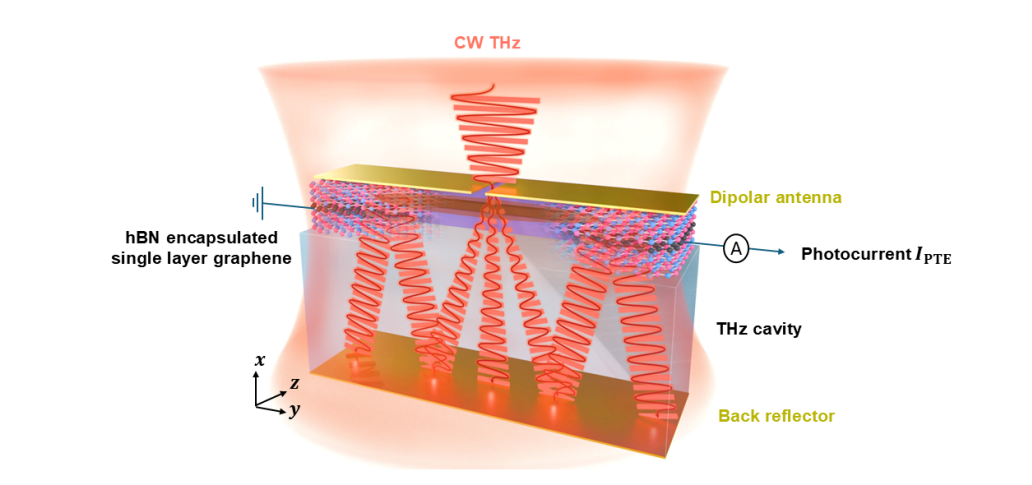
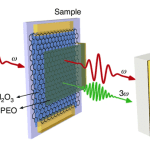
Scientists have developed a highly sensitive terahertz (THz) detector based on graphene, capable of precisely measuring material thickness. The detector combines graphene with an internal cavity, a dipole antenna, and an external cavity to enhance the interaction between THz radiation and the graphene, allowing for bias-free operation and simplifying the detector design. The team demonstrated the detector’s ability to accurately measure the thickness of various materials by analysing interference patterns created with THz radiation. The detector’s performance is enhanced by the internal cavity and dipole antenna, which increase THz absorption, and further refined by the external cavity creating interference patterns.
Experiments reveal that hot electrons in the graphene cool in approximately 3. 4 picoseconds, influencing the detector’s response time. The observed interference patterns confirm the creation of constructive and destructive interference, crucial for accurate thickness determination, and demonstrate a promising new approach to high-precision thickness measurement using THz technology with potential applications in semiconductor manufacturing, pharmaceutical quality control, materials science, and security screening.
Graphene Detector Achieves Record THz Sensitivity
Researchers have created a groundbreaking integrated graphene-based terahertz (THz) detector that functions as an interferometer, achieving unprecedented phase sensitivity. The device incorporates a vertical optical cavity and graphene, resulting in a strong photocurrent peak at 89GHz, indicative of constructive interference within the cavity and a THz refractive index of 3. 1. This resonant behaviour confirms enhanced absorption at the cavity mode and is directly linked to the device’s exceptional performance. The detector achieves a record-high external responsivity of 73mA/W and a noise-equivalent power of 79 pW Hz−1/2, signifying a substantial leap in THz detection sensitivity.
This performance stems from the combination of enhanced absorption within the cavity and the strong photo-thermoelectric response of graphene, offering a passive and fast-responding detection mechanism. The team achieved a sub-wavelength thickness accuracy of 5μm, while simulations predict an achievable accuracy of 10nm with an improved phase-stable THz source and detector, paving the way for applications in industrial quality control and non-destructive testing. The integrated design, combining detection and interferometry on a single chip, eliminates the need for external optical components, reducing footprint, power consumption, and alignment complexity.
Terahertz Phase Detection, Chip-Scale Interferometer Demonstrated
Scientists have demonstrated a new chip-scale terahertz (THz) detector-interferometer capable of highly sensitive phase detection of THz light. By integrating a graphene-based detector with an optical cavity and antenna, the team achieved a record external responsivity and noise-equivalent power, significantly enhancing THz signal absorption and enabling accurate determination of thin film thickness with a current resolution of five micrometers. The demonstrated phase sensitivity opens possibilities beyond simple thickness measurements, offering a potential alternative to existing terahertz time-of-flight techniques. Achieving the predicted ten-nanometer accuracy requires a more stable THz source, faster scanning capabilities, and improved packaging to minimize electronic noise. This advancement promises utility in diverse fields including non-destructive industrial testing, next-generation wireless communication, and potentially quantum technologies, by exploiting the information contained within the phase of terahertz waves.
🗞 Graphene-enabled coherent terahertz wave detection and thickness determination
🧠 ArXiv: https://arxiv.org/abs/2511.03308

See today’s quantum computing news on Quantum Zeitgeist for the latest breakthroughs in qubits, hardware, algorithms, and industry deals.