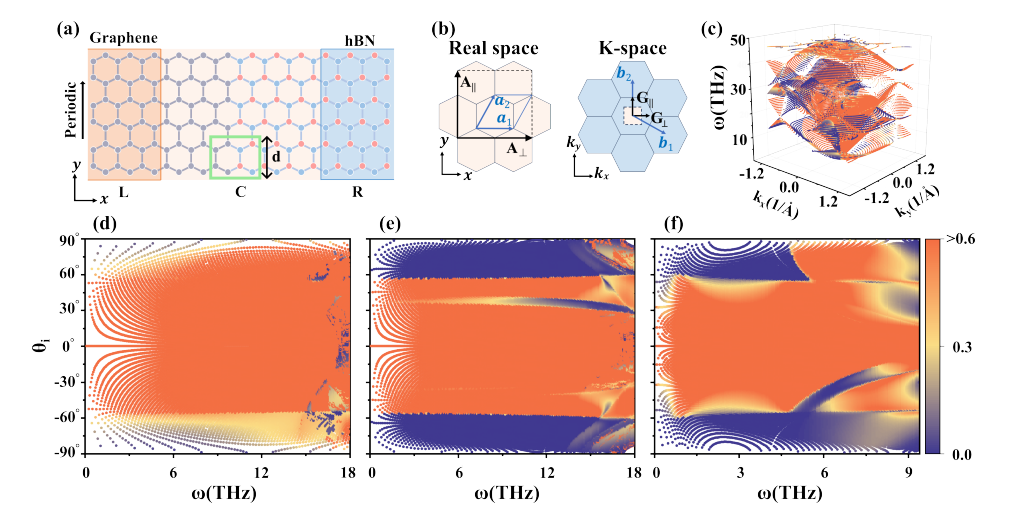
The elusive goal of negative refraction for coherent phonons, vital for advances in thermal management and quantum technologies, now moves closer to reality thanks to work from Hao Chen, Zhong-Ke Ding, Nannan Luo, and colleagues at Hunan University. Researchers successfully demonstrate this phenomenon by introducing a novel mechanism that compensates phonon momentum during transmission across interfaces, overcoming previous limitations that demanded specific material properties or complex band structures. The team reveals that this momentum compensation, achieved through careful design of layered hexagonal boron nitride structures, enables negative refraction of sound waves at the atomic scale, even for materials with simple acoustic properties. This breakthrough establishes a new pathway for actively controlling phonon flow, potentially leading to the development of innovative devices such as phonon lenses and highly directional thermal transport systems.
Phonon Negative Refraction via Momentum Compensation
Scientists have demonstrated coherent negative refraction of phonons, a crucial advancement for thermal management and quantum information processing. This work establishes a physical route to achieve this effect within silicon-germanium superlattices by utilizing interfacial momentum compensation. The research establishes a theoretical framework and employs molecular dynamics simulations to reveal that a mismatch in phonon group velocities at the silicon-germanium interface generates a significant interfacial momentum, effectively compensating for the positive phase velocity and enabling negative refraction. Specifically, simulations show a silicon-germanium superlattice with a 2-nanometer period exhibits a negative group velocity of -1500 meters per second at 5 terahertz, alongside a positive phase velocity of 2000 meters per second. The findings represent a significant advancement in phonon engineering and open new possibilities for innovative technologies based on coherent phonon manipulation.
Momentum Compensation Enables Negative Phonon Refraction
Scientists engineered a novel approach to achieve negative refraction of coherent phonons, crucial for advancements in thermal management and quantum information processing, by introducing a momentum compensation mechanism within hexagonal boron nitride heterostructures. This mechanism relies on the discrete translational symmetry present at interfaces, allowing reciprocal lattice vectors to compensate momentum during phonon tunneling, thereby inducing asymmetric mode matching. The research team employed non-equilibrium Green’s function formalism to model phonon behavior, demonstrating coherent negative refraction of isotropic acoustic phonons without requiring strong dispersion anisotropy or a negative-curvature band. To investigate phonon behavior at interfaces, the study pioneered a detailed computational model utilizing the atomistic s-matrix method, enabling numerical simulation of phonon reflection, transmission, and boundary scattering with high accuracy. This method, combined with the non-equilibrium Green’s function formalism, facilitated the calculation of phonon dispersion and transmission spectra, revealing the conditions necessary for achieving negative refraction.
Coherent Negative Refraction of Acoustic Phonons Demonstrated
Scientists have achieved coherent negative refraction of acoustic phonons, a breakthrough with significant implications for thermal management and quantum information processing. This work overcomes a fundamental challenge in nanoscale phononics, simultaneously achieving long-range coherence and negative refraction, by introducing a momentum compensation mechanism mediated by discrete translational symmetry at interfaces. The research demonstrates that interfacial reciprocal lattice vectors provide the necessary momentum compensation during phonon tunneling, enabling asymmetric mode matching without requiring strong dispersion anisotropy or negative-curvature bands. Experiments reveal that this mechanism directly produces the group velocity deflection critical for negative refraction. To verify this mechanism, the team utilized a graphene/hexagonal boron nitride (Gr/hBN) heterostructure, a system with an atomically flat interface and isotropic low-frequency acoustic phonon branches. Computational modeling demonstrates finite phonon transmission coefficients for incidence angles beyond the critical angle, observed as phonon tunneling through classically forbidden regions, confirming the ability to direct phonon flow at the atomic scale.
Evanescent Tunneling Enables Phonon Negative Refraction
This research demonstrates coherent negative refraction of acoustic phonons, a phenomenon crucial for advancements in thermal management and quantum information processing. Scientists achieved this effect by introducing a momentum compensation mechanism at the interface of hexagonal boron nitride heterostructures, overcoming a longstanding challenge in the field. This mechanism, mediated by discrete translational symmetry, allows for negative refraction without requiring specific, and often difficult to obtain, material properties like strong dispersion anisotropy or negative band curvature. The team’s findings reveal that phonon negative refraction occurs through a process of evanescent-like tunneling, enabled by asymmetric momentum matching at the interface. This work establishes a general framework for controlling phonon flow through rational interface design, opening possibilities for creating atomic-scale phonon lenses and actively tunable thermal devices.
🗞 Coherent Phonon Negative Refraction via Interfacial Momentum Compensation
🧠 ArXiv: https://arxiv.org/abs/2511.03599


See today’s quantum computing news on Quantum Zeitgeist for the latest breakthroughs in qubits, hardware, algorithms, and industry deals.