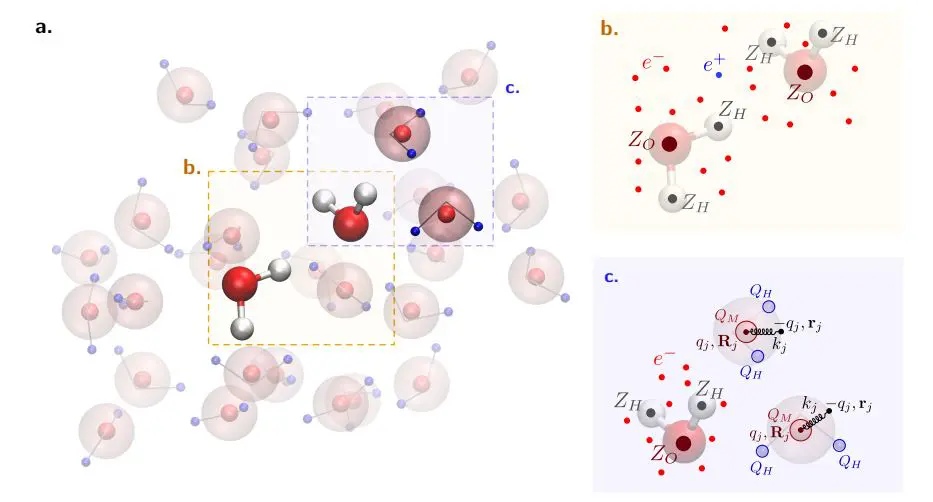
Understanding the complex interactions between particles requires increasingly sophisticated computational methods, and a team led by Matteo Barborini, Jorge Charry, and Matej Ditte from the University of Luxembourg now presents a powerful new tool for this purpose. They have developed QMeCha, an open-access software package that uses quantum Monte Carlo techniques to simulate the behaviour of systems containing both fermions and a surrounding environment of classical particles. This achievement significantly expands the scope of computational chemistry and physics, enabling researchers to explore correlation effects in systems with thousands of interacting particles, something previously inaccessible to existing methods. QMeCha’s modular design and efficient algorithms promise to unlock new insights into the properties of complex materials and molecules, offering a versatile platform for future research.
The Carlo Quantum Monte Carlo (QMC) package represents a development aimed at studying many-body interactions between diverse types of quantum particles, and it features a modular, easily expandable structure. This code solves the Hamiltonian of a system encompassing nuclei and fermions of varying mass and charge, for example, electrons and positrons, all within an environment of classical charges and quantum Drude oscillators. To approximate the ground state of this many-particle operator, the code incorporates several wavefunction options, extending beyond conventional Slater determinants to include geminal functions, such as the Pfaffian, and implements various types of explicit correlation terms.
Transcorrelated Coupled Cluster and Quantum Monte Carlo
Current research in computational chemistry and physics focuses on developing increasingly accurate and efficient methods for simulating complex systems. A central theme is the application of wavefunction-based methods, including Quantum Monte Carlo (QMC), particularly Diffusion Monte Carlo (DMC), to calculate energies, forces, and excited states. Researchers are actively improving the efficiency and accuracy of these methods, for example, through space-warp coordinate transformations, and refining Transcorrelated Coupled Cluster (CC) theory to improve convergence and accuracy, especially for systems with strong correlation. Machine learning (ML) and neural networks are emerging as powerful tools, used to solve the electronic Schrödinger equation and represent wavefunctions and potential energy surfaces.
Accurate modeling of long-range interactions, such as Van der Waals (vdvW) forces, is crucial, and researchers are employing techniques like quantum Drude oscillators and many-body dispersion calculations. Software tools like VMD (Visual Molecular Dynamics) and Gnuplot are essential for visualization and data analysis, and these methods rely on high-performance computing (HPC) clusters. Current research also focuses on calculating forces accurately for molecular dynamics simulations and on modeling excited states using QMC and neural networks. The TEA challenge serves as a benchmark for machine learning force fields, and researchers are striving to balance accuracy with computational efficiency, particularly for strongly correlated systems and those involving long-range interactions.
Accurate Many-Body Calculations with QMeCha Code
The development of the QMeCha code represents a significant advancement in the study of many-body quantum systems, enabling researchers to model interactions between diverse particles with unprecedented detail. This new computational tool accurately solves the Hamiltonian for systems including nuclei, fermions, and classical charges, incorporating effects like dispersion, polarization, and electrostatics within a molecular environment. The code utilizes both variational and diffusion Monte Carlo methods, coupled with a robust wavefunction optimization procedure, to explore correlation effects in systems containing thousands of particles, exceeding the capabilities of previously available methods. Recent work employing QMeCha focused on obtaining highly accurate reference calculations for a new dataset, the “Quantum Interacting Dimer” (QUID), comprised of large macromolecules interacting with benzene or imidazole.
Comparisons against LNO-CCSD(T) results revealed discrepancies in binding energies, particularly for dimers involving imidazole and hydrogen bonding. Analysis of the binding energies showed that the largest differences between FN-DMC and LNO-CCSD(T) calculations occurred in specific conformers, with the relative error reaching up to 30% in certain cases. The team measured the relative error, defined as the absolute difference between the computed binding energy and the LNO-CCSD(T) value, divided by the LNO-CCSD(T) binding energy, and found an average absolute error of less than 1% for both FN-DMC and DFT calculations. However, the analysis of individual conformers revealed that the discrepancies between methods were not uniformly distributed, with certain structures exhibiting significantly larger errors. These findings underscore the importance of developing improved theoretical methods and benchmark datasets for accurately predicting the properties of complex molecular systems, particularly those involving weak intermolecular interactions.
Quantum Many-Body Calculations with Realistic Environments
The development of the QMeCha code represents a significant advance in the field of quantum many-body calculations. Researchers have created a new, open-access Monte Carlo package designed to investigate interactions between diverse particles, including nuclei, electrons, and positrons, within complex environments. The code incorporates sophisticated trial wavefunctions, extending beyond traditional Slater determinants to include geminal functions and explicit correlation terms, allowing for a more accurate description of quantum correlations. Crucially, QMeCha models the surrounding molecular environment using classical point charges and quantum Drude oscillators, enabling the explicit calculation of dispersion, polarization, and electrostatic effects on the quantum subsystem.
This achievement expands the scope of accessible quantum calculations, particularly for systems containing thousands of interacting particles, exceeding the capabilities of many existing methods. The code’s massively parallel structure, combined with efficient variational and diffusion Monte Carlo protocols, facilitates calculations on modern high-performance computing facilities. While the accuracy of the results depends on the chosen trial wavefunctions and approximations within the Monte Carlo methods, QMeCha provides a powerful new tool for investigating complex quantum systems. Future work will likely focus on applying the code to a wider range of physical and chemical problems, and on further refining the methods to improve accuracy and efficiency.
🗞 QMeCha: quantum Monte Carlo package for fermions in embedding environments
🧠 ArXiv: https://arxiv.org/abs/2511.03439