Controlling qubits with precision remains a central challenge in the development of practical quantum computers, and researchers are continually seeking methods to improve the accuracy and speed of quantum operations. Qi Ding, Shoumik Chowdhury from the Massachusetts Institute of Technology, and Agustín Di Paolo from Google Quantum AI, alongside Réouven Assouly and Alan V. Oppenheim from MIT, and Jeffrey A. Grover, present a new theoretical framework for implementing quantum gates using both frequency and amplitude modulation of microwave control signals. This approach cleverly shifts the need for tuning qubit frequencies to modulating the drive frequencies, offering a potentially simpler and more robust method for achieving high-fidelity control. The team demonstrates, through detailed simulations, the ability to create a universal set of quantum gates with exceptionally low error rates and fast operation times, paving the way for more complex and reliable quantum computations.
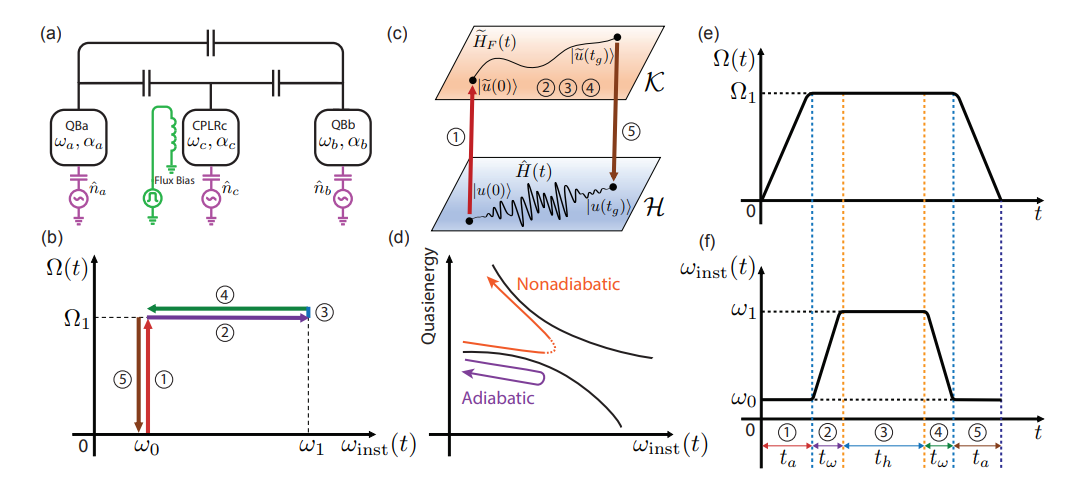
Achieving high-fidelity single- and two-qubit gates is essential for executing arbitrary digital quantum algorithms and for building error-corrected quantum computers. This research proposes a theoretical framework for implementing quantum gates using frequency- and amplitude-modulated microwave control, extending conventional amplitude modulation by introducing frequency modulation as an additional control parameter. This approach operates on fixed-frequency qubits, eliminating the need for qubit frequency tunability, and leverages Floquet theory to analyse and design these gates, demonstrating a pathway towards improved quantum control.
Superconducting Qubit Control and Optimisation Techniques
Recent advances in quantum computing increasingly focus on sophisticated control techniques for superconducting qubits. Core to this field is the development of universal gate sets, enabling complex quantum computations, and researchers are actively investigating advanced control techniques, including Floquet engineering and adiabatic control, to protect qubits from noise and enhance coherence. Theoretical tools, such as quantum master equations and numerical simulations, play a crucial role in modelling qubit dynamics and optimising control parameters, driving progress towards scalable quantum processors. A key trend is a move beyond static control pulses towards dynamic control, using time-varying drives to engineer qubit properties and enhance performance. Noise mitigation remains paramount, and the field is continually evolving, with researchers exploring new qubit designs and architectures to improve performance and scalability.
Fast, Precise Quantum Control via Frequency Modulation
Scientists have achieved high-fidelity control of quantum bits, or qubits, using a novel approach to gate implementation based on precisely shaped microwave signals. This work introduces a theoretical framework that extends conventional amplitude modulation of microwaves by incorporating frequency modulation as an additional control parameter, allowing for operation on fixed-frequency qubits. The team demonstrates the ability to design universal quantum gates, including X, Hadamard, phase, and CZ gates, with control signals exhibiting minimal amplitude variation. Single-qubit operations are achieved in 25 to 40 nanoseconds, while two-qubit operations, including a tailored always-on CZ gate, are completed in 80 to 135 nanoseconds.
The research leverages Floquet theory to analyse and optimise these microwave drives, ensuring broad applicability across different gate types and control schemes. By carefully manipulating both the frequency and amplitude of the microwave signals, scientists can precisely control the interactions between qubits, enabling the execution of complex quantum algorithms. Experiments, conducted using numerical simulations with realistic transmon qubit parameters, confirm the practical viability of the approach. Furthermore, the team developed a fast quasiadiabatic method to accelerate adiabatic gate dynamics by shaping the temporal profile of the control parameter, maintaining homogeneous adiabaticity while reducing total gate duration. This method dynamically adjusts the control signal based on the energy gap between qubit states, speeding up the process without sacrificing accuracy.
Fast, Precise Gates Without Frequency Tuning
This research presents a new theoretical framework for designing high-fidelity quantum gates using microwave control, extending conventional methods by incorporating both frequency and amplitude modulation. The team demonstrates that this approach allows for precise control of qubit operations, accommodating both adiabatic and nonadiabatic gate designs, and crucially, does not require qubit frequency tunability. Numerical simulations, employing realistic parameters for transmon qubits, confirm the feasibility of this framework, achieving a universal gate set, including X, Hadamard, phase, and CZ gates, with control errors consistently below 0. 1%.
Single-qubit operations demonstrate particularly fast gate times, ranging from 25 to 40 nanoseconds, while two-qubit operations achieve times of 80 to 135 nanoseconds. The significance of this work lies in expanding the toolkit for microwave-based quantum control and providing a systematic strategy for optimizing gate design parameters. By moving beyond simple amplitude modulation, the researchers unlock greater precision and flexibility in manipulating qubits, and the framework is potentially applicable to other qubit modalities, such as fluxonium qubits, neutral atoms, or trapped ions.
🗞 Frequency- and Amplitude-Modulated Gates for Universal Quantum Control
🧠 ArXiv: https://arxiv.org/abs/2511.03164
See today’s quantum computing news on Quantum Zeitgeist for the latest breakthroughs in qubits, hardware, algorithms, and industry deals.