

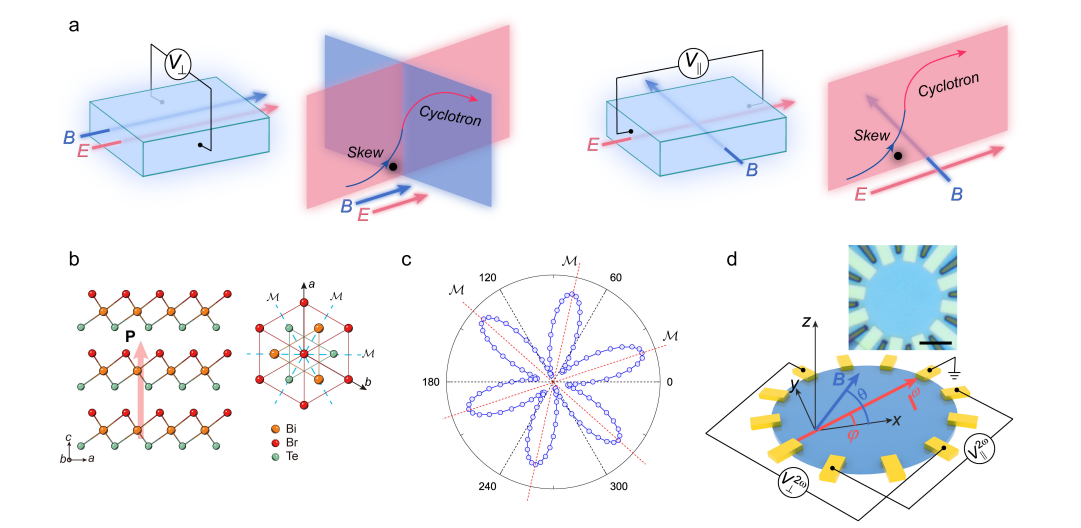
Nonreciprocal magneto-transport, where electrical conductivity depends on the direction of applied electric and magnetic fields, holds considerable promise for next-generation electronic devices, and researchers are actively seeking to understand and enhance this phenomenon in materials lacking symmetry. Xiu Fang Lu, Xue-Jin Zhang, and Naizhou Wang, along with their colleagues, have now discovered a previously unknown mechanism driving this effect, Lorentz skew scattering, and demonstrated its dominance in the material bismuth tellurobromide. Their work reveals an unexpected quartic relationship between conductivity and applied fields, a finding that aligns theoretical predictions with experimental results, and bridges classical and quantum effects on the material’s electronic structure. This discovery is particularly significant because it identifies a leading mechanism for strong nonreciprocal magneto-transport in materials with high electron mobility, offering a new pathway for designing low-energy rectifiers and advanced quantum electronics.
BiTeBr Nonlinear Transport and Hall Effect Studies
This research investigates nonlinear electrical responses in bismuth telluride bromide, a promising material for advanced electronic devices. Unlike conventional conductivity, nonlinear effects enable functionalities beyond standard electronics, opening new avenues for technological innovation. The team demonstrates a significant nonlinear Hall effect in BiTeBr, even at room temperature, a major advantage over materials requiring extremely cold operating conditions. This effect arises from Lorentz skew scattering, where electrons deflect off impurities, creating a transverse current. Combining detailed theoretical calculations with experimental measurements, the research provides a comprehensive understanding of the underlying physics and guides the development of materials with enhanced nonlinear properties, with potential applications in high-frequency rectifiers, nonlinear signal processing, novel sensors, and next-generation electronic components.
Lorentz Skew Scattering Drives Quartic Magneto-transport
Scientists have achieved a breakthrough in understanding nonreciprocal magneto-transport, a phenomenon where electrical conductivity depends on both electric and magnetic fields. Their work reveals Lorentz skew scattering as the driving force behind this effect in bismuth telluride bromide. Experiments demonstrate an unprecedented quartic scaling law for nonreciprocal magneto-transport, sharply contrasting with previously observed mechanisms and confirming theoretical predictions. The team measured the nonlinear electrical response of BiTeBr, finding almost perfect sine and cosine dependence with a 90° phase shift under a 5 Tesla magnetic field and a 200μA driving current at 50 Kelvin. This achievement relies on high-quality BiTeBr samples with remarkably low linear resistivity, indicating superior material quality. The research establishes Lorentz skew scattering as the dominant mechanism in high-mobility systems, offering a new principle for enhancing nonreciprocal magneto-transport by maximizing electronic relaxation time in topological materials, paving the way for low-dissipation rectifiers and high-performance quantum electronics.
Lorentz Scattering Drives Nonreciprocal Conductivity
Researchers have discovered a fundamental mechanism driving nonreciprocal magneto-transport, where electrical conductivity depends on the direction of both electric and magnetic fields. Their work identifies Lorentz skew scattering as the origin of this effect in bismuth telluride bromide, demonstrating a unique quartic scaling relationship between the effect and applied fields. This finding contrasts with previous understanding, which attributed such transport primarily to Zeeman interactions and observed quadratic scaling. The team’s analysis reveals that Lorentz skew scattering dominates in bismuth telluride bromide due to the material’s high electron mobility and strong Rashba splitting, linking classical forces with quantum effects on the material’s electronic structure. While specific to the studied material, the researchers suggest that materials with long electronic relaxation times and strong Berry curvatures, such as graphene superlattices and Weyl semimetals, could exhibit even more pronounced nonreciprocal transport, opening new avenues for developing low-dissipation rectifiers and high-performance quantum electronic devices.
🗞 Lorentz Skew Scattering Nonreciprocal Magneto-Transport
🧠 ArXiv: https://arxiv.org/abs/2511.03273


See today’s quantum computing news on Quantum Zeitgeist for the latest breakthroughs in qubits, hardware, algorithms, and industry deals.



