Understanding how electrons move through materials and respond to external stimuli is fundamental to developing next-generation technologies, and researchers increasingly rely on solving the Boltzmann transport equation to model these processes. Shiyu Peng, Donnie Pinkston, Jia Yao, Sergei Kliavinek, Ivan Maliyov, and Marco Bernardi, all from the California Institute of Technology, have now dramatically accelerated these calculations by harnessing the power of modern graphics processing units. Their work overcomes a significant computational bottleneck in modelling electron-phonon interactions, a key factor governing material properties and electron behaviour. By developing a novel data structure and algorithm optimised for GPU hardware, the team achieves a forty-fold speed-up compared to existing CPU-based methods, and demonstrates excellent scalability across multiple GPUs, paving the way for detailed investigations of electron transport and dynamics in a wide range of materials and preparing the Perturbo code for the next generation of supercomputers.
Existing computational methods often struggle with accurately modelling electron-phonon interactions, particularly in complex materials and at nanoscale dimensions. To address these limitations, the team developed a highly parallelized implementation of the Perturbo code, specifically designed for execution on Graphics Processing Units (GPUs). By leveraging the inherent parallelism of GPU architectures, they significantly speed up the computation of key quantities involved in electron-phonon interactions.
This involved a comprehensive restructuring of the Perturbo code to fully utilise the massively parallel processing capabilities of GPUs. The team rewrote critical sections of the code using CUDA, a parallel computing platform developed by NVIDIA, and optimised data transfer between the CPU and GPU to minimise bottlenecks. They carefully mapped computational tasks onto the GPU’s architecture, maximising occupancy and minimising communication overhead. This advancement unlocks the possibility of studying complex materials phenomena, such as thermal transport and hot carrier dynamics, with unprecedented accuracy and efficiency. The optimised code provides a valuable tool for researchers in materials science, condensed matter physics, and nanotechnology, facilitating the design and discovery of novel materials with tailored properties.
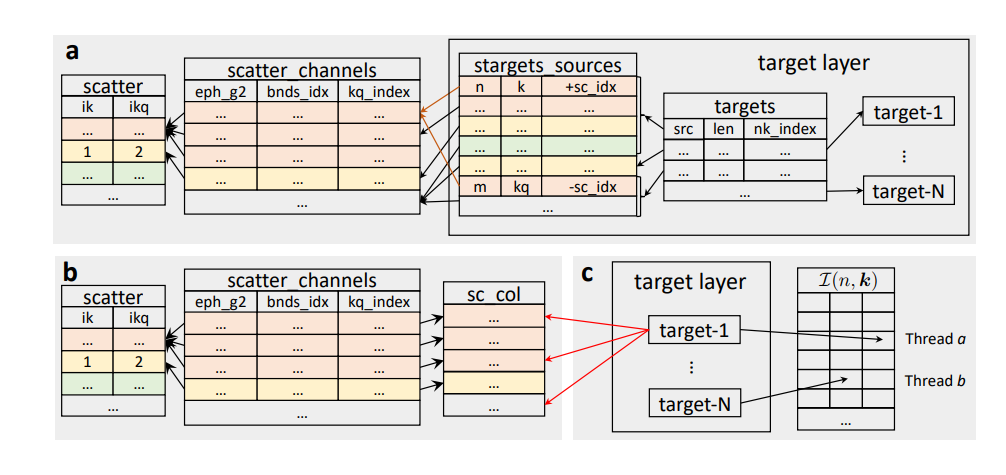
Calculating the electron-phonon collision integral is the most computationally demanding step in modelling electronic transport and nonequilibrium dynamics in materials. This makes it difficult to study materials with large unit cells and to achieve high resolution in momentum space. Researchers demonstrate acceleration of Boltzmann Transport Equation (BTE) calculations of electronic transport and ultrafast dynamics using graphical processing units (GPUs), implementing a novel data structure and algorithm optimised for GPU hardware.
Electron-Phonon Interactions and Ultrafast Material Response
Understanding how electrons interact with lattice vibrations (phonons) is crucial for explaining many material properties, including electrical and thermal conductivity, and carrier mobility. Investigating the behaviour of electrons and phonons on extremely short timescales following excitation is also key, including studying energy relaxation, carrier dynamics, and the generation and propagation of coherent phonons. Researchers are developing and applying advanced computational techniques to simulate electron-phonon interactions and ultrafast dynamics, ranging from ab initio calculations to machine learning approaches. Strong electron-phonon coupling plays a vital role in various phenomena, including superconductivity, polaron formation, and the efficiency of energy transfer in materials.
Research reveals the intricate dynamics of energy relaxation, carrier cooling, and coherent phonon generation following photoexcitation, critical for optimising materials for applications like solar cells and optoelectronics. Defects significantly impact carrier mobility, and accurate modelling of electron-defect scattering is crucial for predicting and controlling material performance. Density Functional Theory (DFT) and many-body perturbation theory are used to calculate electronic structure and electron-phonon coupling. The Boltzmann Transport Equation (BTE) is used to model carrier and phonon transport, accounting for scattering processes.
Time-dependent DFT and real-time GW are employed to simulate ultrafast dynamics. Machine Learning (ML) techniques are increasingly used to accelerate calculations, compress data, and identify important features in complex simulations. Several software packages are used for these calculations, including Octopus, Perturbo, Phoebe, and Cepellotti, as well as various GPU-accelerated implementations. These calculations are computationally demanding and require access to High-Performance Computing (HPC) resources, including supercomputers and GPU clusters. GPU acceleration is crucial for achieving reasonable simulation times, and parallel computing techniques are used to distribute the workload across multiple processors or GPUs. Future research will focus on combining ab initio calculations with machine learning to create more efficient and accurate simulations, developing methods to bridge the gap between ab initio calculations and macroscopic material properties, and continuing the development of GPU-accelerated codes to improve performance and enable larger-scale simulations.
GPU Acceleration of Boltzmann Transport Simulations
Researchers have significantly accelerated calculations used to model how electrons move through materials, achieving a forty-fold increase in speed compared to existing methods. This advance focuses on solving the Boltzmann transport equation by optimising how computationally intensive collision integrals are calculated. The team developed a novel data structure and algorithm specifically for graphics processing units (GPUs), streamlining data handling and reducing processing time. This new approach scales effectively with increasing numbers of GPUs, up to one hundred, paving the way for more complex and detailed material modelling.
The optimised code has been integrated into a publicly available software package, enabling broader access for researchers in the field. The researchers demonstrated that the GPU implementation is substantially faster than running the same code on conventional processors. The authors acknowledge that the performance gains are dependent on the specific hardware and that further optimisation may be possible. They suggest that the developed data structure is adaptable to other types of electron interactions, opening avenues for future research into a wider range of materials and phenomena. Future work will likely focus on applying this accelerated method to study complex materials and explore novel electronic devices.
🗞 Efficient GPU Parallelization of Electronic Transport and Nonequilibrium Dynamics from Electron-Phonon Interactions in the Perturbo Code
🧠 ArXiv: https://arxiv.org/abs/2511.03683