Quantifying entanglement in complex quantum systems presents a significant challenge for physicists, yet understanding these correlations is crucial for advancing quantum technologies. Harsh Sharma from the Indian Institute of Technology Bombay, Sampriti Saha from ETH Zurich, and A. S. Majumdar, along with colleagues Manik Banik and Himadri Shekhar Dhar, now present a new framework for measuring multipartite entanglement, even in systems where strong interactions between particles complicate traditional methods. Their approach utilises thermodynamic principles, specifically the concept of ‘ergotropy’, the maximum work extractable from a system, to assess entanglement through controlled changes to interactions or by measuring local properties. This innovative technique accurately estimates genuine multipartite entanglement in both stable and evolving quantum states, and demonstrates promising applicability to realistic physical models and near-term quantum simulators, offering a versatile tool for characterising entanglement in increasingly complex systems.
Quantum Entanglement and Computation References
This extensive list details research in quantum information theory, quantum computing, condensed matter physics, and related fields. It covers core concepts like quantum entanglement, algorithms, and resource theories, alongside investigations into many-body systems and numerical methods. The compilation highlights a strong focus on quantifying entanglement, detecting it in complex systems, and understanding its role in quantum phase transitions. The list includes references to key algorithms such as Grover’s algorithm and techniques for distributed quantum computation, alongside explorations of quantum compiling and optimization.
It also acknowledges the current era of noisy intermediate-scale quantum (NISQ) computing and its implications for practical quantum computation. A significant portion of the research focuses on quantum resource theories and the challenges of quantum error correction and mitigation. Investigations into condensed matter physics emphasize quantum phase transitions, spin chains, and models like the Dicke model and the SSH model. References to these models suggest an interest in understanding collective phenomena, superradiance, and topological phases of matter. The list also includes references to numerical methods, such as tensor networks and Monte Carlo simulations, used for studying entanglement and many-body systems.
Theoretical foundations are represented by references to Bell’s theorem, mathematical physics, and statistical mechanics. This broad coverage suggests potential research directions, including investigating entanglement in quantum phase transitions, developing tensor network methods for quantum simulation, and exploring quantum error mitigation strategies. The list also points towards characterizing genuine multipartite entanglement, developing NISQ-era algorithms for condensed matter physics, and exploring the connection between entanglement and topological phases. Overall, this bibliography represents a robust foundation in quantum information theory, condensed matter physics, and numerical methods. It suggests a research program focused on understanding the role of entanglement in complex quantum systems and developing new tools and techniques for studying these systems. The breadth of the list indicates a multidisciplinary approach, combining theoretical insights with numerical simulations and experimental investigations.
Ergotropy Accurately Quantifies Multipartite Entanglement
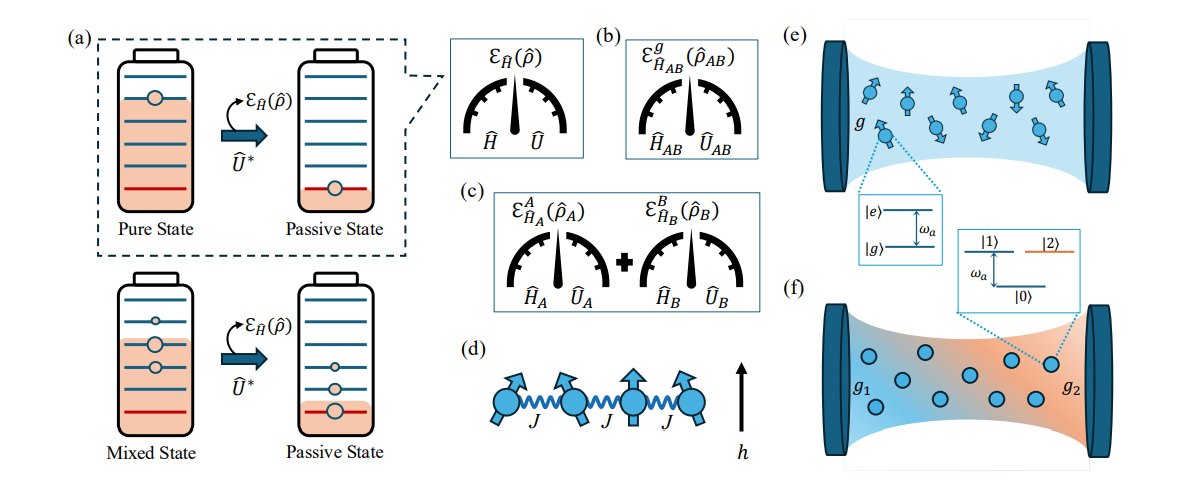
Scientists have established a new framework for quantifying multipartite entanglement, a complex property of quantum systems involving multiple interacting particles. This work addresses a fundamental challenge in characterizing entanglement, particularly in systems where strong interactions between particles make traditional measurements difficult. The team proposes a method that evaluates entanglement by examining the ergotropy of a quantum state, either by temporarily removing interactions or by measuring only local properties of the system. The research demonstrates that this approach accurately estimates genuine multipartite entanglement, even in systems with strong interactions and in states that evolve over time.
Experiments reveal that by controlling the strength of interactions or focusing on local measurements, scientists can determine the ergotropic gap, a measure of how much work can be extracted from a quantum state, and use this to quantify entanglement. This is particularly important for simulating complex quantum systems using platforms like trapped ions or superconducting circuits. Measurements confirm that the method works effectively for several physical models, including the Tavis-Cummings model, the three-level Dicke model, and the transverse-field Ising model. The team successfully applied the framework to parametrized states simulated on a quantum circuit, varying the circuit depth and introducing noise to mimic real-world conditions.
Results show the ability to accurately assess entanglement even with these complexities. This breakthrough delivers a versatile tool for characterizing entanglement in near-term quantum simulators, which are essential for advancing quantum computing and materials science. By focusing on ergotropy and utilizing controlled quenching of interactions or local measurements, scientists can overcome limitations of previous methods and gain deeper insights into the behavior of complex quantum systems. This work paves the way for more accurate simulations and a better understanding of entanglement in a variety of physical contexts.
🗞 Thermodynamic Probes of Multipartite Entanglement in Strongly Interacting Quantum Systems
🧠 ArXiv: https://arxiv.org/abs/2511.03266