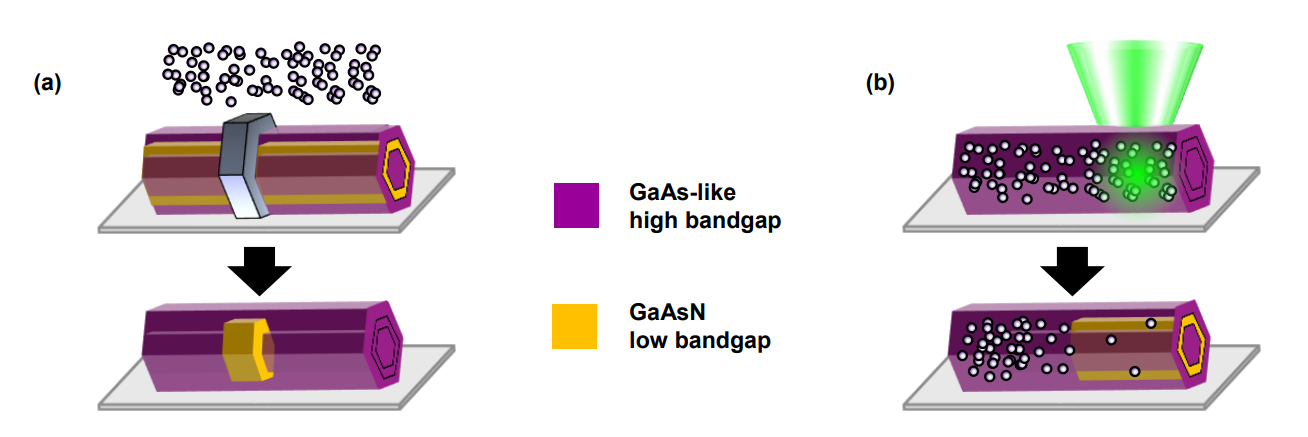
Controlling the bandgap of semiconductor materials is crucial for advancing photonic and optoelectronic technologies, and researchers are continually seeking more precise and versatile methods to achieve this. Nadine Denis, Akant Sharma, and Elena Blundo, alongside colleagues at their respective institutions, demonstrate a novel approach to bandgap engineering in gallium arsenide nitride nanowires. The team successfully increases the bandgap of these nanowires by up to 460 meV through a post-growth hydrogen implantation process, achieving a reversible and tunable effect previously unattainable in conventional semiconductor layers. This breakthrough, enabled by the unique properties of nanowire structures, allows for precise control over the material’s optical properties and significantly enhances photoluminescence efficiency, paving the way for innovative, locally and energy-controlled devices.
The team demonstrates hydrogen implantation introduces defects that deactivate nitrogen-related electronic states, modifying the nanowires’ electronic properties and allowing for on-demand bandgap control, offering potential for advanced optoelectronic devices. The study correlates hydrogen implantation dose with resulting bandgap changes, paving the way for tailored semiconductor materials with specific functionalities.
Tunable Bandgaps in Core-Multishell Nanowires
Scientists engineered core-multishell nanowires composed of gallium arsenide, gallium arsenide nitride, and gallium arsenide, achieving precise control over bandgap energy through post-growth modification. The study pioneered a method for increasing the bandgap in gallium arsenide nitride nanowires grown on silicon by up to 460 meV, a reversible process accomplished through hydrogen implantation. These nanowires feature a 170nm gallium arsenide core, a 40-50nm gallium arsenide nitride shell with varying nitrogen concentrations of 0. 6%, 1. 6%, and 4.
2%, and a 40-50nm gallium arsenide outer shell, allowing for tunable heterostructures. Researchers employed micro-photoluminescence measurements on individual nanowires to characterize bandgap energy, meticulously analyzing emission spectra before and after hydrogenation. By measuring photoluminescence emission at room temperature from specific points on individual nanowires, scientists tracked bandgap energy shifts as a function of nitrogen concentration and hydrogen dose. The team observed the bandgap of gallium arsenide nitride decreased from 1. 43 eV to 0.
97 eV with increasing nitrogen concentration, but hydrogenation fully restored the higher gallium arsenide-like bandgap energy across all samples. Quantitative analysis revealed the full width at half maximum of the emission narrowed after hydrogenation, indicating a reduction in concentration fluctuations inherent in gallium arsenide nitride materials. The study demonstrates bandgap recovery originates from the formation of nitrogen-hydrogen complexes, effectively passivating the electronic potential of nitrogen atoms within the gallium arsenide nitride lattice. Furthermore, scientists achieved continuous tuning of the bandgap by controlling the thermal decomposition of these nitrogen-hydrogen complexes, offering a pathway to locally and energy-controlled structures within the nanowires.
This innovative approach opens possibilities for developing novel optoelectronic devices operating within the telecommunications O-band, specifically targeting energies between 0. 91 and 0. 98 eV.
Tunable Bandgap Control in GaAsN Nanowires
Scientists achieved significant bandgap engineering in gallium arsenide nitride nanowires, demonstrating a reversible and tunable method for controlling their optical properties. The research focused on core-shell-shell gallium arsenide/gallium arsenide nitride/gallium arsenide nanowires, incorporating nitrogen concentrations up to 4. 2% within the gallium arsenide nitride shell, initially lowering the bandgap to as little as 0. 97 eV. Through post-growth hydrogen implantation, the team successfully increased the bandgap by up to 460 meV, effectively restoring the bandgap energy of gallium arsenide at 1.
42 eV. This substantial shift is achieved without damaging the nanowire structure, offering a non-destructive method for bandgap control. Experiments involved measuring photoluminescence from individual nanowires before and after hydrogenation, revealing a complete recovery of the gallium arsenide bandgap. Measurements confirm the bandgap can be shifted by as much as 460 meV through hydrogen implantation, with the magnitude of the shift directly correlated to the initial nitrogen concentration in the gallium arsenide nitride shell. This breakthrough delivers a versatile platform for designing novel optoelectronic devices, including energy-matched detectors, spin filters, nanowire lasers, and nanowire solar cells potentially operating within the telecom O-band and C-band. The ability to precisely control the bandgap at both a global and local level opens up new possibilities for advanced photonic and quantum technologies.
Tunable Bandgap in GaAsN Nanowires via Hydrogenation
This research demonstrates a versatile new technique for tuning the bandgap of gallium arsenide nitride nanowires post-growth, achieving a wide energy range of 0. 97 to 1. 43 electron volts. The team successfully increased the bandgap of gallium arsenide nitride nanowires through hydrogen implantation, a process enabled by the relaxed strain requirements inherent in nanowire heterostructures. This approach allows for a full shift of the gallium arsenide nitride bandgap along the nanowires, proving nitrogen passivation, a previously unattempted feat.
Notably, optimized hydrogenation conditions resulted in an order of magnitude increase in optical emission intensity. The researchers further demonstrated that this bandgap shift is reversible and continuously tunable through controlled thermal treatment, achieved by breaking up nitrogen-hydrogen complexes. Local bandgap tuning was also achieved using laser annealing, opening possibilities for creating novel, locally and energy-controlled structures. This work establishes dilute gallium arsenide nitride as a viable alternative to indium gallium arsenide alloys for achieving appropriate bandgaps for telecommunications photonics, and provides a route to post-growth, localized bandgap control.
🗞 Bandgap Engineering On Demand in GaAsN Nanowires by Post-Growth HydrogennImplantation
🧠 ArXiv: https://arxiv.org/abs/2511.02697