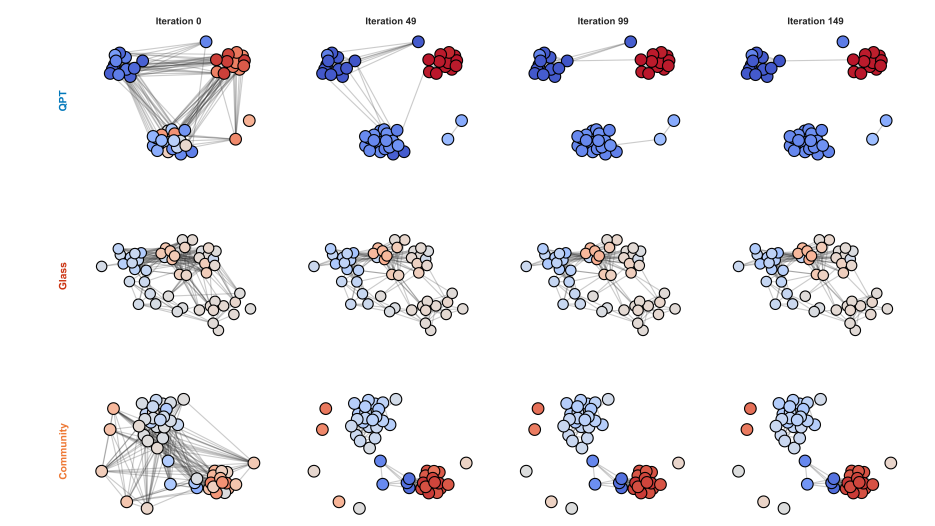
Researchers are increasingly exploring how quantum systems can exhibit complex, adaptive behaviours, mirroring the self-organisation seen in natural systems. Lakshya Nagpal and Syed R. Hassan, from the Institute of Mathematical Sciences, have developed a new framework called Adaptive Quantum Ising Agents, which demonstrates how quantum coherence can drive organisation through informational feedback. This approach models quantum systems as interacting agents, each possessing internal quantum properties and communicating via state-dependent channels, effectively transforming a static system into a dynamic, reconfigurable medium. The team’s investigations reveal distinct organisational regimes, from patterned domain formation to frustrated, glass-like states, all arising from informational similarity rather than physical geometry, and offering a minimalistic model for exploring self-organisation and learning in quantum systems.
Ising Model Validation Through Simulation Analysis
Scientists rigorously tested a simulation, confirming its behaviour aligns with the well-established 2D Ising model, a benchmark for understanding systems undergoing phase transitions where material properties change dramatically. The research focused on demonstrating that observed changes matched the expected behaviour of the 2D Ising model, confirming its underlying principles. Systems exhibiting similar behaviour, despite different microscopic details, are grouped into universality classes, and the 2D Ising model provides a standard for comparison. Researchers used critical exponents, numbers describing how quantities change near the transition point, to verify the system’s behaviour, employing measurements of the order parameter, susceptibility, and Binder cumulant, alongside finite-size scaling to reveal universal behaviour.
The team used bootstrap resampling, a statistical method for estimating uncertainty, to confirm the accuracy of the critical exponents, analysing raw data for different system sizes and conditions. Consistency between multiple estimation methods, including minimizing collapse variance and the Binder crossing method, further validated the findings, with raw data made publicly available for independent verification. This research confirms that the simulated system exhibits a phase transition consistent with the 2D Ising model, strengthening the understanding of complex systems and providing insights into their behaviour. Each agent functions as a self-contained quantum system, maintaining internal coherence while interacting with others through feedback channels defined by observable properties. The core of the AQIA framework is an effective Hamiltonian, a mathematical description of the system’s energy, including terms representing individual agents and interaction terms that depend on their observable properties. Researchers solved for the system’s stable configuration using a mean-field approximation, simplifying calculations while capturing essential dynamics.
Numerical investigations revealed three distinct regimes within the AQIA framework: domain formation near the feedback-fluctuation critical point, glass-like frustration indicating a complex energy landscape, and sustained modular polarisation through structured interactions. Remarkably, these phenomena occur independently of the network’s physical layout. The AQIA framework is adaptable to various quantum platforms, including superconducting circuits, trapped ions, and Rydberg atoms, making it a promising platform for exploring self-organisation and learning in adaptive quantum systems. Each agent functions as a self-contained quantum system, maintaining internal coherence while interacting with others through feedback channels defined by observable properties. The effective Hamiltonian generated at each iteration remains Hermitian, ensuring the system’s stability. Researchers solved this Hamiltonian self-consistently using a mean-field approximation, iteratively adjusting the feedback fields to minimise the total energy and achieve a stable configuration.
Numerical investigations revealed three distinct regimes within the AQIA framework: domain formation, glass-like frustration, and sustained modular polarisation. Remarkably, these phenomena occur independently of the system’s physical layout. The AQIA framework is adaptable to various quantum platforms, including superconducting circuits, trapped ions, and Rydberg atoms, making it a promising platform for exploring self-organisation and learning in adaptive quantum systems. This research demonstrates that global organisation, including critical balance, adaptive glass-like states, and modular polarisation, emerges from informational interactions that evolve based on the agents’ own reduced properties. The team established a Lyapunov functional, allowing for rigorous analysis of adaptive feedback using principles similar to those applied to equilibrium systems, uniting quantum many-body theory, adaptive network dynamics, and cybernetics within a Hamiltonian framework consistent with quantum mechanics. The researchers highlight that the emergent regimes observed represent a novel approach to understanding complex quantum systems and their potential for self-organisation and adaptation.
🗞 Adaptive Quantum Matter: Variational Organization through Ising Agents
🧠 ArXiv: https://arxiv.org/abs/2511.02636




See today’s quantum computing news on Quantum Zeitgeist for the latest breakthroughs in qubits, hardware, algorithms, and industry deals.