The apparent scarcity of interstellar meteoroids between the sizes of dust grains and kilometre-scale objects presents a significant puzzle for astronomers, and new research addresses this ‘interstellar flux gap’. Eloy Peña-Asensio from Politecnico di Milano and University of Alicante, alongside Darryl Z. Seligman from Michigan State University, investigated whether a simple relationship between the flux of tiny interstellar dust particles and larger interstellar objects accurately predicts the expected number of intermediate-sized meteoroids detected by existing surveys. Their analysis reveals a substantial discrepancy, with spacecraft measurements of dust flux exceeding predictions based on meteor observations and kilometre-scale objects by a considerable margin. This finding suggests that the distribution of interstellar material is not continuous across all sizes, potentially indicating different origins or destruction mechanisms for dust and larger bodies, and prompting a reassessment of current understanding of interstellar material within our solar system.
Context exists for three kilometer-sized interstellar objects detected traversing the Solar System, and spacecraft have directly measured micrometer-scale interstellar dust. Currently, no intermediate-size interstellar meteoroids have been identified in existing meteor surveys. This research tests whether a power-law extrapolation connecting spacecraft dust measurements with these larger interstellar objects is consistent with meteor survey data, and quantifies the expected interstellar impacting flux.
Orbital Eccentricity and Inclination Measurements
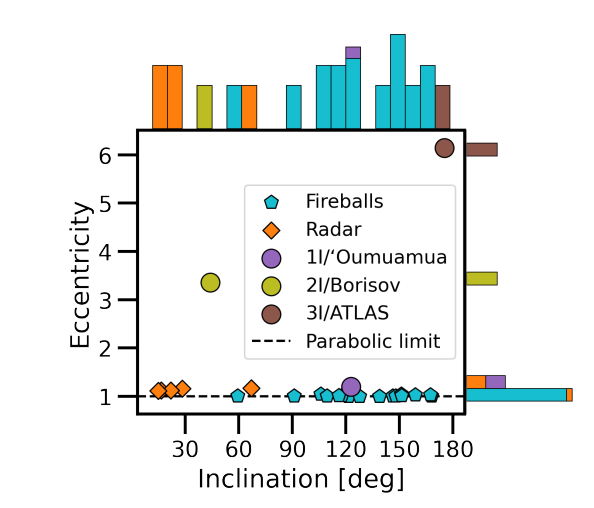
The research compiled data from radar meteor detections, optical fireball observations, and confirmed interstellar objects, 1I/’Oumuamua, 2I/Borisov, and 3I/ATLAS, to analyze their orbital characteristics. Key parameters included eccentricity, a measure of orbital shape, and inclination, the angle of the orbit relative to Earth’s orbital plane. The team also calculated hyperbolic excess velocity, which indicates whether an object is bound to the Sun or on a hyperbolic trajectory originating from interstellar space. The data reveals a clear distinction between the orbits of radar and optical meteors compared to the confirmed interstellar objects.
Radar and optical detections exhibit a range of eccentricities and inclinations, suggesting they originate within the Solar System. In contrast, the interstellar objects display significantly higher eccentricities, confirming their origin beyond our solar system0. 1I/’Oumuamua, 2I/Borisov, and 3I/ATLAS all demonstrate hyperbolic orbits, indicating they are not gravitationally bound to the Sun. This analysis provides a snapshot of the orbital characteristics of small solar system bodies, highlighting the importance of eccentricity in distinguishing between interstellar visitors and objects originating within our solar system. The team’s findings underscore the value of combining data from multiple sources, radar, optical surveys, and direct observations of interstellar objects, to build a comprehensive understanding of the small body population.
Interstellar Meteoroid Fluxes and Size Distributions
Scientists have detected three kilometer-sized interstellar objects traversing the Solar System, alongside direct measurements of micrometer-scale interstellar dust particles using spacecraft. However, a significant gap exists in observations, as no intermediate-size interstellar meteoroids have been identified in current meteor surveys. This work tests whether a power-law extrapolation connecting spacecraft dust measurements with these larger interstellar objects is consistent with existing meteor surveys, and quantifies the expected interstellar impacting flux. The team compiled data from spacecraft dust measurements, radar surveys, optical meteor observations, and theoretical estimates to evaluate size-frequency fits and compare measured fluxes to predictions.
Results demonstrate that the spacecraft-measured dust flux exceeds extrapolations based on meteor surveys and kilometer-scale interstellar objects by a factor of 2 to 7 orders of magnitude. This discrepancy suggests that a simple extrapolation from dust to larger objects fails to accurately predict the number of interstellar meteoroids. A fit combining spacecraft dust detections with kilometer-scale ISOs overpredicts the number of meteors with hyperbolic orbits, indicating a discrepancy between the predicted and observed populations. The data reveal a gap between submicron dust entrained in the Local Interstellar Cloud and macroscopic bodies ejected from planetary systems. This suggests that a simple power-law extending from interstellar dust to interstellar objects is inconsistent with current observations and yields unrealistic predictions for interstellar meteoroids. Analysis of orbital data shows that radar detections favor lower-speed prograde orbits, while optical surveys detect luminous, high-speed retrograde entries, potentially reflecting detection biases.
Missing Interstellar Impactors Reveal Complex Origins
This research demonstrates a significant discrepancy between expectations and observations regarding interstellar meteoroids. Scientists have found that extrapolating size-frequency distributions from measurements of both tiny interstellar dust particles and larger kilometer-sized interstellar objects predicts a much higher number of millimeter-to-meter-scale interstellar impactors than are currently detected by meteor surveys. The data reveal a gap in the expected continuum of sizes, suggesting that the processes governing the origin and destruction of interstellar material may be more complex than previously thought. Specifically, the team compared spacecraft measurements of micron-sized dust with observations of larger interstellar objects, and found that a simple power-law relationship fails to align with the number of interstellar meteoroids detected by existing surveys.
This suggests either that the Local Interstellar Cloud is dominated by very small particles, or that current estimates of spacecraft dust fluxes require reassessment. The findings highlight a need to refine models of interstellar material transport and the mechanisms that create and destroy particles as they travel through space. Future research should focus on improving the precision of meteor orbit determination and exploring alternative explanations for the observed size-frequency gap, potentially involving distinct origins or destruction processes for different particle sizes.
🗞 The interstellar flux gap: From dust to kilometer-scale objects
🧠 ArXiv: https://arxiv.org/abs/2511.01957