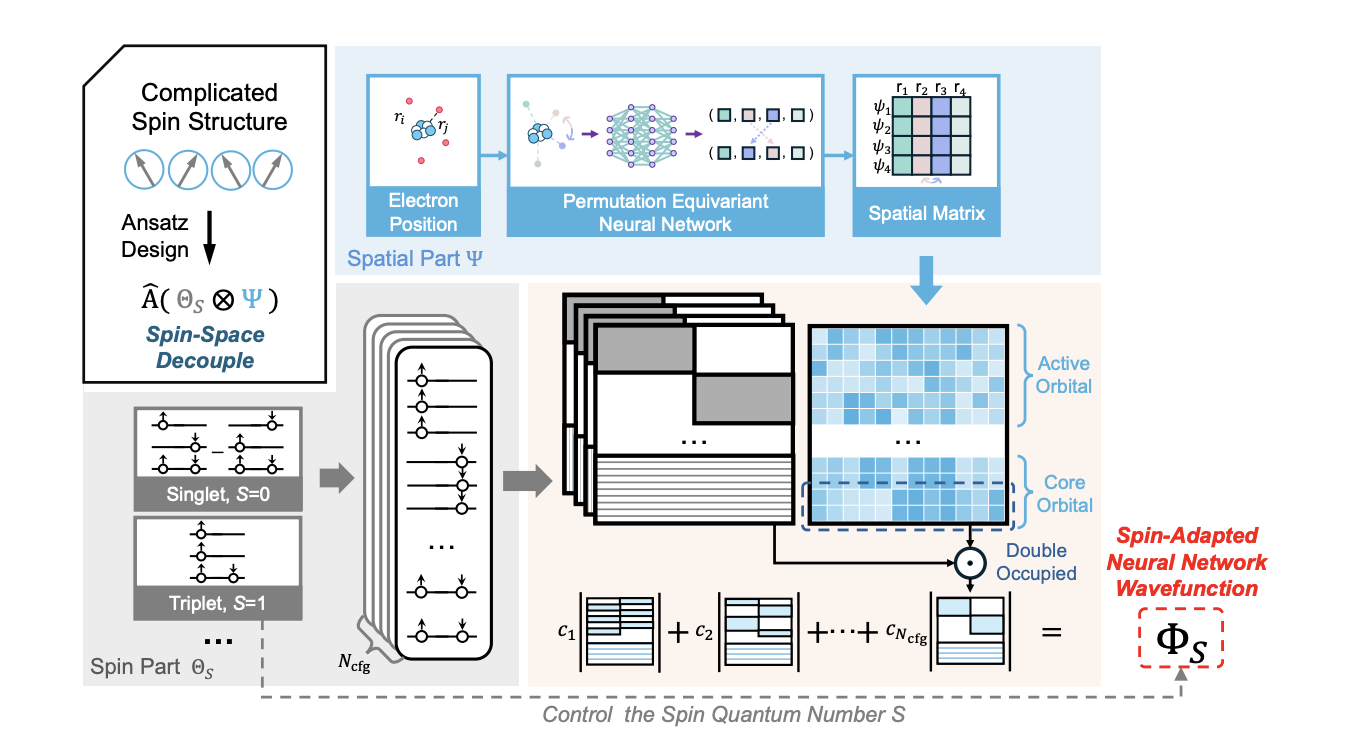
Understanding the behaviour of electrons requires accurate treatment of their intrinsic angular momentum, known as spin, yet conventional computational methods often struggle to incorporate this fundamental property effectively. Ruichen Li, Yuzhi Liu, and Du Jiang, alongside their colleagues, now present a new approach that directly addresses this challenge, introducing the Spin-Adapted Antisymmetrization Method (SAAM). This innovative technique enforces precise spin symmetry within calculations performed using neural networks, allowing researchers to model electron behaviour with greater accuracy and efficiency. The team demonstrates SAAM’s power by successfully applying it to the notoriously difficult problem of iron-sulfur clusters, revealing detailed insights into their electronic structure and establishing a robust, hyperparameter-free standard for future calculations involving strongly correlated electrons.
Methods based on the space wavefunction frequently fail to adequately consider spin symmetry. Within the context of neural network-based quantum Monte Carlo (NNQMC), SAAM leverages the expressiveness of deep neural networks to capture electron correlation while simultaneously enforcing exact spin adaptation through group representation theory. This framework provides a principled route to embed physical priors into otherwise black-box neural network wavefunctions, yielding a compact representation of correlated systems with neural network orbitals. The approach represents a significant advancement over existing methods by explicitly incorporating spin symmetry into the neural network wavefunction.
Solving Many-Body Schrödinger Equations for Clusters
Scientists face a significant challenge in accurately solving the many-body Schrödinger equation, a fundamental equation describing the behavior of interacting particles, particularly in complex systems like iron-sulfur clusters. These clusters, vital in biological processes and materials science, require precise calculations of their electronic structure, a task hampered by computational demands and the tendency for calculations to produce inaccurate results due to spin contamination. To overcome these limitations, researchers have developed SA-LapNet, a novel method employing deep neural networks to approximate the many-body wavefunction. This approach utilizes a specific network architecture, LapNet, designed to represent the wavefunction as a graph and learn relationships between particles.
The key innovation of SA-LapNet lies in SAAM, a technique that enforces spin symmetry within the neural network wavefunction. SAAM calculates analytical moments of the wavefunction, mathematical quantities describing spin distribution, and uses these to constrain the network’s learning process. This ensures the network learns wavefunctions with the correct total spin, reducing inaccuracies. The method simplifies calculations by using a recursive binary tree structure to represent the spin function, improving efficiency. Results demonstrate that SA-LapNet achieves lower variational energy, a measure of system stability and accuracy, compared to other methods, and exhibits a more stable training process. While slightly slower than a basic LapNet implementation, SA-LapNet outperforms LapNet with traditional spin penalty terms, suggesting SAAM is a more efficient way to enforce spin symmetry. This work addresses a fundamental challenge in quantum chemistry, where properly characterizing complex spin structure is crucial for predicting the properties of materials and molecules. The team successfully integrated SAAM with neural network-based quantum Monte Carlo (NNQMC) methods, creating a powerful framework for simulating electronic structures with unprecedented accuracy. The core of SAAM lies in a novel wavefunction ansatz that explicitly separates spin and spatial components, consistent with the fundamental structure of the electronic Hamiltonian.
By constructing spin functions from group representation theory, the method enforces exact spin symmetry without requiring any additional tunable hyperparameters, a significant improvement over existing techniques. This separation, combined with the expressiveness of neural network orbitals, allows for accurate descriptions of both static and dynamic electron correlation. The method models the spatial component using neural networks, naturally enabling the definition of chemical concepts like core and active orbitals within the NNQMC framework. To demonstrate the effectiveness of SAAM, researchers first calculated singlet-triplet gaps for biradical systems, achieving highly accurate predictions.
They then applied SAAM to excited-state calculations, showcasing both efficiency and accuracy on the carbon dimer. Crucially, the team accurately characterized iron-sulfur clusters, notoriously difficult systems due to their complex, nearly degenerate spin spectra. Results reveal accurate resolution of low-lying spin states and spin gaps in [Fe₂S₂] and [Fe₄S₄] clusters, offering new insights into their electronic structures. This work addresses limitations in existing computational techniques that struggle to fully account for spin symmetry. By integrating SAAM with neural network-based Monte Carlo simulations, scientists achieve a more robust and efficient way to model electron correlation, leading to compact representations of electronic structures. The team demonstrated the effectiveness of SAAM by applying it to iron-sulfur clusters, notoriously difficult systems for computational modelling due to their complex electronic states.
Results reveal accurate resolution of low-lying spin states and spin gaps in these clusters, offering new insights into their electronic structures. While the method introduces a slight increase in computational time compared to some existing approaches, it surpasses the efficiency of methods relying on spin penalty terms. Future work will likely focus on extending SAAM to even larger and more complex systems, potentially unlocking new understanding in materials science and quantum chemistry. The development of SAAM represents a significant advancement in computational materials science, providing a powerful tool for accurately modelling the behaviour of electrons in complex systems.
🗞 Spin-Adapted Neural Network Wavefunctions in Real Space
🧠 ArXiv: https://arxiv.org/abs/2511.01671



See today’s quantum computing news on Quantum Zeitgeist for the latest breakthroughs in qubits, hardware, algorithms, and industry deals.