The fundamental nature of space itself remains a profound mystery in physics, and understanding how spatial properties emerge from more basic principles represents a major challenge. Ronak M Soni from the Chennai Mathematical Institute investigates this question by searching for mathematical operators that describe area within a theoretical framework, even when the underlying system appears to lack conventional spatial characteristics. This research demonstrates that while a precise measure of area initially appears to vanish, a meaningful approximation emerges when considering a simplified, or ‘coarse-grained’, view of the system, accurately reflecting the entanglement between different parts of the theoretical space. Importantly, this coarse-grained area operator provides a valuable tool for understanding how classical, intuitive notions of space arise from more complex quantum systems, and offers a potential pathway towards resolving long-standing puzzles about the relationship between gravity, quantum mechanics, and the very fabric of reality.
A vanishing area operator emerges from a code subspace, however, a non-zero area operator appears after coarse-graining. The expectation value of this operator approximates the actual entanglement entropy for a class of states that do not form a linear subspace, and these non-linear constraints can be interpreted as semiclassicality conditions. The coarse-grained area operator exhibits ambiguity, which can be matched with that in defining fixed-area states. This work details the emergence of an area operator from coarse-graining, building upon an exact quantum error correcting code. The research investigates holographic two-dimensional conformal field theories and explores areas, both geometric and information-theoretic, within this framework.
Emergent Spacetime from Two-Dimensional Conformal Field Theory
Scientists are exploring how spacetime and gravity might emerge from the underlying structure of quantum mechanics, specifically through 2D conformal field theory and its generalizations. They investigate the idea that spacetime isn’t fundamental, but rather a derived concept arising from the entanglement structure of a quantum system. The team leverages tools from conformal field theory, quantum information theory, and gravity to build a consistent picture of this emergence. The central goal is to understand how spacetime arises from quantum entanglement, with a focus on 2D conformal field theory as a crucial starting point.
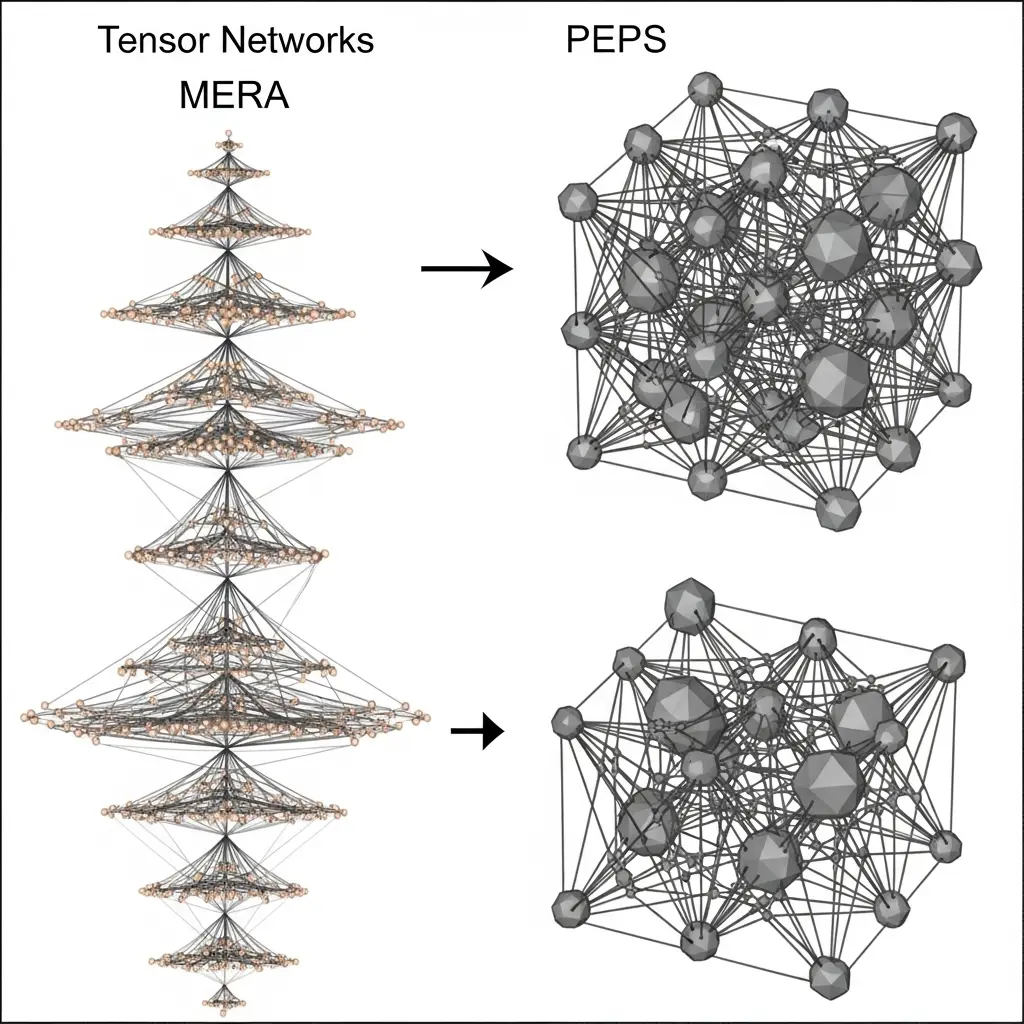
This research strongly advocates for the idea that spacetime is not a fundamental entity but emerges from the entanglement structure of an underlying quantum system. Holographic entanglement entropy plays a central role in connecting the quantum system to the emergent spacetime, allowing scientists to define geometric quantities and understand the properties of the emergent geometry. The team explores averaging over different possible conformal field theories to obtain a more robust and universal description of the emergent spacetime, relating this to concepts like wormholes and the multiverse. The research connects conformal field theory and emergent spacetime to the theory of random tensor networks, which approximate the wave functions of many-body quantum systems, and explores how these ideas apply to specific models of quantum gravity, such as JT gravity and 3D gravity.
The research demonstrates that 2D conformal field theory provides a natural setting for studying emergent spacetime, with the operator algebra of the conformal field theory related to the geometry of the seed spacetime. Holographic entanglement entropy is used as a geometric measure, allowing scientists to reconstruct spacetime from the entanglement structure of the conformal field theory. The Ryu-Takayanagi formula provides a concrete way to connect the quantum system to the emergent geometry. Averaging over different conformal field theories is motivated by the idea that the true quantum gravity theory may not be described by a single conformal field theory, but rather by an ensemble of them.
Wormholes are understood as a manifestation of entanglement between different conformal field theories, and the ensemble averaging can be interpreted as a multiverse. Random tensor networks are used to approximate the wave functions of many-body quantum systems, drawing a connection to the AdS/CFT correspondence. The geometry of the emergent spacetime is described by the structure of the random tensor network, and the research explores how these ideas can be generalized to 3D gravity, suggesting that quantum error correction may play a role in stabilizing the emergent spacetime. This paper is significant because it provides a compelling argument for the idea that spacetime is not fundamental, but rather an emergent phenomenon.
It connects ideas from conformal field theory, quantum information theory, and gravity in a novel and insightful way. This work could lead to a new understanding of quantum gravity, by providing a framework for constructing a theory that does not rely on the assumption that spacetime is fundamental. It supports the holographic principle, which states that the information contained in a volume of space can be encoded on its boundary, and provides a theoretical framework for understanding the multiverse and the existence of wormholes. The suggestion that quantum error correction may play a role in stabilizing spacetime is a novel and potentially important idea. In conclusion, this paper is a deep and ambitious exploration of the connections between quantum mechanics, gravity, and the emergence of spacetime, offering a fascinating glimpse into the cutting edge of theoretical physics.
Entanglement and Area Operators via Error Correction
Scientists have achieved a significant breakthrough in understanding the relationship between gravity and quantum information through detailed analysis of quantum error correcting codes and their application to holographic 2d conformal field theories. The research focuses on defining area operators, mathematical tools used to quantify the entanglement between different regions of spacetime, within the framework of boundary quantum field theories. The team defined an exact quantum error correcting code and demonstrated that, initially, the resulting area operator vanishes. However, after employing a process called coarse-graining, essentially averaging over microscopic details, a non-zero area operator emerges.
This coarse-grained operator approximates the actual entanglement entropy for a specific class of states that do not conform to a simple linear relationship, providing insights into semiclassicality conditions. The ambiguity inherent in defining this coarse-grained area operator aligns with the ambiguity found when defining fixed-area states, suggesting a deep connection between information theory and geometry. The study establishes a code subspace within a holographic conformal field theory, constructed from states derived from the infinite-temperature thermofield double state, including thermofield double states, time-evolved thermofield double states, and states prepared by Euclidean tubes. Analysis of this code reveals a central decomposition of entanglement entropy, expressed as the sum of contributions from different sectors, each weighted by a probability. Crucially, the information-theoretic area operator derived from this decomposition vanishes for the defined code subspace, demonstrating a specific property of the chosen code and its implications for understanding the emergence of spacetime geometry from quantum information.
Entanglement Entropy From Quantum Error Correction
This research establishes a connection between quantum error correction and the emergence of geometric areas in boundary theories, offering new insights into the holographic principle. Scientists demonstrated that, in certain scenarios lacking local degrees of freedom, area operators, which measure the size of boundaries, arise from a precise mathematical construction involving quantum error correcting codes. Initially, these calculations yield a vanishing area, but a non-zero area emerges after a process of coarse-graining, effectively smoothing out the description. Importantly, the expectation value of this coarse-grained area operator closely approximates the entanglement entropy for a specific class of states, those satisfying certain constraints related to semiclassicality.
This suggests a deep link between information content, geometric area, and the underlying quantum structure of spacetime. The research acknowledges an ambiguity inherent in defining the coarse-grained area operator, but demonstrates this ambiguity aligns with the challenges of defining fixed-area states, offering a potential resolution to a long-standing problem. The study builds upon assumptions regarding the density of primary states in conformal field theories, extending existing results to boundary theories. While the precise verification of these assumptions remains a challenge for future work, the scientists note that any corrections to these assumptions would only result in minor adjustments to their findings. Future research directions include further exploration of the relationship between the constraints on states and the emergence of classical geometry, potentially refining our understanding of how spacetime arises from quantum information.
🗞 Emergent Area Operators in the Boundary
🧠 ArXiv: https://arxiv.org/abs/2511.01382