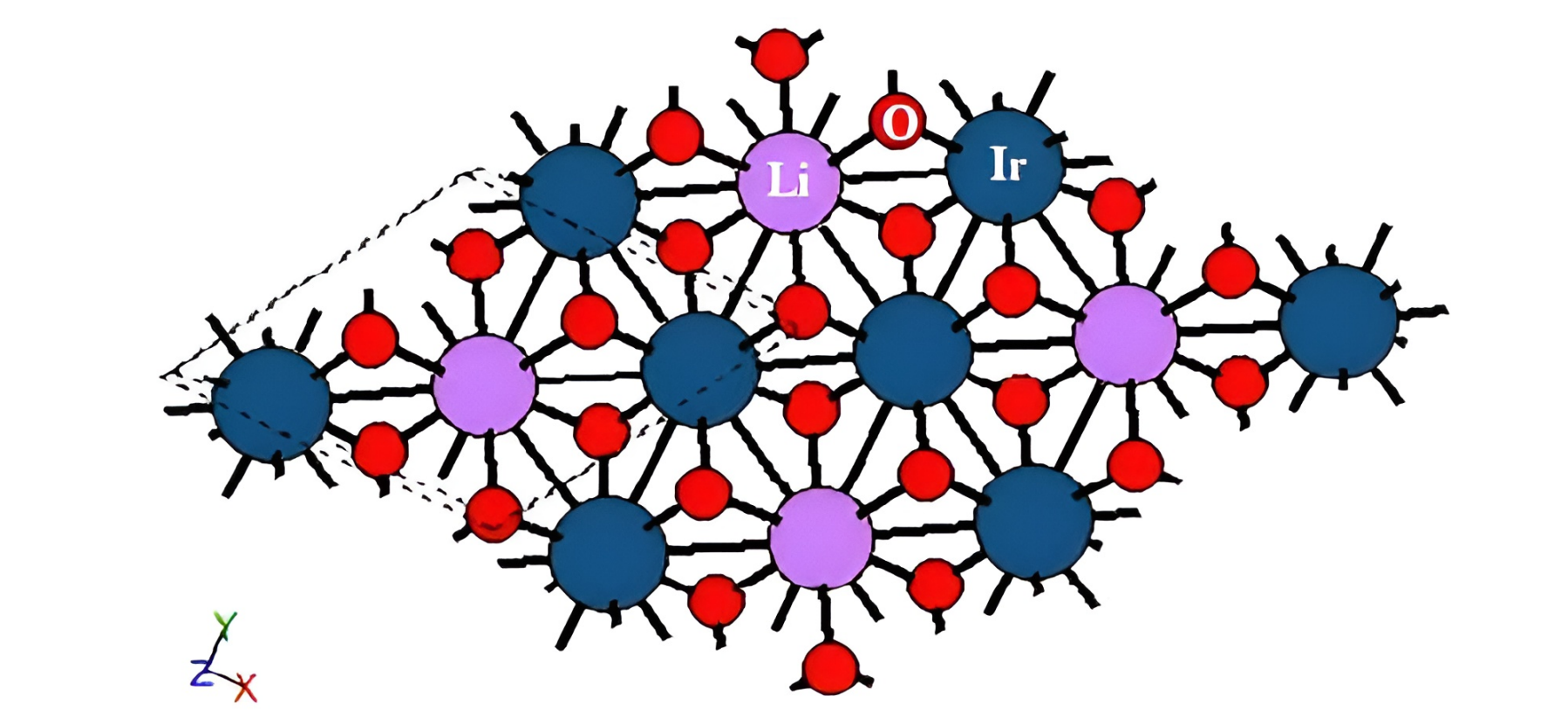
The search for materials hosting Majorana fermions, particles that are their own antiparticles, represents a significant frontier in quantum computing and materials science. Elnaz Rostampour and Badie Ghavami, both from the Department of Quantum Materials at Qlogy Lab Inc., investigate a promising new platform for realising these elusive particles within layered Kitaev materials. Their work demonstrates the potential for high-temperature superconductivity to support Majorana edge modes, leveraging the material’s strong spin-orbit coupling and unique honeycomb lattice structure, alongside its proximity to a spin liquid phase. By developing a theoretical and numerical framework, the researchers establish the existence of topological zero-energy states and identify spectral signatures that could pave the way for novel spintronic devices, magnetic field sensors, and topological memory applications.
Li2IrO3 as a Majorana Fermion Platform
Recent advances in materials science highlight the potential of Kitaev materials to host Majorana fermions, even without superconductivity. This research proposes lithium iridium oxide, Li2IrO3, as a promising platform for supporting Majorana edge modes, due to its strong spin-orbit coupling, honeycomb lattice structure, and proximity to a quantum spin liquid phase. The team developed a theoretical and numerical framework to investigate the emergence of these modes and their potential for topological quantum computation, establishing Li2IrO3 as a viable candidate for realising robust Majorana fermions and paving the way for advancements in fault-tolerant quantum technologies.
Kitaev-Heisenberg Model of Lithium Iridium Oxide
This work investigates the potential of lithium iridium oxide, Li₂IrO₃, to host Majorana fermions by developing a comprehensive theoretical and numerical framework based on the Kitaev-Heisenberg Hamiltonian. Researchers constructed a model to describe the magnetic interactions within Li₂IrO₃, a material exhibiting strong spin-orbit coupling and a honeycomb lattice structure. The Hamiltonian incorporates parameters representing the strengths of Heisenberg exchange, Kitaev interaction, and second-neighbor Heisenberg terms, accurately reflecting the material’s behaviour. This approach allows for detailed mapping of conditions favoring the separation of electrons and the stabilization of topologically non-trivial excitations.
To probe the Majorana sector, scientists combined analytical techniques with numerical calculations on finite-size honeycomb clusters, directly examining the emergence of these exotic particles. The study further extends this analysis by considering the material’s response to external stimuli, mathematically defined as a function of frequency and wave vector. The research team employed a mathematical formalism to model electron behaviour and systematically account for electron-electron interactions through a correction term, incorporating frequencies to describe the system’s behaviour at low temperatures. Calculations involve specific wave vectors, derived through rotations, to accurately capture the material’s complex electronic structure and interactions. By meticulously modelling these interactions, the study demonstrates how an insulating, spin-orbit coupled magnet can emulate the essential features of topological superconductors, expanding the search for materials suitable for fault-tolerant quantum computation.
Majorana Zero Modes in Lithium Iridate
Researchers have developed a theoretical and numerical framework based on the Kitaev-Heisenberg Hamiltonian to model the spin interactions within Li2IrO3, demonstrating the existence of topological zero-energy states and identifying their signatures in edge-localized spectral weight. This work investigates the emergence of Majorana zero modes in Li2IrO3, focusing exclusively on magnetic interactions to understand how a purely insulating material can emulate key features of topological superconductors. The team systematically varied the relative strengths of the Kitaev and Heisenberg terms within the Hamiltonian, mapping out conditions that favor the separation of electrons and stabilize topologically non-trivial excitations. Combining analytical techniques with numerical calculations on finite-size honeycomb clusters, they directly probed the Majorana sector of the theory, providing a microscopic understanding of how a material without superconductivity can potentially support Majorana fermions.
To model the electronic properties of Li2IrO3, researchers employed a mathematical formalism, incorporating electron-electron interactions through a correction term. The material’s response to external stimuli was calculated as a function of frequency and wave vector, revealing crucial insights into its behaviour. The team defined the probability of occupying energy states by fermions in thermal equilibrium, and utilized frequencies to analyze the material’s behaviour at low temperatures.
Lithium Iridium Oxide Hosts Majorana Fermions
This research demonstrates the potential of lithium iridium oxide to host Majorana fermions, particles with unique quantum properties. Through a combination of theoretical modelling and numerical computation based on the Kitaev-Heisenberg Hamiltonian, scientists have identified topological zero-energy states within the material, evidenced by sharp peaks in the calculated spectral functions at the material’s edges. These findings suggest a pathway towards creating devices leveraging Majorana fermions for applications in spintronics, magnetic field sensing, and topological memory. The study establishes a strong link between the material’s honeycomb lattice structure, strong spin-orbit coupling, and proximity to a spin liquid phase as key factors enabling the emergence of these topological states. Researchers investigated the material’s thermal stability and robustness against disorder, further supporting its viability for practical applications.
🗞 High-temperature superconducting Majorana fermions platforms in the layered Kitaev Materials: Case study of
🧠 ArXiv: https://arxiv.org/abs/2511.01551