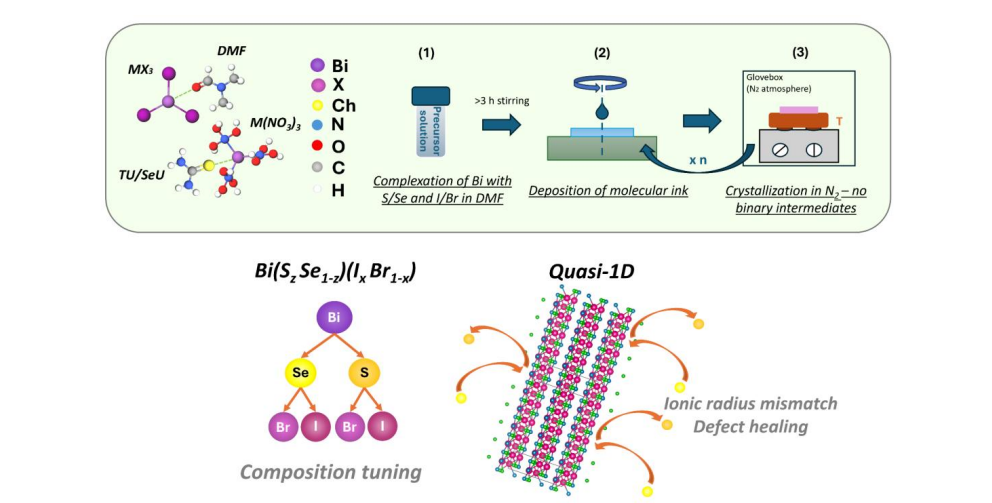
Quasi-one-dimensional van der Waals chalcohalides represent promising materials for advanced energy technologies, offering tunable optoelectronic properties and utilising earth-abundant, non-toxic elements. However, challenges in controlling crystal growth, composition, and optoelectronic properties have limited their widespread adoption. Now, David Rovira, Ivan Caño, Cibran Lopez, and colleagues, from institutions including Universitat Politècnica de Catalunya and the University of Lisbon, present a new low-temperature synthesis route based on molecular ink deposition. This innovative approach enables the direct crystallization of tunable Bi(SzSe1-z)(IxBr1-x) solid solutions, bypassing the need for traditional binary precursors and yielding phase-pure films with precise control over morphology, composition, and crystal orientation. The team’s work, confirmed by detailed analysis and computational modelling, demonstrates the distinct roles of halogen and chalcogen anions in tuning the materials’ bandgap energy and carrier type, paving the way for defect engineering and scalable integration into next-generation energy applications such as photovoltaics, photocatalysis, thermoelectrics, and chemical sensing.
Bi-chalcohalide inks for photovoltaics
Scientists are developing new materials for solar energy applications, focusing on bismuth-chalcohalide solid solutions. This research centers on controlling the composition and structure of these materials to enhance their ability to absorb light and generate electricity. The team employs a molecular ink approach, carefully investigating how precursor ratios, substrate materials, and processing conditions affect the resulting film properties. They utilize a comprehensive range of characterization techniques to understand the material’s structure, composition, and optical and electronic behaviour.
Precise control over the starting materials is crucial for achieving the desired properties in these materials. Researchers demonstrate that different substrate materials significantly impact the texture and compactness of the deposited films, with zinc sulfide proving particularly effective for creating well-defined structures. The amount of bismuth nitrate in the precursor solution also influences the material’s ability to absorb light. Detailed structural analysis confirms the crystal structure and phase purity of the synthesized compounds, while compositional analysis reveals the distribution of elements within the films.
The research team also investigates how the materials interact with light, measuring their ability to absorb and emit photons. These measurements, combined with Raman spectroscopy, provide insights into the material’s vibrational modes and bonding characteristics. They account for the porosity of the films during analysis, using a multilayer model to accurately interpret data. The findings demonstrate that deviations from expected behaviour suggest complex interactions between the different elements within the material. This detailed understanding of material properties is essential for optimizing performance in photovoltaic devices.
This work delivers a foundational framework for controlling the composition and structure of bismuth-chalcohalide materials. The meticulous characterization and analysis demonstrate a deep understanding of the material’s properties and the factors that influence its performance. This research has important implications for the development of new materials for solar energy conversion and other advanced energy applications.
Tunable Chalcohalide Synthesis via Molecular Ink Deposition
Scientists have developed a novel low-temperature synthesis route for creating quasi-one-dimensional van der Waals chalcohalides, materials promising for advanced energy applications. This approach bypasses the need for traditional binary chalcogenide precursors, enabling direct crystallization of tunable bismuth-based solid solutions, specifically Bi(SzSe1-z)(IxBr1-x). The team engineered precursor inks dissolved in a solvent, which were then deposited via spin-coating, followed by thermal annealing to drive crystallization of the desired ternary phase. This method yields phase-pure films with precise control over morphology, composition, and crystallographic orientation, a critical advancement for material functionality.
The study pioneered the synthesis of a complete family of bismuth-chalcohalide compounds, including BiSI, BiSBr, BiSeI, and BiSeBr, alongside their corresponding solid solutions, all from a single solvent system. Researchers meticulously controlled stoichiometry and optoelectronic properties through careful manipulation of the ink composition and annealing parameters. Detailed X-ray diffraction analysis confirms the formation of an orthorhombic structure with a specific space group for all synthesized compounds. Quantitative analysis validates the phase purity and structural integrity of the materials.
To further understand the relationship between composition and structure, the team analyzed shifts in diffraction patterns during solid solution formation. Substituting selenium for sulphur results in expansion of the unit cell, while replacing iodine with bromine causes contraction. Density Functional Theory calculations complement these experimental findings, providing insights into the optoelectronic and structural properties of the solid solutions and supporting the observed trends. This combination of tunable material chemistry and scalable processing positions these chalcohalide semiconductors as promising candidates for diverse applications, including photovoltaics, photocatalysis, thermoelectrics, and chemical sensing.
Tunable Bismuth Chalcohalides via Low-Temperature Synthesis
Scientists have achieved a breakthrough in the synthesis of bismuth-based chalcohalide materials, demonstrating a novel low-temperature process for creating tunable solid solutions without requiring binary chalcogenide precursors. The team developed a molecular ink deposition technique, enabling direct crystallization of materials like BiSI, BiSBr, BiSeI, and BiSeBr, alongside their corresponding solid solutions, all from the same solvent system. This delivers precise control over morphology, composition, and crystallographic orientation, opening new avenues for advanced energy applications. Detailed X-ray diffraction analysis confirms the formation of phase-pure, homogeneous solid solutions with an orthorhombic structure and a specific space group.
Quantitative analysis validates excellent compositional control, demonstrating the viability of this direct synthesis method. Researchers observed shifts in diffraction patterns, illustrating the gradual substitution of sulphur with selenium and confirming changes in the material’s lattice structure. Specifically, substituting sulphur with selenium in BiSBr results in expansion of the material’s atomic arrangement. Optoelectronic measurements reveal the distinct roles of halogen and chalcogen anions in tuning bandgap energy and carrier type, highlighting the potential for band structure engineering.
Density Functional Theory calculations complement these experimental findings, providing a comprehensive understanding of the structural and optoelectronic properties. This combination of tunable material chemistry and scalable processing positions chalcohalide semiconductors as promising candidates for a wide range of applications, including photovoltaics, photocatalysis, thermoelectrics, and chemical sensing. The breakthrough delivers a foundational framework for defect engineering and the scalable integration of these materials into next-generation energy systems.
Tunable Chalcohalide Films via Molecular Ink
This research demonstrates a new method for creating high-quality, tunable chalcohalide semiconductors, materials with promising applications in energy technologies. Scientists have developed a low-temperature synthesis technique using molecular ink deposition to directly crystallize solid solutions of bismuth-based compounds, systematically varying their composition. The resulting films exhibit precise control over their structure, including morphology and crystallographic orientation, without requiring complex precursor materials. Detailed analysis confirms the formation of homogeneous solid solutions where different chalcogen and halogen anions are incorporated into the material’s structure.
Importantly, the research reveals how manipulating the composition of these materials allows for precise tuning of their optoelectronic properties, specifically the bandgap energy and carrier type. The team observed that substituting selenium for sulphur shifts the conduction band downwards, offering a pathway to tailor the material’s behaviour for specific applications. The synthesis technique also proves versatile, enabling the creation of both compact films and rod-shaped microcrystals, broadening the potential uses of these materials in photovoltaics, photocatalysis, thermoelectrics, and chemical sensing. Future work will likely focus on refining the synthesis process to eliminate minor impurity phases and further optimise material purity. The team suggests that continued exploration of compositional variations and structural control will unlock even greater potential for these chalcohalide semiconductors in advanced energy technologies.
🗞 Molecular ink-based synthesis of Bi(SzSe1-z)(IxBr1-x) solid solutions as tuneable materials for sustainable energy applications
🧠 ArXiv: https://arxiv.org/abs/2510.27546


See today’s quantum computing news on Quantum Zeitgeist for the latest breakthroughs in qubits, hardware, algorithms, and industry deals.