Entanglement entropy, a fundamental concept in quantum mechanics, presents a significant challenge when applied to gravity, particularly in understanding the microscopic origins of black hole entropy. Muxin Han from Florida Atlantic University and colleagues now demonstrate a calculation of entanglement entropy within the framework of Lorentzian spinfoam gravity, a promising approach to quantum gravity. The team computes this entropy for a spatial region using states generated by a spinfoam path integral, revealing a geometric area law where the area is determined by the fundamental area spectrum of loop quantum gravity. Crucially, this work reproduces the well-known Bekenstein-Hawking formula for black hole entropy without relying on complex mathematical techniques, offering a direct Lorentzian path integral approach to understanding gravitational entropy and its quantum origins.
Spinfoam Gravity and Entanglement Entropy Connection
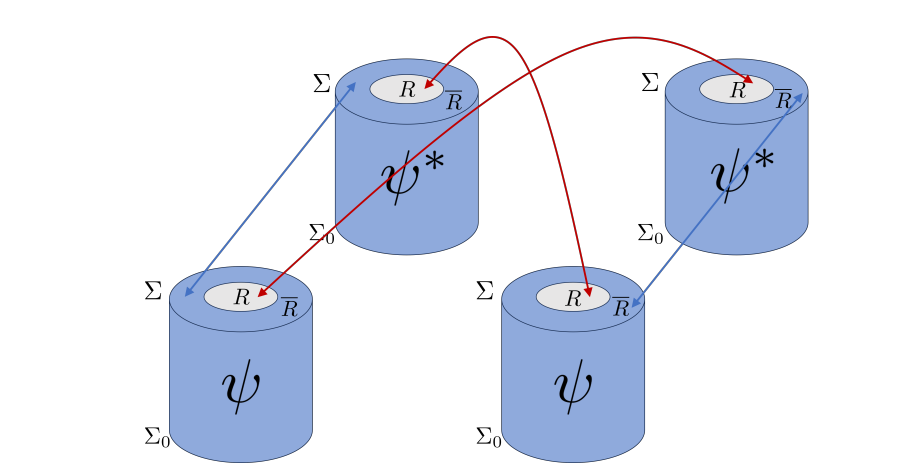
This research investigates entanglement entropy within Loop Quantum Gravity, a theory aiming to reconcile quantum mechanics with general relativity. Scientists calculate the entanglement entropy for a specific region of space using states dynamically generated by the theory, establishing a connection between the spinfoam path integral formulation of gravity and the geometrical area law for entanglement entropy, a key feature observed in many condensed matter systems and crucial for understanding the relationship between gravity and quantum information.
The research employs a spinfoam path integral, a method that sums over all possible configurations of spacetime geometry. This calculation reveals an area law for entropy, meaning the entropy is proportional to the area of the surface separating the region of interest from the rest of the system. The area is determined by the fundamental area spectrum predicted by Loop Quantum Gravity, and the leading coefficient in this law is positive and independent of the specific configurations used. By linking a parameter within the calculation to the Barbero-Immirzi parameter, a key constant in Loop Quantum Gravity, the team reproduces the Bekenstein-Hawking formula, a cornerstone of black hole thermodynamics, for a specific range of parameter values, providing a novel approach to calculating gravitational entropy.
Entanglement Entropy in Loop Quantum Gravity
This research focuses on calculating entanglement entropy within Loop Quantum Gravity, a background-independent approach to quantizing gravity. The central goal is to develop a consistent framework for calculating entanglement entropy and connecting it to holographic principles, which suggest that gravity emerges from quantum information. The work centers on the spinfoam formalism, a path integral approach where spacetime is represented as a network of interconnected surfaces.
A key challenge lies in the complexity of these calculations, prompting the exploration of methods to simplify them, such as localization and summation techniques. Scientists are developing an effective dynamics for spinfoams, a lower-energy approximation of the full theory, to make calculations more manageable and gain insights into the behavior of spacetime at larger scales. The research explores how this formalism can derive holographic formulas for entanglement entropy, relating the entropy calculated within spacetime to the area of a surface on its boundary. The investigation also delves into the role of complex critical points in the spinfoam amplitude, potentially revealing insights into the effective dynamics of spacetime and the emergence of classical gravity.
Entanglement Entropy and Black Hole Thermodynamics
This research demonstrates a calculation of entanglement entropy within the framework of Loop Quantum Gravity, using a path integral approach. Scientists computed the entanglement entropy for a spatial region by summing over configurations of spacetime, revealing a geometric area law where the entropy is proportional to the area of the boundary separating the region from the rest of the system. Importantly, the leading coefficient in this area law is independent of the specific configurations used, suggesting a robust result grounded in the underlying theory.
By linking a parameter within the calculation to the Barbero-Immirzi parameter, the team successfully reproduced the Bekenstein-Hawking formula, a cornerstone of black hole thermodynamics, for a specific range of parameter values. This achievement provides a novel, Lorentzian path integral derivation of gravitational entropy, bypassing the need for complex mathematical techniques often found in other approaches. The researchers acknowledge that their calculations rely on certain approximations and coarse-graining schemes, and that further investigation is needed to fully understand the implications of these choices.
🗞 Lorentzian spinfoam gravity path integral and geometrical area-law entanglement entropy
🧠 ArXiv: https://arxiv.org/abs/2510.26925


See today’s quantum computing news on Quantum Zeitgeist for the latest breakthroughs in qubits, hardware, algorithms, and industry deals.