The pursuit of stable excited states in atoms drives advances in quantum technologies, and researchers are continually seeking ways to extend the lifetime of these states. Einius Pultinevicius, Aaron Götzelmann, and Fabian Thielemann, all from Universität Stuttgart, alongside Christian Hölzl and Florian Meinert, report a significant leap forward in this field, demonstrating exceptionally long-lived circular Rydberg atoms at room temperature. These atoms, characterised by their maximum electron orbital momentum, exhibit lifetimes exceeding 10 milliseconds, over one hundred times longer than previously established low angular momentum states. The team achieves this remarkable stability by suppressing blackbody radiation, and importantly, demonstrates coherent control of these atoms at high excitation levels, opening new possibilities for quantum information processing and precision sensing through the combination of extended lifetimes and strong interactions between atoms.
Excited electronic orbitals decay due to selection rules, a phenomenon particularly striking in highly excited Rydberg states. Low angular momentum Rydberg states are central to recent advances in quantum computing, simulation and sensing with neutral atoms. For these applications, the lifetime of the Rydberg levels fundamentally limits gate fidelities, coherence times, or spectroscopic precision. Consequently, scientists have pursued methods to extend these lifetimes, leading to the generation, coherent control and trapping of circular Rydberg atoms, which possess the maximally allowed electron orbital momentum and were instrumental in Nobel prize-winning experiments.
Strontium Rydberg State Lifetime Measurements
Scientists meticulously measured the lifetimes of circular Rydberg states in strontium-88 atoms, highly excited electronic states with specific angular momentum properties. The experiment investigated how the surrounding electrode structure influences these lifetimes, a critical factor in controlling their stability. A key challenge lies in the fact that these states don’t simply decay back to other circular Rydberg states; they also transition into elliptical states with different angular momentum. Researchers employed a rate equation model to describe the decay of the circular Rydberg states, accounting for all possible decay pathways and their corresponding rates. Numerical simulations validated this model, ensuring accurate lifetime extraction even with population in elliptical states. Detailed analysis revealed how the electrode structure modifies the spontaneous emission rate of the Rydberg atom, quantified by the Purcell factor, demonstrating the importance of considering elliptical states in the analysis.
Circular Rydberg Atoms Sustained Over Milliseconds
Scientists have achieved a significant breakthrough in controlling and sustaining the lifetime of circular Rydberg atoms, demonstrating lifetimes exceeding 10 milliseconds. This represents a two-orders-of-magnitude improvement over established lifetimes of low angular momentum orbitals, opening new avenues for quantum technologies. The team successfully trapped individual strontium atoms in circular Rydberg states, characterized by maximal angular momentum, and maintained these states for significantly extended periods at room temperature. The research focused on suppressing blackbody radiation, a primary cause of Rydberg state decay.
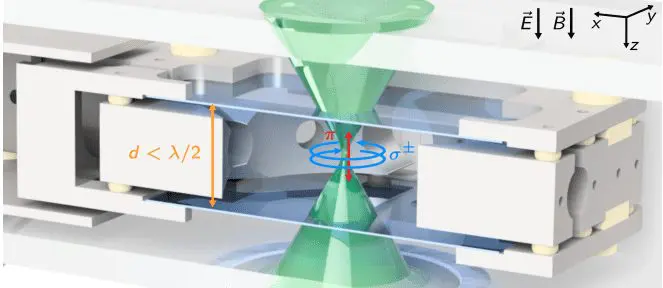
Instead of relying on cryogenic cooling, scientists employed a novel approach using a specially designed capacitor structure. This capacitor, consisting of highly reflective indium-tin oxide coated glass plates, modifies the microwave mode density around the atom, effectively suppressing blackbody radiation and creating conditions akin to a 14 Kelvin environment. This innovative technique allows for sustained Rydberg states at room temperature, simplifying experimental setups and broadening potential applications. Experiments revealed coherent control of individual circular Rydberg levels up to a principal quantum number of 103, corresponding to an orbital diameter of 1.
1 micrometers, enabled by a sequence of up to 12 adiabatic state preparation pulses. Measurements demonstrate adiabatic transfer between states, confirming the effectiveness of the pulse sequence and the enhanced lifetime of the high-n circular Rydberg atoms. The results demonstrate a thousand-fold stronger van der Waals blockade and more than ten times larger dipole-exchange coupling compared to previous experiments, forming the basis for dissipationless quantum simulation on timescales two orders of magnitude longer than currently possible, and benefiting erasure conversion schemes and mitigating anomalous dephasing in atom arrays.
Long Lived Circular Rydberg Atom Control
Researchers have demonstrated exceptionally long lifetimes, exceeding 10 milliseconds, in individually trapped circular Rydberg atoms, representing an improvement of two orders of magnitude over established low angular momentum orbitals. This achievement stems from the suppression of blackbody radiation, effectively extending the duration these excited states remain stable. The team not only observed these extended lifetimes but also coherently controlled individual circular Rydberg levels at previously inaccessible principal quantum numbers, maintaining tweezer trapping for several hundred milliseconds. These findings unlock new possibilities for quantum technologies, specifically quantum information processing and sensing, by combining extreme state lifetimes with the strong interactions inherent in Rydberg atom systems. Through detailed modeling of the decay dynamics, the researchers validated their experimental data analysis, demonstrating that their simplified rate model accurately extracts lifetimes even when decay into non-circular states occurs. The analysis revealed deviations of less than 16% between calculated and fitted lifetimes across a range of principal quantum numbers.
🗞 Long-lived giant circular Rydberg atoms at room temperature
🧠 ArXiv: https://arxiv.org/abs/2510.27471


See today’s quantum computing news on Quantum Zeitgeist for the latest breakthroughs in qubits, hardware, algorithms, and industry deals.