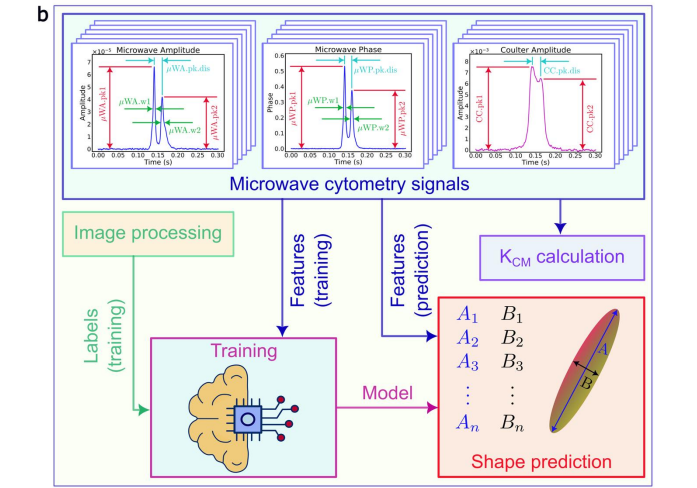
Microplastics represent a growing global environmental threat, yet current methods for identifying and characterizing these particles often prove costly and slow. Sayedus Salehin, Syed Shaheer Uddin Ahmed, and Uzay Tefek, alongside colleagues at Bilkent University and the University of Bremen, now present a significant advance in microplastic detection by combining microwave cytometry with machine learning. Their innovative system overcomes the limitations of existing sensors, which typically assume particles are spherical, by electronically determining particle geometry without relying on optical input. The team trained a machine learning model to decode complex microwave signals, allowing them to accurately extract particle dimensions and even estimate material properties, paving the way for portable, high-throughput devices capable of morphology-aware microplastic analysis.
Laboratory (INL), 4715-330, Braga, Portugal. Microplastics increasingly pose a global environmental health threat, yet their detection and characterisation remain challenging due to the cost, size, and throughput limitations of current analytical tools. Researchers are developing portable, nanotechnology-based sensors to address this need, but many rely on the assumption of spherical particle geometry, limiting their effectiveness for environmental analysis. This research overcomes this limitation by advancing microwave cytometry with machine learning-enabled shape recognition. Microwave cytometry is a flow-through electronic platform that integrates microwa.
Microfluidic Imaging and Machine Learning Analysis
This research focuses on characterizing and analysing microplastic particles using a combination of microfluidics, image analysis, and machine learning. The goal is to develop a robust and automated method for identifying, measuring, and classifying these particles based on their shape and behaviour in fluid flow, which is crucial for environmental monitoring and understanding the fate of microplastics. The team designed a custom microfluidic device to flow particles through a narrow channel, allowing for controlled observation and high-resolution microscopy to capture images and videos. These videos are then processed using techniques like background subtraction and edge detection to isolate and identify individual particles, tracking their movement and extracting key features including shape, orientation, velocity, and trajectory.
A random forest model uses these features to classify particles, and statistical analysis validates the model’s performance. The team incorporated theoretical models of particle motion in fluids, including ellipsoidal particle dynamics and Poiseuille flow, to predict particle behaviour and compare it to experimental observations. Software tools like OpenCV, NumPy, and Scikit-learn facilitate image processing, data analysis, and machine learning.
Ellipsoidal Microplastic Shape Detected by Microwave Cytometry
This work presents a breakthrough in microplastic detection by overcoming limitations imposed by traditional methods that assume spherical particle geometry. Scientists achieved accurate determination of particle shape using microwave cytometry combined with machine learning, enabling electronic-only assessment of microplastic morphology. The team trained a random forest model to decode complex microwave signals, successfully extracting the major and minor axes of ellipsoidal microparticles with an average relative error of less than 8%. Experiments revealed a significant shift in the Clausius-Mossotti (KCM) factor for ellipsoidal microplastics compared to spherical particles, with mean KCM values for ellipsoids ranging in eccentricity from 0.
55 to 0. 99 shifted downwards by 11% relative to spherical microplastics. Monte Carlo simulations corroborated these findings, demonstrating a 7. 6% coefficient of variation for KCM in ellipsoidal particles and validating the strong influence of eccentricity and orientation on the KCM factor. Detailed analysis demonstrated that the deviation in KCM from spherical values increases with increasing eccentricity, with simulations showing KCM deviations of 16.
35% at 0 degrees and 13. 21% at 22. 5 degrees relative to spherical particles. These results confirm that particle shape significantly impacts dielectric signatures, and that accurate shape determination is crucial for reliable microplastic detection. The team’s approach establishes a pathway toward portable, high-throughput, morphology-aware detection of microplastics, offering a substantial advancement in environmental monitoring capabilities.
Microplastic Shape and Permittivity via Cytometry
This research demonstrates a new approach to detecting and characterizing microplastics, overcoming limitations inherent in existing methods that assume spherical particle shapes. Scientists developed a microwave cytometry system, coupled with machine learning, to determine both the size and shape of individual microplastic particles as they flow through a microfluidic channel. By training a model on microscopy-derived shape data, the system accurately predicts the major and minor axes of ellipsoidal particles, enabling the calculation of their dielectric permittivity without relying on optical input. This achievement establishes a pathway towards portable, high-throughput microplastic detection that accounts for particle morphology, a significant advancement for environmental monitoring. The team acknowledges that several factors can influence the accuracy of shape measurements, including particle rotation within the sensing region, limitations in electronic sensing, and potential inaccuracies in the training data, and notes that the complex motion of non-spherical particles contributes to variations in experimental results. Future work could focus on refining the model to account for these complexities and further reduce uncertainty in shape prediction, ultimately improving the reliability and precision of microplastic analysis.
🗞 Microwave Cytometry with Machine Learning for Shape-Resolved Microplastic Detection
🧠 ArXiv: https://arxiv.org/abs/2510.26377