Hybrid excitations known as Bernstein modes offer a pathway to explore the non-local behaviour of electrons in two-dimensional materials, but achieving strong nonlinear responses has proven difficult, until now. I. Yahniuk, I. A. Dmitriev, A. L. Shilov, and colleagues demonstrate a clear observation of these nonlinear Bernstein modes in graphene, utilising terahertz excitation and strategically embedded metallic contacts to amplify the signal. The team’s experiments reveal that the observed resonances saturate at significantly lower radiation intensities than conventional cyclotron resonance, indicating strong local heating of the electron gas driven by high-amplitude magnetoplasmons. These findings establish graphene as a promising platform for nonlinear magnetoplasmonics, potentially enabling new approaches to manipulating electron behaviour and creating solid-state systems that mimic the complex interactions found in cavity quantum electrodynamics.
Researchers investigate the interplay between Bernstein modes and plasmons in graphene, exploring how these interactions influence magnetoabsorption in the near field. The study focuses on understanding how graphene responds to terahertz radiation in the presence of a magnetic field, revealing enhanced absorption due to the excitation of both Bernstein modes and plasmons. Specifically, the team demonstrates that the strong nonlinearity of Bernstein modes efficiently excites plasmons, resulting in a significant enhancement of near-field magnetoabsorption, particularly at frequencies corresponding to the Bernstein mode resonances, indicating a strong coupling between these collective excitations and the incident terahertz radiation. The findings provide new insights into the fundamental physics of collective excitations in two-dimensional materials and open up possibilities for developing novel terahertz optoelectronic devices based on graphene.
Bernstein modes, hybrid magnetoplasmon excitations arising from the coupling between cyclotron motion and collective oscillations in two-dimensional electron systems, offer direct access to non-local electrodynamics and can exhibit rich nonlinear behaviour akin to strong-coupling phenomena.
Terahertz Spectroscopy Reveals Graphene Carrier Dynamics
This research details experimental results related to cyclotron resonance and ballometric magnetotransport in graphene, using terahertz radiation. The experiments are sensitive to the type of charge carrier, either electrons or holes, while ballometric magnetotransport is insensitive to carrier type. The study examines polarization and carrier density dependence, observing how graphene’s response changes with these parameters. Key findings are presented through detailed analysis of experimental data, including plots of longitudinal resistance and carrier mobility as a function of carrier density, establishing the range of carrier densities used in the experiments.
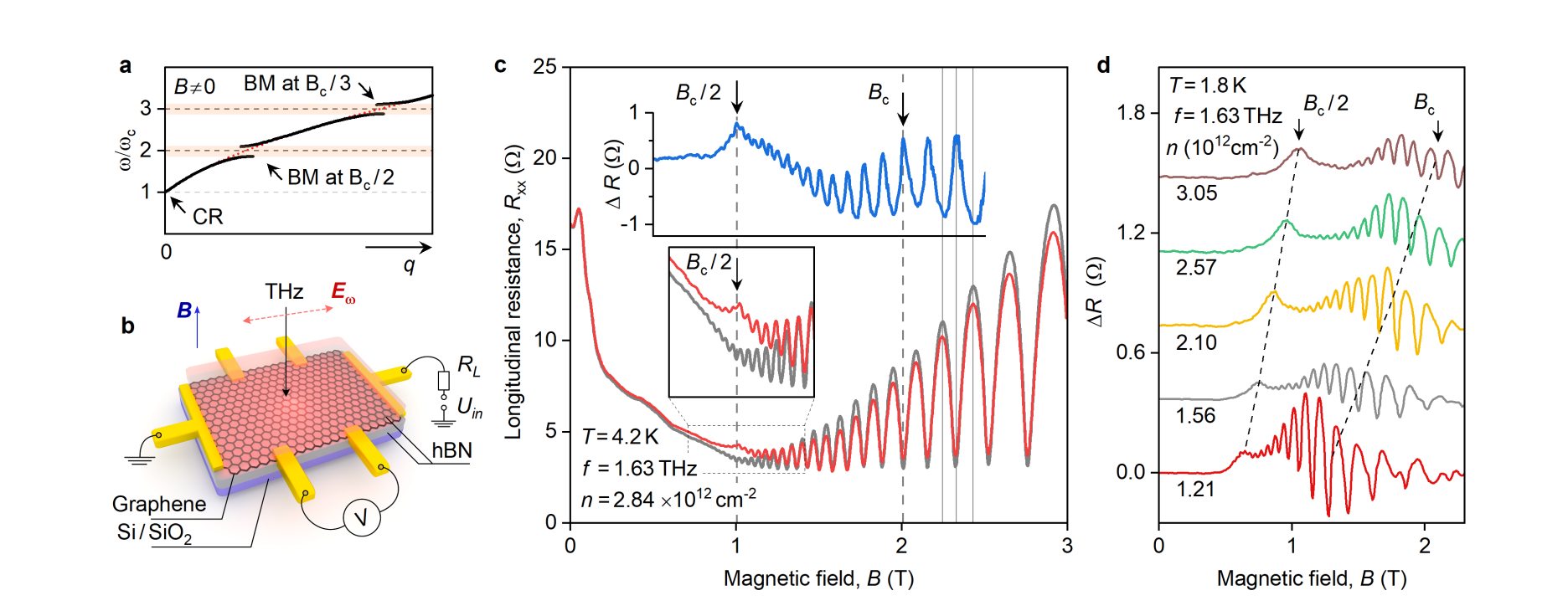
Crucially, the team observed peaks in photoresistance, corresponding to cyclotron resonance and ballometric magnetotransport resonances, which shift with carrier density and frequency. Further analysis reveals that ballometric magnetotransport resonances shift with frequency, demonstrating a clear relationship between resonance position, carrier density, and frequency. Zoomed-in plots of photoresistance around the ballometric magnetotransport resonances demonstrate the intensity dependence of the resonances, aligning with theoretical models.
Polarization-resolved measurements compare photoresistance for right-circularly and left-circularly polarized terahertz radiation, showing that cyclotron resonance is sensitive to polarization, while ballometric magnetotransport is not. Experiments with linearly polarized terahertz radiation, varying the orientation of the electric field, reveal that the magnitude of the ballometric magnetotransport resonance changes with the angle, following a cosine squared dependence, attributed to the antenna effect, where linear polarization enhances radiation absorption. These results confirm the existence of both cyclotron resonance and ballometric magnetotransport in graphene, with the polarization dependence of the resonances providing crucial information about the underlying physics.
Observed shifts in resonance positions with frequency and carrier density allow for the determination of key material parameters, and the linear polarization experiments reveal the importance of the antenna effect in enhancing terahertz radiation absorption in graphene. In essence, this research provides a detailed characterization of the interaction between terahertz radiation and graphene carriers, offering insights into the fundamental physics of this material and its potential for applications in terahertz devices.
Graphene Magnetoplasmons Enable Strong Nonlinear Effects
Researchers have demonstrated strong nonlinear effects associated with the excitation of Bernstein magnetoplasmons in graphene, revealing a new pathway for exploring nonlinear electrodynamics in two-dimensional materials. The team observed resonant excitation of these magnetoplasmons using terahertz radiation, achieving saturation intensities significantly lower than those observed in cyclotron resonance due to localized electron heating. This localized heating arises from a combination of near-field effects and plasmonic amplification, overcoming limitations imposed by wave-vector mismatch and enabling the generation of short-wavelength magnetoplasmons.
Polarization-resolved measurements confirmed the near-field origin of the observed resonances, demonstrating insensitivity to circular helicity and strong dependence on linear polarization angle, a clear distinction from cyclotron resonance behaviour. The findings establish graphene as a promising platform for investigating nonlinear magnetoplasmonics and potentially realizing solid-state analogues of cavity quantum electrodynamics, opening opportunities for manipulating collective electron dynamics and exploring out-of-equilibrium electron transport.
🗞 Strongly nonlinear Bernstein modes in graphene reveal plasmon-enhanced near-field magnetoabsorption
🧠 ArXiv: https://arxiv.org/abs/2510.25443




See today’s quantum computing news on Quantum Zeitgeist for the latest breakthroughs in qubits, hardware, algorithms, and industry deals.