Quantum computers utilising qudits, quantum systems with more than two levels, promise enhanced computational power, but realising this potential requires carefully translating complex operations into the specific actions a physical qudit can perform. Denis A. Drozhzhin, Evgeniy O. Kiktenko, Aleksey K. Fedorov, and colleagues at National University of Science and Technology “MISIS” address a critical challenge in this process, namely decomposing arbitrary qudit operations into a sequence of simpler pulses that respect the natural limitations of how energy levels interact within the qudit. Their research introduces a new algorithm that efficiently achieves this decomposition, ensuring the number of required pulses remains minimal, at most four for any single-qudit operation, and significantly reducing both computational time and the potential for errors. By comparing decompositions across various trapped ion systems and different qudit levels, the team demonstrates a substantial advancement in resource-efficient quantum control, paving the way for more practical and scalable qudit-based quantum computers.
Qudit Circuit Decomposition Methods Compared
This work presents a comprehensive evaluation of methods for decomposing a unitary transformation into a quantum circuit suitable for qudit-based quantum computers. Researchers investigated several approaches, including QSearch and QSweep, and decomposition techniques leveraging the MQT, specifically LocQRPass and LocAdaPass. The team implemented these methods and tested their performance using code relying on libraries such as BQSKit, MQT, NetworkX, and NumPy, utilizing a fake backend for testing without requiring access to actual quantum hardware. The results, presented in a comparative analysis, focused on execution time as a primary metric. However, the study highlights the importance of considering additional factors beyond execution time, such as the transition graph, which defines allowed transitions between qudit levels and influences decomposition complexity. Researchers recommend measuring accuracy using metrics like fidelity, gate count, and circuit depth, and benchmarking methods on a variety of unitary matrices.
Optimal Pulse Sequences for Qudit Control
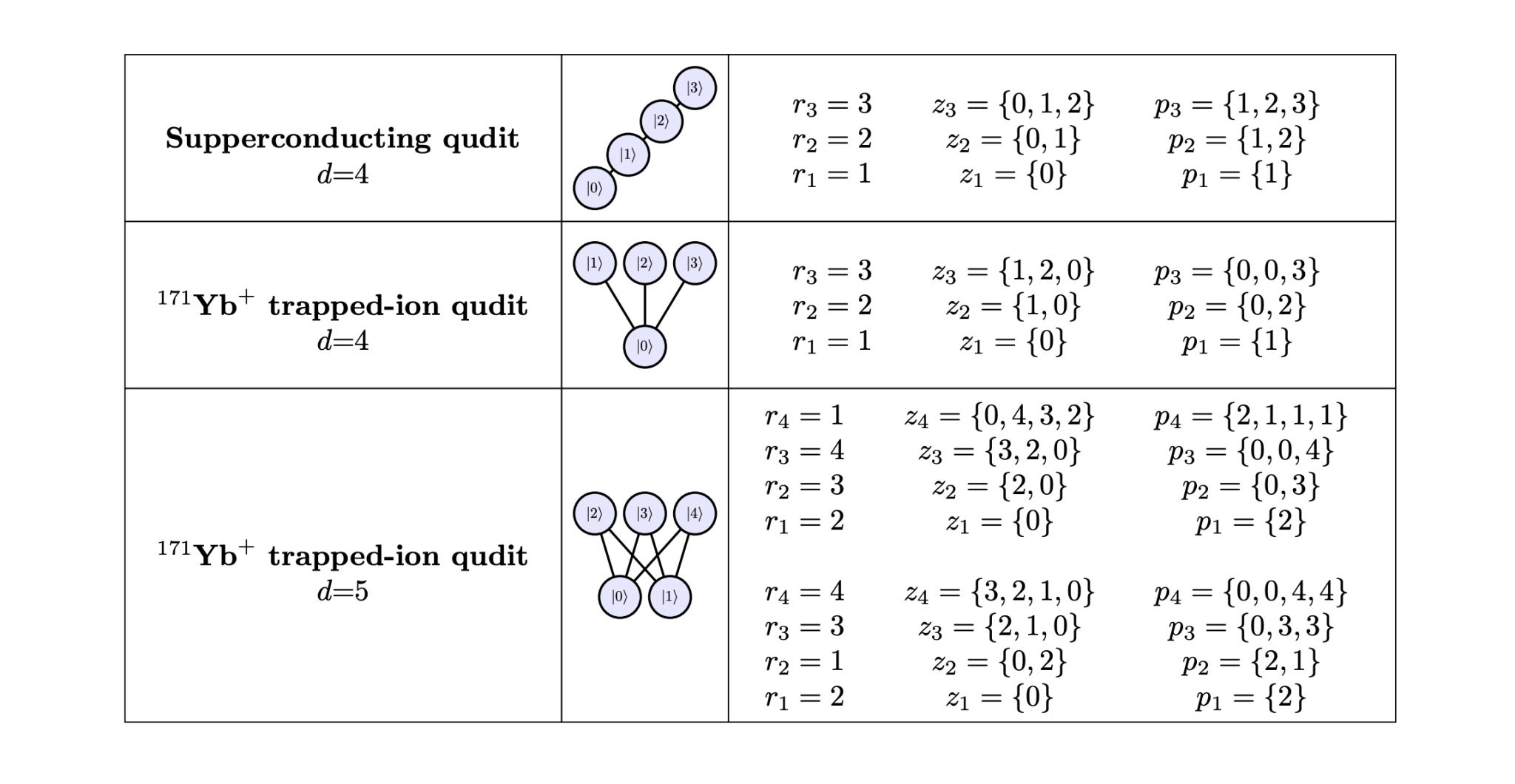
Researchers have addressed a fundamental challenge in qudit-based quantum computing: efficiently decomposing single-qudit operations into a sequence of physically realizable pulses. Qudits, unlike qubits, utilize quantum systems with a dimension greater than two, requiring more complex control mechanisms. The team developed an algorithm that minimizes the number of pulses needed to perform operations on these qudits, taking into account the specific selection rules governing transitions between energy levels. The algorithm guarantees that any single-qudit operation can be achieved with at most d(d-1)/2 pulses, often requiring fewer, representing a significant resource optimization. To validate their approach, scientists performed detailed comparisons across several trapped ion species, including 171Yb+, 137Ba+, 40Ca+, and 86Rb+, and extended the analysis to superconducting qudits.
Minimal Pulse Sequences for Qudit Operations
Scientists have developed a new algorithm to decompose operations on qudits into a sequence of pulses compatible with specific hardware limitations. This work addresses a key challenge in qudit-based quantum computation, where not all transitions between energy levels are readily achievable due to selection rules. The team’s method efficiently determines the minimal sequence of pulses needed to perform a desired operation, considering these restrictions. Experiments demonstrate that the algorithm requires at most d(d-1)/2 transitions for an arbitrary d-dimensional qudit unitary operation, achieving a theoretical upper bound on the number of necessary pulses.
The researchers tested the algorithm on three distinct qudit platforms, each with unique selection rules: systems with line graphs, trapped-ion qudits exhibiting star or bipartite graphs, and general qudits. For superconducting and photonic qudits with line transition graphs, the algorithm performs comparably to existing qudit synthesis frameworks. Notably, the method significantly outperforms existing approaches for trapped-ion qudits with arbitrary selection rules, consistently producing shorter decomposition sequences than QSearch, random numerical decomposition, and LocQRPass. Tests included state increment/decrement gates, quantum Fourier transforms, uniformly distributed unitary matrices, and two-qubit gates embedded within qudits. This work addresses a key challenge in qudit-based quantum computation, where operations must be broken down into steps compatible with the specific connectivity and selection rules of the hardware. The algorithm efficiently determines the minimal sequence of transitions needed to perform a given operation, with a demonstrated upper bound matching the theoretical limit for such decompositions. The team’s approach is notable for its adaptability to various qudit platforms and their unique selection rules, offering a consistent method for optimizing operations across different physical implementations.
Comparisons with existing decomposition techniques reveal that this new method achieves competitive or superior performance, particularly for complex operations and specific hardware configurations. The algorithm’s efficiency stems from its ability to consider both the sparsity of the operation and the allowed transitions simultaneously, reducing the overall number of steps required. Future work could explore integration with virtual level swaps within a broader quantum circuit workflow, and investigate scalability to larger qudit systems.
🗞 Transition-Aware Decomposition of Single-Qudit Gates
🧠 ArXiv: https://arxiv.org/abs/2510.25561