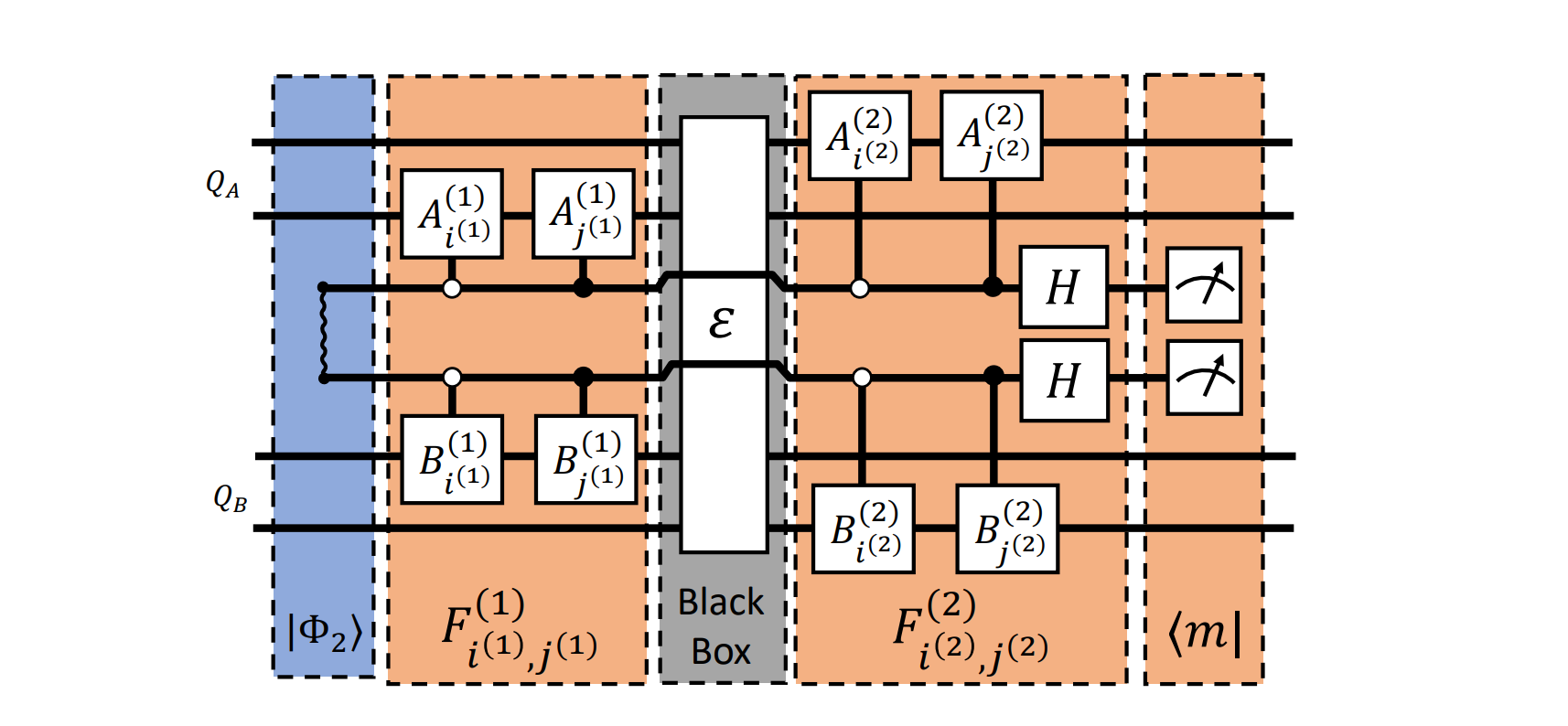
Distributed computing presents a significant challenge in the pursuit of scalable computation, and researchers are exploring various methods to overcome its limitations. Shao-Hua Hu, Po-Sung Liu from the National Cheng Kung University, and Jun-Yi Wu investigate a novel approach that combines the strengths of two existing techniques, entanglement-assisted local operations and classical communication, and circuit knitting. Their work establishes a theoretical framework for optimising computational efficiency and demonstrates that even a small amount of entanglement, specifically a single shared Bell pair, dramatically reduces the computational overhead typically associated with circuit knitting. This hybrid method represents a crucial step towards more practical and resource-efficient implementations of distributed computation, offering a pathway to overcome current limitations in the field.
Entanglement-assisted local operations and classical communication, and circuit knitting represent two complementary approaches toward scalable quantum computation. The former deterministically realises nonlocal operations but demands extensive entanglement resources, whereas the latter requires no entanglement yet suffers from exponential sampling overhead. This work proposes a hybrid framework that integrates these two paradigms by performing circuit knitting assisted with a limited amount of entanglement. A general theoretical formulation is established, yielding lower bounds on the optimal sampling overhead, and a constructive protocol demonstrates that a single shared Bell pair can reduce this overhead significantly.
Distributed Quantum Circuit Decomposition and Execution
This research addresses the challenge of performing complex quantum computations on a distributed quantum computer, breaking down large circuits into smaller parts that can run on multiple quantum processing units. This approach is crucial because building a single, large, fault-tolerant quantum computer presents significant hurdles. The team explores techniques for dividing circuits and recombining the results, focusing on the roles of entanglement and shared entanglement, where entangled pairs of qubits are distributed between processing units to enable communication and computation. They investigate the use of states that are not perfectly entangled, and explore quantum catalysis, a process where a special quantum state facilitates computation without being consumed.
The research also examines virtual quantum resource distillation, a technique for improving the reliability of distributed computations, and explores methods for efficiently cutting and recombining circuits, known as circuit knitting. The study addresses key challenges including the difficulty of distributing entanglement over long distances, minimizing communication overhead, and reducing the overall resource requirements for distributed quantum computation. It also considers the critical issues of fault tolerance, scalability, and achieving optimal performance. This research is important because it opens up the possibility of performing complex computations on more realistic and achievable systems than a single, large quantum computer. By developing techniques for distributed quantum computing and focusing on resource efficiency, the team is paving the way for a viable technology.
Hybrid Protocol Minimizes Quantum Sampling Overhead
A significant advancement in distributed quantum computing has been achieved through the development of a novel hybrid framework that combines circuit knitting with a limited amount of entanglement. Researchers established a general theoretical formulation defining lower bounds on optimal sampling overhead, and crucially, demonstrated a constructive protocol achieving this limit. This breakthrough reduces computational cost by leveraging just a single shared Bell pair to minimize sampling overhead, matching the efficiency of standard circuit knitting without requiring extensive classical resources. Experiments reveal that the proposed method successfully decomposes complex quantum computations into smaller, locally executable parts, connected via limited entanglement.
The team mathematically formulated the conditions for optimal performance, proving that the hybrid approach enhances both sampling and entanglement efficiency. Specifically, the research establishes that the framework’s performance is governed by a quantifiable parameter, representing the cost of quantum state discrimination. Analysis demonstrates that the hybrid protocol maintains the same performance bounds as standard circuit knitting, even with significantly reduced entanglement requirements. Further theoretical work rigorously proves the robustness and predictability of the framework. The study demonstrates that using a single Bell state achieves an overhead matching the theoretical lower bound, confirming the efficiency gains from even minimal entanglement. This hybrid approach represents a pivotal step towards practical, resource-efficient distributed quantum computing, paving the way for scalable quantum computation by reducing the demands on both entanglement resources and computational overhead.
Entanglement and Circuit Knitting for Efficiency
This research presents a hybrid framework for distributed quantum computation that integrates entanglement-assisted approaches with circuit knitting, aiming to overcome limitations inherent in each individual method. Researchers demonstrate that incorporating even a limited amount of entanglement, specifically a single shared Bell pair, can substantially reduce the sampling overhead associated with circuit knitting, bringing it closer to the efficiency of fully entanglement-assisted protocols. This achievement addresses a fundamental trade-off in distributed quantum computation between entanglement consumption and execution time, offering a pathway towards more resource-practical implementations. The core of this work lies in a constructive protocol that leverages entanglement to enhance the efficiency of quasi-probability decomposition, a key technique within circuit knitting.
By strategically utilizing entanglement, the researchers establish theoretical lower bounds on optimal sampling overhead and demonstrate a significant reduction in the number of circuit executions required to achieve a given level of accuracy. While acknowledging that circuit knitting still requires classical post-processing, this hybrid approach represents a valuable step towards balancing the demands of entanglement distribution and runtime performance in distributed quantum systems. Further research could explore the optimal allocation of entanglement and investigate the scalability of this hybrid framework with larger numbers of quantum processing units.
🗞 Entanglement-assisted circuit knitting
🧠 ArXiv: https://arxiv.org/abs/2510.26789
See today’s quantum computing news on Quantum Zeitgeist for the latest breakthroughs in qubits, hardware, algorithms, and industry deals.