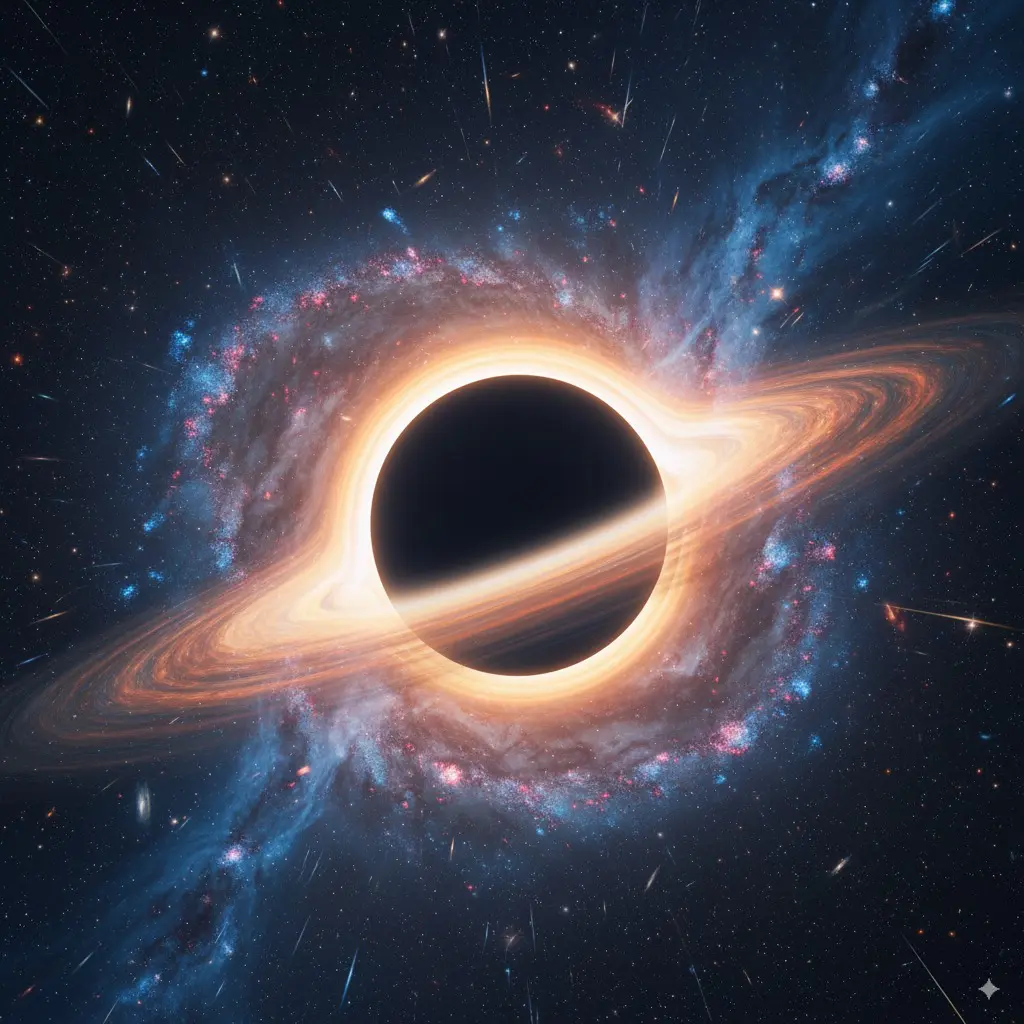
The nature of black holes receives continued scrutiny from physicists seeking to reconcile quantum mechanics with general relativity, and recent work by Faizuddin Ahmed, Ahmad Al-Badawi, and Orhan Donmez, along with colleagues, delves into this challenging area. Their investigation explores black holes incorporating both quantum corrections and the influence of string-like clouds of matter, offering a detailed analysis of how these factors alter the behaviour of light and particles around these extreme objects. The team demonstrates that these modified black holes exhibit distinct characteristics in several key areas, including the paths of light, the orbits of test particles, and even their thermodynamic properties, creating observable differences between theoretical models. This research is significant because it proposes specific, measurable signatures, from gravitational lensing patterns to the frequencies of observed oscillations, that could ultimately allow astronomers to test the validity of different quantum gravity theories and refine our understanding of the universe’s most enigmatic objects.
Scientists have investigated black hole spacetimes incorporating quantum corrections and the presence of surrounding string clouds, examining two theoretical models that account for quantum gravitational effects through different approaches. The research focuses on understanding how these modifications affect the paths of light and matter in the extreme gravity near black holes, specifically examining photon spheres, black hole shadows, and the innermost stable circular orbits of test particles. By comparing these features to predictions from classical general relativity, the team seeks to identify potential observational signatures of quantum gravity.
Relativity, Black Holes, and Cosmology Foundations
A comprehensive collection of research papers focuses on General Relativity, Black Holes, Cosmology, and related theoretical physics. The bibliography demonstrates a strong foundation in the core principles of general relativity and black hole physics, with foundational papers by Einstein and Schwarzschild forming a key component. Numerous studies explore black hole solutions, properties, thermodynamics, and the information paradox, indicating a deep investigation into these complex phenomena. The inclusion of texts on differential geometry and spacetime manifolds highlights a rigorous mathematical approach to understanding these concepts.
Research extends to cosmology, encompassing studies of dark energy, dark matter, and various cosmological models. The bibliography also delves into advanced theoretical topics, including string theory, loop quantum gravity, the holographic principle, and noncommutative geometry. A significant portion of the collection focuses on observational astronomy, with a prominent emphasis on the Event Horizon Telescope and gravitational wave astronomy, suggesting a strong connection to real-world observations. This collection represents a comprehensive and interdisciplinary approach to modern physics, connecting theoretical concepts with observational data.
Quantum Shadows and Cosmic String Effects
Scientists have thoroughly characterized black hole shadows and photon orbits in spacetimes modified by both quantum corrections and cosmic strings, revealing distinct observational signatures for each effect. The research team meticulously investigated how these modifications alter the paths of light around black holes, focusing on the photon sphere and the resulting shadow cast on the sky. Through rigorous analysis, they demonstrate that the size and shape of the black hole shadow are sensitive indicators of the underlying spacetime geometry. The team measured the photon sphere radius and shadow radius for a model incorporating both cosmic strings and quantum corrections, demonstrating that increasing the cosmic string parameter enlarges both radii, indicating a stronger gravitational field.
Conversely, increasing the quantum correction parameter reduces both quantities, signifying a weakening of the photon capture region. Further analysis reveals a three-dimensional relationship between the photon sphere radius, shadow radius, and the parameters governing cosmic strings and quantum corrections. The team found that the shadow profiles for one model remain identical to a known case, as its quantum corrections do not affect the key metric function governing light paths, providing a clear observational discriminant between the two models. By introducing a topological classification of photon spheres, assigning topological charges to characterize their stability, the research delivers a comprehensive framework for interpreting black hole shadow observations and distinguishing between different quantum gravity models, offering testable predictions for next-generation VLBI arrays.
Quantum Gravity Effects on Black Hole Shadows
This research presents a detailed investigation into black hole spacetimes incorporating both quantum corrections and the influence of surrounding string clouds. The analysis demonstrates fundamental alterations to particle trajectories, specifically impacting the properties of photon spheres, black hole shadows, and the innermost stable circular orbits of test particles, when compared to classical black hole solutions. These modifications offer potential observational signatures for distinguishing between different theories of quantum gravity. Furthermore, the study reveals contrasting behaviours between the two models across multiple observational channels. The team calculated weak-field deflection angles using gravitational lensing and derived relationships between frequency and quasi-periodic oscillations arising from particle motion around the black holes. Importantly, these calculations show opposite dependencies on key parameters between the two models, providing unambiguous observational discriminants for future astronomical studies.
🗞 Spherically Symmetric Quantum-Corrected Black Holes with String Clouds: A Multi-Observable Analysis
🧠 ArXiv: https://arxiv.org/abs/2510.25764
See today’s quantum computing news on Quantum Zeitgeist for the latest breakthroughs in qubits, hardware, algorithms, and industry deals.