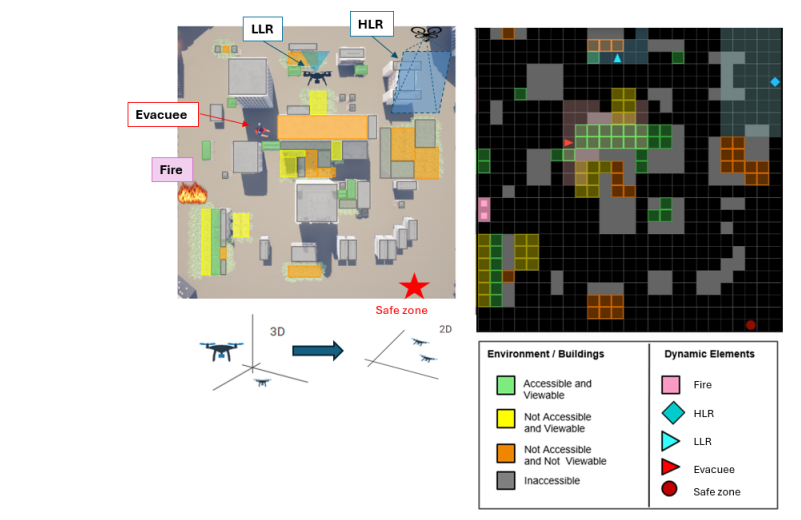
Coordinating effective evacuations during urban fires presents a significant challenge, particularly when information is incomplete and human behaviour is unpredictable. Maria G. Mendoza, Addison Kalanther, and Daniel Bostwick, from the University of California, Berkeley, along with colleagues including Emma Stephan and Chinmay Maheshwari, address this critical need by developing a system of coordinated autonomous drones. Their research introduces a framework where unmanned aerial vehicles (UAVs) actively locate, intercept, and guide evacuees to safety, even when faced with uncertainty and limited visibility. The team models human behaviour using insights from empirical psychology, recognising that panic dynamically influences decision-making during emergencies, and combines this with a sophisticated planning algorithm to enable the drones to adapt to changing conditions and effectively reduce evacuation times compared to traditional methods. This work represents a substantial step towards deploying truly human-centered robotic assistance in high-stress, real-world scenarios.
Drones and Robotics for Disaster Evacuation
This research explores the use of unmanned aerial vehicles (UAVs) and robotics to improve disaster response, specifically focusing on evacuating people from dangerous situations. Key themes include enhancing disaster resilience, understanding how robots can assist humans during emergencies, utilizing teams of robots for better coverage, and modelling human behaviour during evacuations. The work leverages artificial intelligence to improve robot autonomy, decision-making, and adaptation to rapidly changing environments, presenting a comprehensive overview of current disaster robotics technology and envisioning future developments. The research incorporates drones, ground robots, and potentially underwater vehicles, utilizing technologies like Simultaneous Localization and Mapping (SLAM) to enable robots to build maps and determine their location within disaster zones.
Path planning algorithms allow robots to find optimal routes while avoiding obstacles, and sensor fusion combines data from multiple sensors for a more accurate understanding of the environment. Researchers are developing computational models of human behaviour during evacuations, capturing how panic and irrational decisions affect movement. Reinforcement learning trains robots to learn optimal evacuation strategies, while computer vision identifies victims, obstacles, and hazards. The research highlights applications including searching for and rescuing victims, assessing infrastructure damage, providing emergency responders with real-time situational awareness, guiding evacuees, delivering supplies, detecting hazardous materials, and monitoring disaster zones. Key challenges include ensuring reliability in harsh environments, increasing robot autonomy, establishing reliable communication links, providing sufficient power, designing intuitive human-robot interfaces, addressing ethical concerns, managing large amounts of data, and developing interoperability standards. Future research directions include developing advanced AI algorithms, improving robotic robustness, creating effective human-robot interaction interfaces, exploring swarm robotics, and creating realistic simulations for testing.
Drones Coordinate Evacuation Using Psychological Models
This research pioneers a multi-agent coordination framework for autonomous drones assisting human evacuation during emergencies, addressing limitations in existing models that often overlook the psychological impact of stressful situations. Scientists developed a system where two Unmanned Aerial Vehicles (UAVs), a high-level rescuer (HLR) and a low-level rescuer (LLR), collaborate to locate, intercept, and guide evacuees to safety in uncertain environments. The study models this complex scenario as a Partially Observable Markov Decision Process (POMDP), enabling the drones to make informed decisions despite incomplete information. To realistically simulate human behaviour, the team integrated an agent-based model grounded in empirical psychology, capturing how panic dynamically affects decision-making and movement in response to environmental stimuli.
Scientists employed the Proximal Policy Optimization (PPO) algorithm with recurrent policies, allowing the drones to robustly navigate and make decisions in partially observable settings. The experimental setup represents an urban environment modeled as a discrete-time, 2D grid, incorporating stochastic fire spread, unknown evacuee locations, and limited visibility. The team engineered asymmetric drone roles, with the HLR operating at high altitude to map the environment and infer the evacuee’s location, while the LLR operates at low altitude to physically intercept the evacuee. This division of labour, combined with the advanced algorithms and realistic environmental modelling, enables the UAV team to rapidly locate and intercept evacuees.
UAV Team Accelerates Fire Evacuation Times
This work presents a multi-agent system employing two Unmanned Aerial Vehicles (UAVs) to assist human evacuation during fire emergencies, demonstrating a significant advancement in disaster response technology. Researchers developed a coordinated strategy where a High-Level Rescuer (HLR) operates at altitude for broad situational awareness, while a Low-Level Rescuer (LLR) navigates closer to the ground to detect occluded regions and directly guide evacuees. Experiments demonstrate that this UAV team significantly reduces the time required for evacuees to reach safety compared to scenarios without assistance. The team modelled human behaviour using an agent-based model, capturing how panic dynamically affects decision-making and movement in response to environmental stimuli.
To enable robust decision-making in uncertain conditions, the researchers employed deep reinforcement learning with recurrent neural networks, training a single policy to control both asymmetric UAV agents. This approach allows the UAVs to reason under uncertainty and leverage observation histories for effective coordination. Evaluations in randomized testing environments reveal that the policy performs well regardless of fire start locations when evacuee start and end points are similar. Crucially, the simulations demonstrate the significant impact of human panic on evacuation times, confirming the importance of proactive robotic assistance in guiding evacuees and mitigating the effects of stress during emergencies.
UAVs Guide Evacuees, Reducing Escape Times
This research presents a novel framework for enhancing fire evacuation procedures through the coordinated use of autonomous drones, or Unmanned Aerial Vehicles (UAVs). The team developed a system in which two UAVs, operating with.
🗞 Coordinated Autonomous Drones for Human-Centered Fire Evacuation in Partially Observable Urban Environments
🧠 ArXiv: https://arxiv.org/abs/2510.23899




See today’s quantum computing news on Quantum Zeitgeist for the latest breakthroughs in qubits, hardware, algorithms, and industry deals.