The pursuit of stable, highly entangled states of matter, crucial for future technologies, faces a significant hurdle in the form of energy absorption that leads to rapid decay. Zehang Bao, Zitian Zhu, and Yang-Ren Liu, alongside colleagues, now demonstrate a novel mechanism, termed Fock space prethermalization, which effectively suppresses this heating. The team’s work reveals that by structuring the complex network of quantum states into simpler, interconnected parts, they can dramatically slow down the rate at which energy is lost, even when starting with highly energetic systems. Using an impressive array of 72 superconducting qubits, they observe a form of time-crystalline order, sustained for over 120 cycles, arising from this prethermalization process, and identify the underlying principle as the near-conservation of specific quantum boundaries. This achievement establishes Fock space prethermalization as a robust method for creating stable, non-equilibrium states of matter, opening exciting possibilities for exploring new materials and quantum technologies.
Many-Body Localization and Time Crystal Dynamics
This research investigates the complex behavior of quantum systems, specifically many-body localization and time crystals. Scientists explore how interactions within these systems prevent them from reaching thermal equilibrium, leading to localized states and unusual dynamic properties. The team utilizes quantum simulations with superconducting qubits to observe and characterize these phenomena. A central theme involves studying quantum dynamics within a mathematical framework called Fock space, which represents quantum states based on particle number. This approach allows researchers to analyze complex quantum behavior, particularly in disordered systems where randomness plays a crucial role.
The research relies on quantum simulations and detailed characterization of the experimental setup. Disorder, or randomness, is a key ingredient for many-body localization. The team investigates how disorder affects quantum dynamics, revealing its influence on maintaining quantum coherence. Further research emphasizes the importance of Fock space as a tool for understanding complex quantum dynamics in disordered systems. The team also investigates prethermalization, a transient state before full thermalization, and its connection to many-body localization. They utilize quantum computing frameworks for simulations, building upon previous experiments that successfully emulated many-body localization with superconducting quantum processors. This research uses superconducting qubits to simulate disordered quantum systems, focusing on how these systems avoid thermalization and exhibit phenomena like many-body localization and prethermalization, all analyzed through the lens of Fock space representation.
Fock Space Prethermalization Stabilizes Quantum Time Crystals
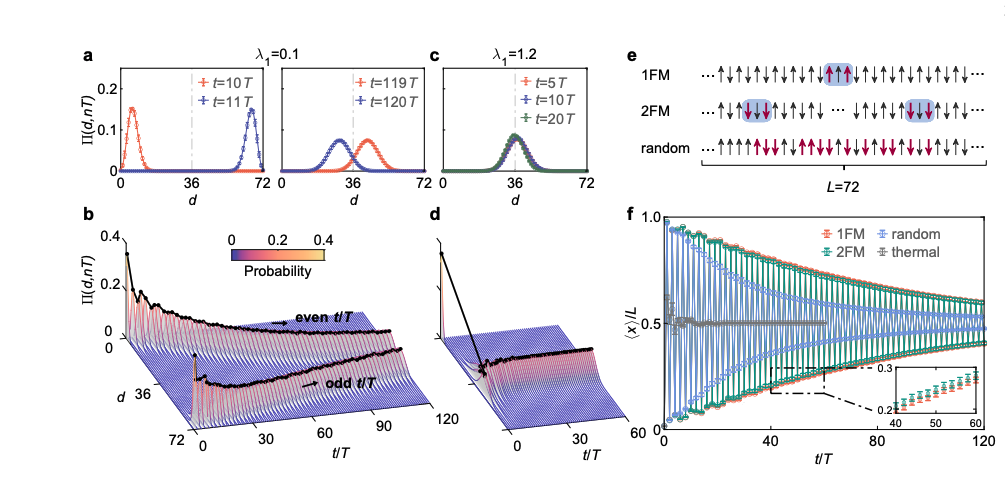
Scientists achieved a breakthrough in controlling complex quantum systems by demonstrating Fock space prethermalization. This work utilizes 72 superconducting qubits to suppress heating, a major obstacle in harnessing highly entangled states of matter, and establishes a new pathway for exploring novel quantum phenomena. The team discovered that carefully designing interactions between qubits divides the network of possible quantum states into simpler, sparsely connected sub-networks, slowing down the rate at which the system loses energy and reaches thermal equilibrium. Experiments revealed that this prethermalization-based time-crystalline order persists for an impressive 120 cycles, even when starting from a wide range of initial quantum states.
Researchers identified that the key to this stability lies in the approximate conservation of domain wall numbers, representing boundaries between different quantum configurations. By measuring site-resolved correlations, they confirmed that the number of these domain walls remains relatively constant, restricting the system’s ability to explore all possible states and thus delaying thermalization. Finite-size scaling demonstrated that the prethermalization-thermalization crossover occurs in regimes independent of system size, linking the system’s dynamic behavior to the underlying structure of its Floquet unitary. The team meticulously controlled perturbation strengths, maintaining a fixed relationship to observe the emergence of this stable, sparse network. Measurements of the averaged domain wall number for each Floquet eigenstate confirmed the role of domain wall conservation in structuring the quantum system and suppressing energy dissipation. This work establishes Fock space prethermalization as a robust mechanism for breaking ergodicity, paving the way for exploring novel nonequilibrium matter and its potential applications in quantum technologies.
Fock Space Prethermalization Extends Quantum Coherence
This research demonstrates a novel mechanism, Fock space prethermalization, which effectively suppresses heating in periodically driven quantum systems. By dividing the complex network of possible quantum states into simpler, sparsely connected sub-networks, the team prolonged the timescale before the system reaches thermal equilibrium, even when starting from high-energy initial conditions. This was experimentally verified using 72 superconducting qubits, where a time-crystalline order persisted for over 120 cycles, showcasing the robustness of the approach. The underlying principle involves constraints on the number of domain walls within the system, identified through detailed measurements of site-resolved correlations and finite-size scaling analysis.
This work establishes Fock space prethermalization as a means of breaking ergodicity and opens avenues for exploring new, exotic states of quantum matter. The authors acknowledge that the stability of this prethermalization against external coupling requires further investigation, and future research will explore extending this scheme to systems driven in non-periodic ways, potentially leading to the creation of discrete time quasi-crystals. This achievement also highlights the potential of large-scale superconducting qubits for directly probing the complex structure of many-body quantum systems, offering a powerful tool for future research in this field.
🗞 Fock space prethermalization and time-crystalline order on a quantum processor
🧠 ArXiv: https://arxiv.org/abs/2510.24059
See today’s quantum computing news on Quantum Zeitgeist for the latest breakthroughs in qubits, hardware, algorithms, and industry deals.