Quantum error correction holds immense promise for building practical quantum computers, but accurately interpreting the results of experiments remains a significant challenge. Evangelia Takou and Kenneth R. Brown, from Duke University, now demonstrate a method for estimating and decoding errors in quantum error correction experiments without relying on extensive prior device characterisation. Their work reveals that the history of error syndromes alone provides sufficient information to detect and quantify coherent errors, a type of noise previously difficult to assess. Crucially, the team shows that detector models established through experimentation function effectively across both stochastic and coherent noise environments, and their simulations, utilising both Majorana and Monte Carlo techniques, capture the unique signatures of coherent errors, ultimately leading to improved decoding thresholds and a more accurate understanding of quantum error correction performance.
Coherent Error Mitigation in Quantum Error Correction
This work explores the challenges of coherent errors in quantum error correction, going beyond the standard focus on simple bit flips and phase flips. Coherent errors introduce complex distortions that can significantly degrade performance, requiring specialized mitigation strategies. Scientists present a combination of theoretical analysis, simulations, and experimental considerations to address these challenges, aiming to advance the field and build more robust quantum computers. The team developed and utilized detector error models and hypergraphs to represent the complex relationships between errors and syndrome measurements, allowing for a more accurate modelling of the error landscape. They also explored techniques for self-consistent learning, refining error models directly from experimental data, crucial for adapting to the specific noise characteristics of quantum hardware.
Noise Characterisation From Quantum Error Correction Data
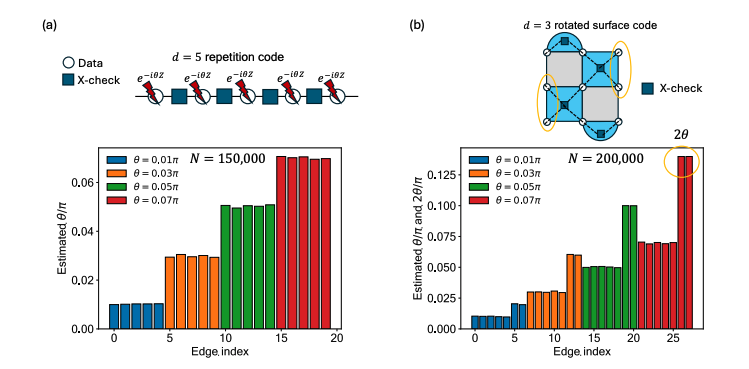
Scientists have achieved a breakthrough in quantum error correction by demonstrating a method to detect and estimate coherent noise without prior device calibration. This research reveals that the history of quantum error correction experiments, specifically the syndrome data, is sufficient to characterize noise. The team modelled both fully coherent and fully stochastic noise using simulations, employing Majorana and Monte Carlo techniques to accurately capture the interference effects of coherent noise, which manifest as enhanced or suppressed error rates compared to purely stochastic noise. Experiments with a repetition code revealed that the estimated error rates closely align with the actual rotation angles applied to the qubits, demonstrating the accuracy of the method. Further investigation using a rotated surface code showed that boundary edges exhibit error rates proportional to twice the rotation angle, a distinct signature of coherent noise. Analysis of the estimated angles across different edges demonstrated accurate recovery of the applied rotation angles for bulk qubits, and accurate summation of angles for boundary qubits connected to specific checks.
Coherent Noise Estimation From Syndrome History
This work demonstrates that coherent noise, a significant challenge in quantum error correction, can be effectively detected and estimated directly from the syndrome history of experiments, removing the need for prior device characterization. Researchers showed that detector error models function equally well whether the noise is stochastic or coherent in nature. By employing both Majorana and Monte Carlo simulations, the team captured the interference effects caused by coherent noise, revealing unique features in detector error models not present in purely stochastic scenarios. Importantly, the study demonstrates practical improvements in quantum error correction performance by utilizing these estimated models. For both repetition and surface codes, the team observed reductions in logical error rates, and in some cases, improvements in error thresholds, when using detector error models built to account for coherent noise.
🗞 Estimating and decoding coherent errors of QEC experiments with detector error models
🧠 ArXiv: https://arxiv.org/abs/2510.23797
See today’s quantum computing news on Quantum Zeitgeist for the latest breakthroughs in qubits, hardware, algorithms, and industry deals.