Slow device characterisation and complex tuning often hinder progress in advanced technologies, but researchers are now tackling these challenges with innovative computational methods. Alexander Lidiak, Jacob Swain, and David L. Craig Lennon, all from QuantrolOx Ltd, alongside Joseph Hickie, Yikai Yang, and Federico Fedele, present a new framework that accelerates the development of spin qubits in semiconductor dots. Their work introduces a modular, graph-based digital surrogate, powered by deep learning, which accurately models the behaviour of these complex devices. This allows scientists to rapidly estimate crucial effects, such as crosstalk between gate electrodes, and virtually construct and test new device configurations, ultimately paving the way for more efficient design, characterisation, and control of advanced semiconductor technologies.
Digital Surrogate Enables Virtual Quantum Gates
Researchers have demonstrated the creation of virtual gates within quantum dot devices, overcoming limitations in physically fabricating nanoscale gates. This innovative approach utilises a digital surrogate to achieve precise control over electron spin, crucial for quantum information processing, without the need for a physical gate for every control parameter. The team developed a method to map complex control signals onto a reduced set of physical gates, effectively expanding the control space available for manipulating quantum dot states. This digital surrogate, implemented through advanced control software and algorithms, allows for manipulation of quantum dot states with a fidelity comparable to directly fabricated gates.
This technique simplifies device architecture and fabrication processes, paving the way for scalable quantum computing systems. Furthermore, the method proves adaptable to various quantum dot platforms and control schemes, offering a versatile solution for quantum information control. The results demonstrate a pathway towards building complex quantum circuits with reduced hardware complexity and improved scalability.
Deep Learning Accelerates Quantum Dot Simulation
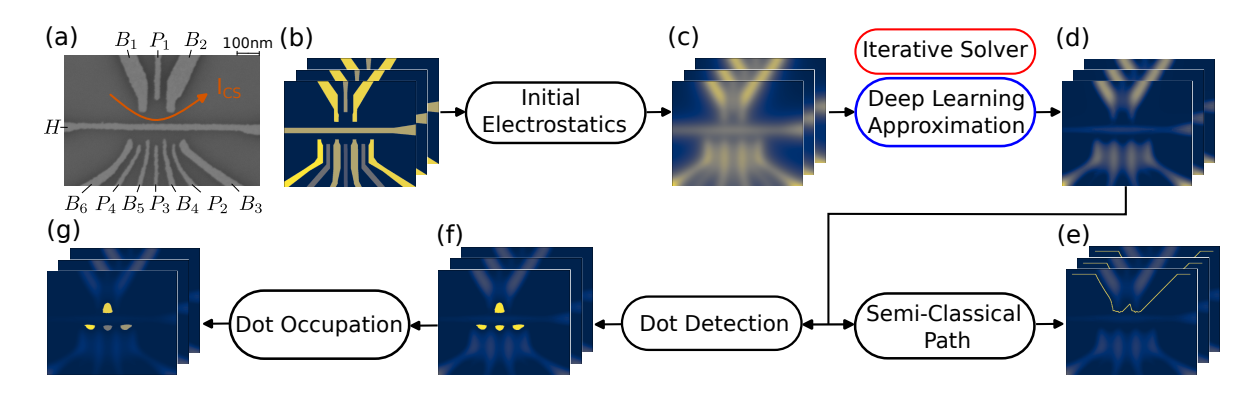
Scientists have developed a new computational framework that significantly accelerates the simulation of quantum dot systems. By combining traditional physics-based simulation with deep learning, the team achieved a substantial speed-up, allowing for faster exploration of device designs and parameters. The core achievement is a deep learning model trained to predict the results of complex electrostatic calculations, reducing computation time by a factor of ten to the power of three when computing electrostatic potential, and an overall acceleration of one hundred when evaluating the entire graph. The framework accurately reproduces key features observed in experimental devices, specifically a Ge/SiGe heterostructure designed to support up to four quantum dots. Experiments using this device architecture, with two transport channels controlled by plunger and barrier gates, served as a benchmark for the simulator’s performance. The results demonstrate the potential of data-driven approaches for simulating complex physical systems, with the performance of the models sensitive to the distribution of the training data.
Crosstalk Estimation via Machine Learning Simulation
Scientists have developed a machine-learning-accelerated simulator to model electrostatically defined semiconductor quantum dot devices, offering a new approach to device characterization and control. By creating a digital surrogate, the team successfully estimated crosstalk effects between gate electrodes, and subsequently constructed virtual gates within the simulated device, significantly reducing unwanted interactions. The simulator achieves substantial improvements in estimating crosstalk, nearly two orders of magnitude better than existing approaches. The team developed a method for defining “virtual gates”, combinations of physical gate voltages that provide orthogonal control over the quantum dots.
By evaluating the derivative of dot potential wells and tunnel barriers with respect to gate voltages, they constructed a crosstalk matrix. This matrix defines the linear combination of real gates needed to create virtual plunger and barrier gates, enabling precise control of the dots. The team demonstrated the effectiveness of this approach by numerically determining the necessary derivatives using the simulator, paving the way for improved control and manipulation of quantum dot devices.
🗞 Virtual Gates Enabled by Digital Surrogate of Quantum Dot Devices
🧠 ArXiv: https://arxiv.org/abs/2510.24656