

The atmospheres of exoplanets orbiting close to their stars experience intense radiation that drives atmospheric escape, a process shaping planetary evolution and influencing the observed population of these worlds. Madelyn Broome, Ruth Murray-Clay, and John McCann, all from the University of California Santa Cruz, alongside James Owen from Imperial College London, have developed a new computational tool, Wind-AE, to model this crucial phenomenon with unprecedented speed and flexibility. This open-source code simulates how stellar X-ray and extreme ultraviolet radiation heats and erodes planetary atmospheres, accounting for the complex interplay of multiple elements and frequencies of light. The team’s work demonstrates that incorporating high-energy radiation and atmospheric composition significantly refines estimates of atmospheric escape rates, revealing that current models often underestimate mass loss for smaller planets and those with weaker gravity, and providing a more accurate picture of how these worlds evolve over time.
Throughout their lives, short-period exoplanets, those with orbital periods less than 100 days, experience intense radiation from their stars, heating and altering their upper atmospheres and driving atmospheric escape. This process, known as photoevaporation, plays a crucial role in shaping planetary evolution and influencing the observed characteristics of exoplanet populations. Directly measuring the rate of atmospheric loss remains a significant challenge, requiring scientists to rely on complex models to infer these values. To address this, a team of researchers has developed a new, efficient model to simulate photoevaporation, building upon earlier work and incorporating the effects of multiple wavelengths of radiation and the presence of metals in planetary atmospheres.
XUV Radiation, Metal Cooling and Atmospheric Escape
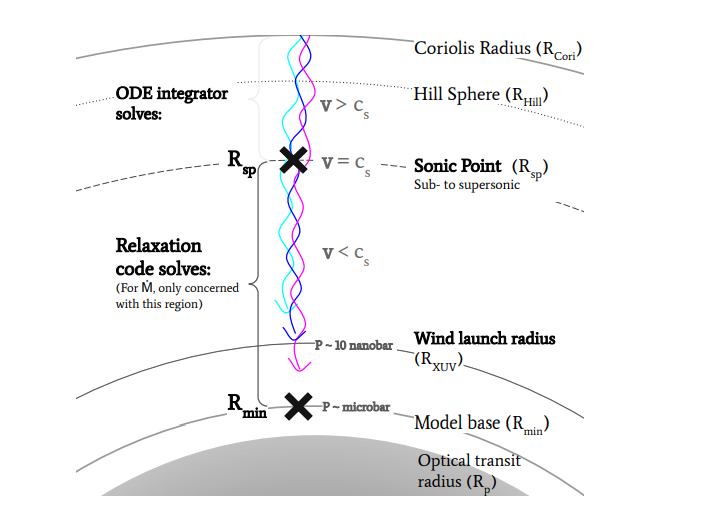
The team’s model simulates the structure of a wind driven by the heating caused by photoionization, extending from the planet’s surface to the point where the wind becomes supersonic. The calculations demonstrate that high-energy X-ray radiation increases the rate of atmospheric mass loss, while the presence of metals in the atmosphere tends to decrease it. For many hot Jupiters, these opposing effects balance each other, resulting in a similar overall mass loss rate, but the escaping wind is hotter, faster, and more gradually ionized. Importantly, the model reveals that the altitude at which the wind begins to accelerate is approximately 10 nanobars for most planets, except those with very high surface gravity.
For planets like HD 209458b, the model predicts a mass loss rate of 1. 1 to 1. 8 under typical conditions. However, for smaller planets with lower escape velocities, such as sub-Neptunes and super-Earths, the mass loss rate can be significantly higher, requiring the full model to avoid underestimation. The research confirms that radiative cooling becomes significant at high fluxes and velocities, meaning that simpler calculations can overestimate the actual rate of atmospheric escape. The model incorporates detailed calculations of ionization balance, heating, and cooling, accounting for multiple species and frequencies of radiation to accurately simulate the complex physics of photoevaporation.
A New Model for Exoplanet Atmospheric Loss
Scientists have developed a new model, called Wind-AE, to calculate the rate at which exoplanet atmospheres lose mass through photoevaporation. Building upon previous simulations, the team incorporated the effects of multiple wavelengths of extreme ultraviolet and X-ray radiation, as well as the presence of metals in the planetary atmospheres, to refine calculations of mass loss. The model demonstrates that including a broader range of radiation wavelengths and metal content affects the temperature, speed, and composition of the escaping gas. The researchers found that for many hot Jupiters, current methods for estimating mass loss are reasonably accurate, but for smaller planets with lower gravity, these methods can significantly underestimate the rate of atmospheric escape.
Wind-AE’s speed and flexibility allow for broad studies of how factors like stellar flux, planet size, orbital distance, and atmospheric composition influence photoevaporation. By closely reproducing the results of a more complex model in a fraction of the time, this work demonstrates a significant advancement in computational efficiency. The team acknowledges that simplifying the lower atmosphere and molecular layers may introduce some uncertainty, particularly for smaller planets, and future work will focus on incorporating more detailed atmospheric modeling and exploring a wider range of planetary conditions, leveraging the model’s open-source nature and versatile Python interface.
Improving Accuracy and Efficiency in Photoevaporation Modeling
This research presents a new model for calculating the rate at which exoplanet atmospheres lose mass through photoevaporation. The model builds upon previous simulations by incorporating the effects of multiple wavelengths of extreme ultraviolet and X-ray radiation, as well as the presence of metals in the planetary atmospheres. This refinement allows for more accurate calculations of mass loss and a better understanding of the complex physics driving atmospheric escape. The team’s work demonstrates that current methods for estimating mass loss are reasonably accurate for many hot Jupiters. However, for smaller planets with lower gravity, these methods can significantly underestimate the rate of atmospheric escape. The new model’s speed and efficiency allow researchers to study a wider range of planetary conditions and explore how factors like stellar flux, planet size, and atmospheric composition influence photoevaporation. The team acknowledges that simplifying the lower atmosphere and molecular layers may introduce some uncertainty, particularly for smaller planets, and future work will focus on incorporating more detailed atmospheric modeling.
🗞 Wind-AE: A Fast, Open-source 1D Photoevaporation Code with Metal and Multi-frequency X-ray Capabilities
🧠 ArXiv: https://arxiv.org/abs/2510.23857




See today’s quantum computing news on Quantum Zeitgeist for the latest breakthroughs in qubits, hardware, algorithms, and industry deals.



