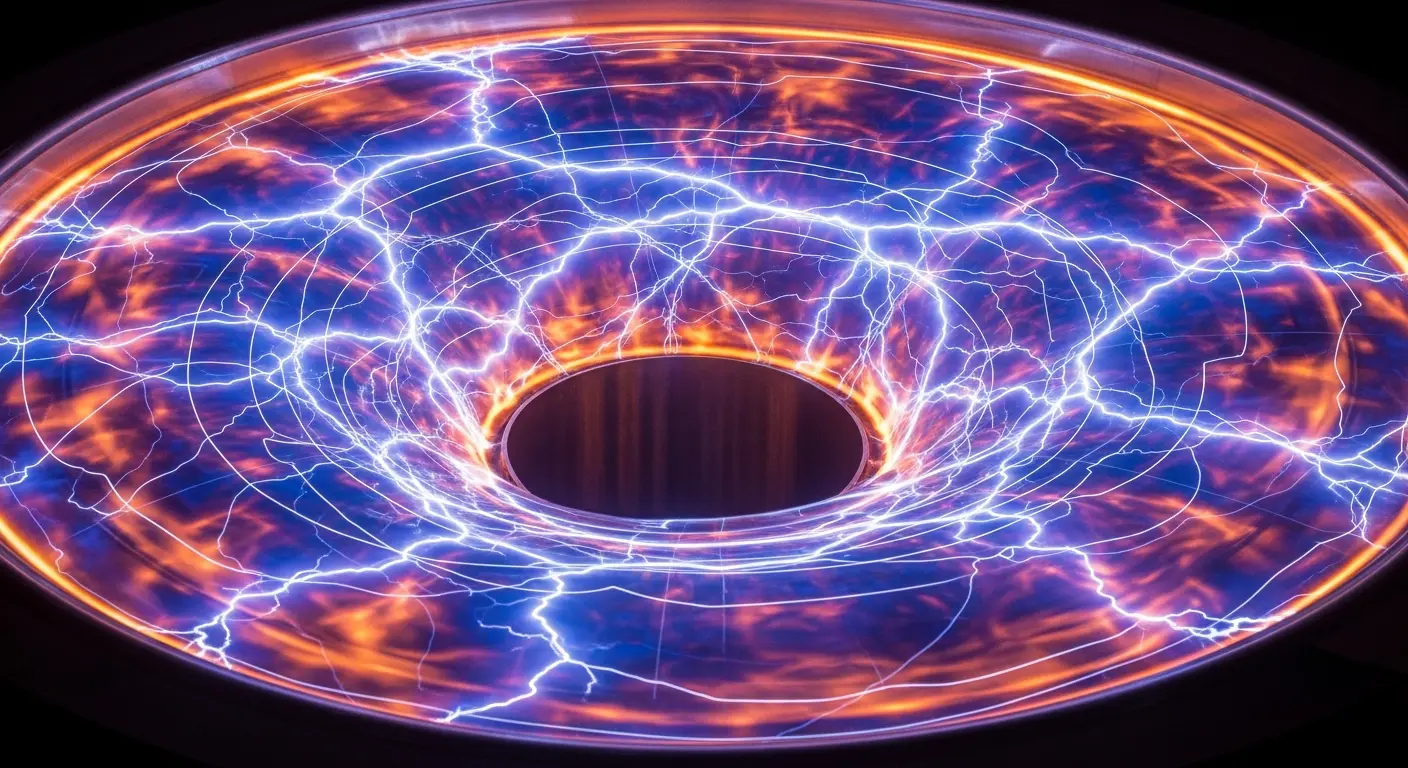
NVIDIA and General Atomics have achieved a breakthrough in fusion energy research with an AI-powered digital twin of a fusion reactor, accelerating the path toward practical fusion energy. Raffi Nazikian, fusion data science lead at General Atomics, highlighted the interactive digital twin’s ability to explore scenarios virtually, enabling researchers to test and refine ideas orders of magnitude faster. This groundbreaking project leverages the NVIDIA Omniverse platform and data center GPUs, reducing simulation times from weeks to seconds and paving the way for a virtually limitless, clean energy source by replicating the power of the sun.\n\n
AI Accelerates Fusion Energy Research with Digital Twin Technology
\n\nThe race to harness fusion energy is now significantly accelerated by advancements in artificial intelligence and digital twin technology. NVIDIA, General Atomics, and collaborating partners have developed a high-fidelity, AI-enabled digital twin of a fusion reactor, offering interactive performance capabilities. This innovative approach allows researchers to virtually explore reactor scenarios and refine designs at an unprecedented pace, potentially revolutionizing the pursuit of clean, limitless energy.\n\nThis groundbreaking project leverages the power of supercomputing systems like Polaris at the Argonne Leadership Computing Facility (ACLF) and Perlmutter at NERSC. These systems were used to train three distinct AI surrogate models at scale, utilizing the NVIDIA Omniverse platform and CUDA-X libraries. According to Raffi Nazikian, fusion data science lead at General Atomics, the ability to explore scenarios virtually through this interactive digital twin is a game-changer, enabling faster testing and verification of ideas. Traditionally, simulating plasma behavior required weeks of computing time; however, AI is now reducing these simulations to mere seconds.\n\nBuilding on this, General Atomics is actively developing this AI-enabled digital twin as part of its research at the US Department of Energy’s DIII-D National Fusion Facility. This technology addresses the immense challenge of controlling plasma at extreme temperatures , hundreds of millions of degrees , and predicting its behavior quickly enough to maintain stable reactor operation. By enabling risk-free virtual experimentation, researchers can accelerate the path toward practical fusion energy and potentially unlock a sustainable energy source for the future.\n\n
Simulating Stars: AI Breakthroughs Speed Fusion Reactor Development
\n\nBuilding on this advancement, researchers are now able to explore a wider range of plasma scenarios virtually, significantly reducing the risk and cost associated with physical experiments. According to the company announcement, this AI-enabled digital twin drastically cuts simulation times, from weeks to mere seconds, allowing for rapid iteration and refinement of reactor designs. This accelerated process is critical for addressing the complex challenges inherent in controlling plasma at hundreds of millions of degrees.\n\nThe core of this speed-up lies in the use of three distinct AI surrogate models, trained on supercomputing systems like Polaris at the Argonne Leadership Computing Facility and Perlmutter at the National Energy Research Scientific Computing Center. Raffi Nazikian, fusion data science lead at General Atomics, emphasized the impact, stating that working with NVIDIA allows them to test, refine, and verify ideas orders of magnitude faster. This capability extends beyond simply accelerating simulations; it enables researchers to explore scenarios that might damage a physical reactor without any real-world risk, fostering innovation and pushing the boundaries of fusion research.
\n\n
\n“Working with NVIDIA, we can now test, refine and verify our ideas orders of magnitude faster, accelerating the path toward practical fusion energy.”\nRaffi Nazikian, General Atomics\n
\n\nThis shift towards AI-driven simulation is fundamentally changing how fusion energy research is conducted. By providing a high-fidelity, interactive digital twin, General Atomics is paving the way for more efficient and targeted experiments at the DIII-D National Fusion Facility. The ability to rapidly assess different configurations and control strategies is expected to accelerate the path toward practical fusion energy, bringing the promise of a clean, virtually limitless energy source closer to reality. This approach represents a significant leap forward in tackling one of science’s toughest problems.\n\nThis advancement, developed by NVIDIA and General Atomics, could enable faster refinement of fusion reactor designs and accelerate the pursuit of practical fusion energy. By leveraging AI and high-fidelity digital twins, researchers can now explore complex plasma behaviors with unprecedented speed and accuracy. For the energy sector, this represents a significant step toward a potentially limitless source of clean power. The implications extend beyond energy, as the techniques pioneered here, combining AI, simulation, and advanced computing resources at facilities like the Argonne Leadership Computing Facility and National Energy Research Scientific Computing Center, may benefit other complex scientific challenges.\n\n
\n Source: https://blogs.nvidia.com/blog/nvidia-general-atomics-fusion/\n
\n