Bosonic codes offer a compelling pathway to error correction for continuous-variable quantum systems, with potential applications in technologies like circuit QED and optomechanics, but creating and maintaining these codes demands exceptionally precise control over quantum interactions. Zheping Wu, alongside Lingzhen Guo from Tianjin University and Haobin Shi and Wei-Wei Zhang from Northwestern Polytechnical University, now present a new method that uses reinforcement learning to autonomously design the optimal control sequences for preparing these codes. Their approach, which employs a technique called Floquet engineering, dramatically reduces the time needed to generate high-fidelity bosonic codes, achieving over two orders of magnitude improvement compared to conventional methods, and maintains performance even with significant noise. This achievement not only showcases the power of artificial intelligence in quantum control, but also establishes a practical and scalable route towards building fault-tolerant quantum computers based on bosonic codes, offering a promising solution to overcome decoherence challenges in emerging quantum technologies.
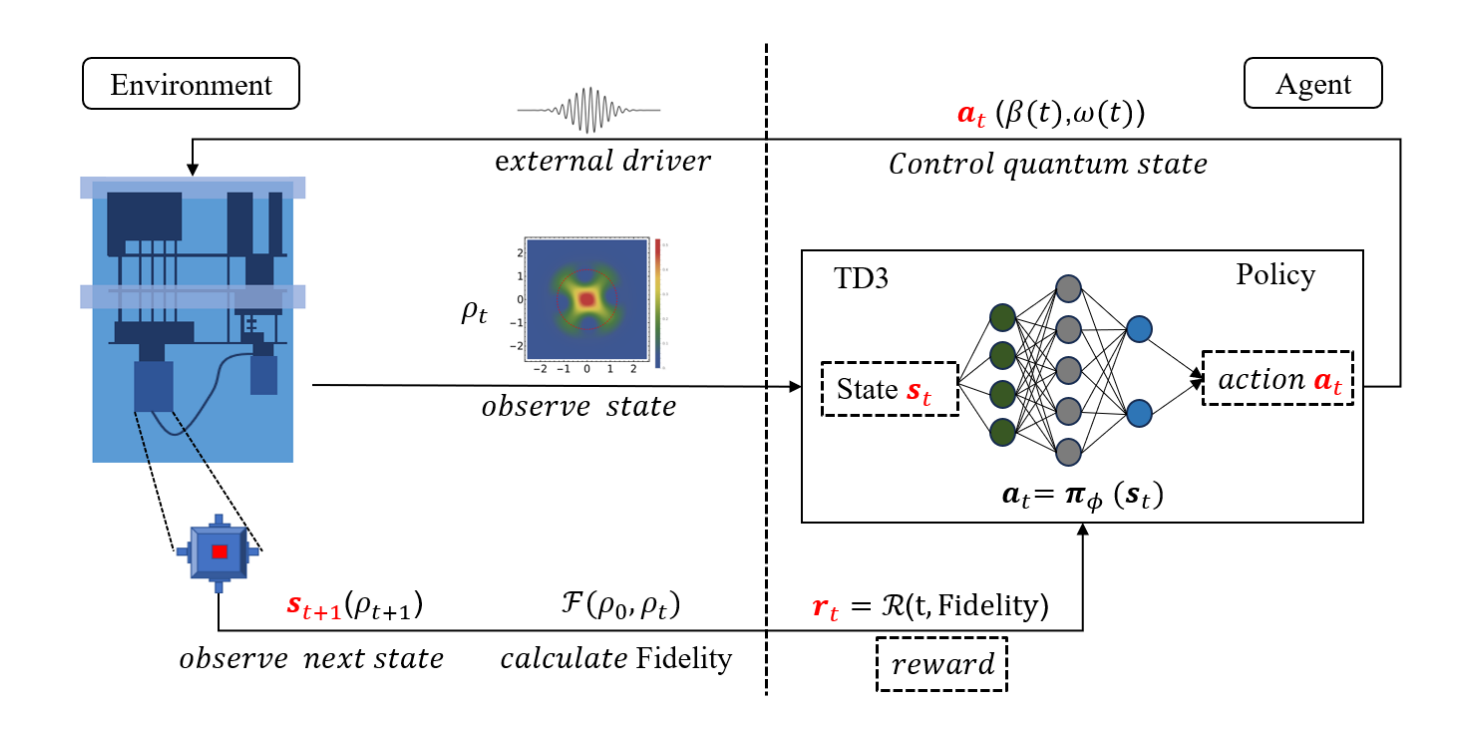
The team introduces a reinforcement learning approach to engineer time-periodic driving terms, known as Floquet Hamiltonians, that generate codes with desirable properties. Specifically, they aim to discover Floquet Hamiltonians which produce highly entangled bosonic codes capable of protecting quantum information from noise. The method involves training a reinforcement learning agent to optimise the parameters of the Floquet Hamiltonian, maximising code performance as measured by code distance and logical error rates.
This approach leverages a deep reinforcement learning algorithm, enabling the agent to explore a vast parameter space and identify effective Floquet driving terms without prior knowledge of the underlying code structure. The agent receives rewards based on the quality of the generated code, encouraging it to discover driving terms that enhance code performance. Through this iterative process, the agent learns to autonomously engineer Floquet Hamiltonians tailored to specific bosonic systems and noise models. The research demonstrates the ability to discover codes with improved performance compared to existing approaches, offering a pathway towards robust quantum computation with bosonic systems.
This research represents a significant step towards realising fault-tolerant quantum computation with continuous-variable qubits. Bosonic codes represent a promising route toward quantum error correction in continuous-variable systems, with direct relevance to experimental platforms such as circuit QED and optomechanics. However, their preparation and stabilization remain highly challenging, requiring ultra-precise control of nonlinear interactions to create entangled superpositions, suppress decoherence, and mitigate dynamic errors. By leveraging machine learning to optimise Floquet driving parameters, this method achieves robust code preparation even in the presence of realistic noise, circumventing the need for complex calibration procedures and allowing for the dynamic adaptation of control pulses to compensate for system imperfections and environmental fluctuations. The technique demonstrates the ability to efficiently generate and stabilise bosonic codes with high fidelity, paving the way for practical implementation of continuous-variable quantum error correction.
Bosonic Qubit Error Correction via Reinforcement Learning
This research addresses the challenge of quantum error correction, specifically for bosonic qubits. Bosonic qubits, which encode quantum information in continuous variables, are promising for quantum computing but are highly susceptible to errors caused by environmental noise. The team focuses on improving the robustness of bosonic qubits against these errors by employing a novel approach combining Floquet engineering and reinforcement learning. The research centers on using bosonic qubits and explores codes like the Gottesman-Kitaev-Preskill code, a prominent approach for encoding quantum information in a continuous variable system.
Floquet engineering is used to periodically drive the quantum system, effectively creating a new Hamiltonian that implements the necessary operations for error correction. Crucially, the researchers employ deep reinforcement learning to optimise the parameters of this periodic driving. The reinforcement learning agent learns a policy that maximises the performance of the quantum error correction scheme. The researchers demonstrate that using reinforcement learning to optimise the Floquet drive significantly improves the fidelity of state preparation and the performance of quantum error correction, enhancing the robustness of the bosonic qubits.
This work represents a significant step forward in the development of practical quantum error correction schemes for bosonic qubits. Improving the robustness of bosonic qubits is crucial for building scalable quantum computers. The research demonstrates the power of reinforcement learning as a tool for quantum control and optimisation, opening up new possibilities for using machine learning to design and improve quantum technologies. The reinforcement learning-based approach offers a more efficient way to find optimal control parameters for complex quantum systems.
Floquet Control and Machine Learning Accelerate Bosonic Codes
Preparing bosonic codes presents a significant challenge in continuous-variable quantum computing due to stringent demands on coherence and control precision. Researchers have now demonstrated a reinforcement learning-assisted Floquet engineering scheme that substantially improves both the efficiency and robustness of this process. Remarkably, the method reduces the time required for code preparation to approximately one percent of that needed by previous adiabatic approaches, while maintaining high-fidelity state generation even under strong noise conditions. This achievement demonstrates the effectiveness of Floquet-based control for continuous-variable systems and highlights the potential of machine learning to discover optimal control strategies that surpass conventional, human-designed protocols. The team anticipates that this framework can be extended to other quantum platforms and noise models, offering a scalable route toward practical implementations of quantum error-correcting codes in near-term quantum hardware. While acknowledging the limitations inherent in current experimental setups, the researchers suggest that further development of this combined artificial intelligence and quantum control paradigm holds promise for realising fault-tolerant bosonic quantum computation.
🗞 Autonomous Floquet Engineering of Bosonic Codes via Reinforcement Learning
🧠 ArXiv: https://arxiv.org/abs/2510.22227