

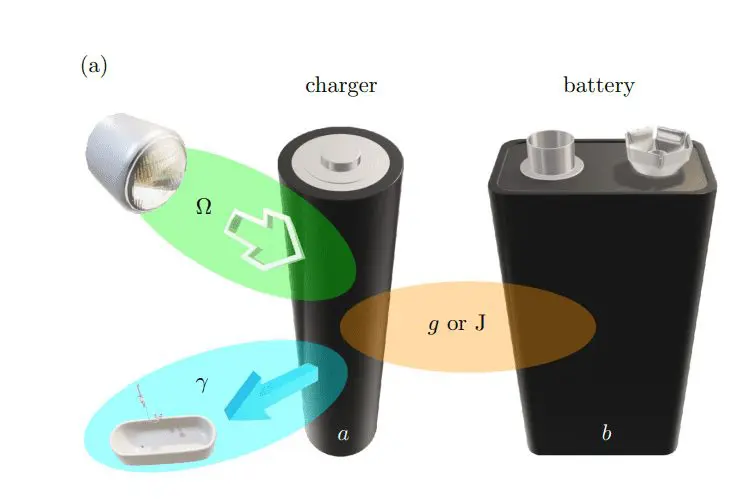
The pursuit of efficient energy storage continually benefits from exploring the potential of quantum phenomena, and recent work by C. A. Downing and M. S. Ukhtary investigates this possibility within the framework of quantum batteries. Their research demonstrates a fundamental link between the maximum usable energy from a quantum battery and Heisenberg’s uncertainty principle, revealing that achieving minimum uncertainty guarantees complete energy withdrawal. The team shows that while linear coupling between charger and battery easily satisfies this criterion, nonlinear coupling allows for nontrivial achievement of minimum uncertainty through a process called squeezing. This theoretical advance characterises the performance of these continuous variable batteries and offers a pathway towards designing highly efficient batteries utilising bosonic excitations, potentially paving the way for innovative photonic energy storage systems.
Researchers investigated how this nonlinearity affects charging power, energy storage capacity, and overall efficiency, modelling the quantum battery as a system of coupled harmonic oscillators. By engineering nonlinear coupling, the scientists examined how quantum effects could enhance energy storage. The results demonstrate that nonlinear coupling significantly improves charging power and increases energy storage capacity. The optimal level of nonlinearity depends on the specific characteristics of the quantum cells and desired operating conditions. This research contributes to the field of quantum energy storage, offering insights into the design and optimisation of quantum batteries and paving the way for more efficient energy storage devices.
Quantum Theory Surpassing Classical Energy Limits
Quantum Theory Surpassing Classical Energy Limits
Quantum Batteries Surpass Classical Charging Limits
This research details theoretical work on quantum batteries, exploring their design, charging mechanisms, and potential advantages over classical batteries. The core concept involves leveraging quantum mechanical principles to achieve faster charging, higher energy density, or improved efficiency, employing mathematical models and simulations to investigate different battery designs and charging protocols. Researchers investigated using squeezed states of light to enhance charging rates, exploring battery designs exhibiting non-reciprocal behavior, and investigating charging protocols leading to hyperbolic increases in charging rate. They also explored the benefits of using multiple quantum modes to increase energy storage capacity and charging speed, and investigated using ancillary quantum systems to accelerate the charging process.
Battery designs based on two-level systems, harmonic oscillators, and many-body systems were analysed, modelling batteries as open quantum systems interacting with the environment. The research investigated thermodynamic properties using KMS states and the concept of passivity. This work contributes to a deeper understanding of the fundamental limits of energy storage and the potential benefits of quantum technologies. Quantum batteries could potentially offer a pathway to overcome the limitations of current lithium-ion battery technology, leading to higher energy density, faster charging, and improved efficiency.
Material Challenges for Quantum Battery Implementation
Material Challenges for Quantum Battery Implementation
Quantum effects can potentially enhance battery performance, but decoherence is a major challenge. Materials science is crucial for translating theoretical concepts into practical devices, requiring the development of suitable materials and fabrication techniques. The field is still in its early stages, and significant challenges remain before quantum batteries become a reality.
Uncertainty Principle and Optimal Energy Extraction
Uncertainty Principle and Optimal Energy Extraction
Quantum Batteries, Uncertainty, and Optimal Energy Extraction
This research demonstrates a fundamental connection between the efficiency of energy storage in quantum batteries and Heisenberg’s uncertainty principle. Scientists have shown that maximizing extractable energy from a bosonic battery requires minimizing uncertainty in its quantum state, effectively allowing all stored energy to be harnessed for work. This principle is readily achieved in batteries with simple, linear charging mechanisms. However, the team also discovered that more complex batteries, employing nonlinear coupling, can also reach this optimal state through a process called squeezing, which manipulates quantum fluctuations.
The investigation involved detailed theoretical modelling of continuous variable quantum batteries, utilizing mathematical descriptions of quantum fields and their associated uncertainties. By characterizing the charging performance of these batteries, researchers identified how the interplay between quantum fluctuations and energy storage impacts overall efficiency. The authors acknowledge that their current work relies on theoretical models and does not yet address the practical challenges of building and maintaining such batteries. Future research should focus on exploring specific physical implementations and investigating the effects of noise and dissipation on battery performance, and further investigation into the potential of different nonlinear coupling mechanisms to enhance energy storage efficiency.
🗞 Energy storage in a continuous-variable quantum battery with nonlinear coupling
🧠 ArXiv: https://arxiv.org/abs/2510.21672
Implementing these nonlinear quantum effects necessitates precise control over the coupling Hamiltonian, often achieved through techniques like cavity quantum electrodynamics (cQED). By trapping light-matter interactions within high-finesse optical cavities, researchers can engineer the coupling strength g relative to cavity dissipation rates (κ) and material decay rates (γ). This careful tuning allows the system to operate deep within the regime where the quantum field can be successfully squeezed, effectively mitigating coupling losses that typically limit continuous variable performance in solid-state platforms.
The realization of minimum uncertainty states is intrinsically linked to minimizing quantum noise sources and decoherence channels. Practically, this means that the overall system fidelity must be maintained significantly above the detrimental effects of the environment, which rapidly degrade non-classical correlations. Future advancements depend on developing robust quantum error correction protocols tailored specifically for bosonic modes, allowing quantum advantage to be sustained long enough for significant energy transfer, bridging the gap between theoretical idealization and ambient physical operation.
Furthermore, scaling these devices requires moving beyond idealized two-mode systems to complex multi-mode architectures. The challenge lies in maintaining quantum coherence and correlated non-linearity across multiple coupled oscillators simultaneously. Addressing this necessitates integrating advanced superconducting circuits or photonic integrated circuits that can support high qubit density and precisely controlled interactions, ensuring that the macroscopic utility of the quantum battery scales favorably with system size.




See today’s quantum computing news on Quantum Zeitgeist for the latest breakthroughs in qubits, hardware, algorithms, and industry deals.



