Understanding the dynamics of the solar wind is crucial for predicting space weather and its impact on Earth, and a new study led by Daniela Martin from the University of Delaware, alongside Connor O’Brien and Valmir P. Moraes Filho from the Catholic University of America, presents a powerful new method for analysing data from NASA’s Parker Solar Probe. The team developed a scalable framework that efficiently processes the massive dataset, exceeding 150 GB collected between 2018 and 2024, using advanced computational techniques and a method called Kernel Density Matrices. This approach reveals key trends in the inner heliosphere, including the relationship between solar wind speed, proton density, and distance from the Sun, offering quantitative insights into the processes driving extreme space weather events and ultimately improving our ability to forecast these phenomena. By making both processed data and analysis tools publicly available, the researchers, including Jinsu Hong from Georgia State University, Jasmine R. Kobayashi from Southwest Research Institute, and Evangelia Samara from NASA Goddard Space Flight Center, aim to accelerate future studies of solar wind dynamics and enhance space weather forecasting capabilities.
This research focuses on characterizing the solar wind, a constant stream of particles emitted by the Sun, and its surrounding plasma environment. Advanced data analysis techniques, including machine learning and efficient data storage methods, are crucial for handling the vast quantities of information generated by the PSP, ultimately improving our understanding of space weather and the connection between the Sun and Earth. Efficient data storage and parallel computing are essential for processing these large datasets, enabling investigations into regions where the solar wind is weak, magnetic reconnection events, and plasma characteristics across the heliosphere. This research is aimed at space physicists, solar physicists, data scientists, and those studying space weather, providing valuable information for understanding the physics of plasmas in space, the Sun’s atmosphere, and the effects of solar activity on Earth and other planets. Advanced graduate students and postdoctoral researchers also benefit from these findings, contributing to a broader understanding of the Sun-Earth connection and the dynamics of the solar wind.
The research follows a standard scientific approach, detailing methods, data sources, and models employed before presenting results and discussing their implications. This framework addresses the challenges of processing such large datasets by harnessing the Dask distributed computing library to enable large-scale statistical computations and the efficient estimation of distributions for key solar wind parameters, including speed, proton density, and thermal speed. KDM represents a density matrix, allowing for the computation of both univariate and joint distributions, and learns parameters by maximizing the likelihood of observed data using automatic differentiation, enabling subsequent statistical analyses and anomaly detection.
This approach overcomes limitations of traditional methods at this scale
This approach overcomes limitations of traditional methods at this scale. The team’s method allows for the identification of characteristic trends in the inner heliosphere, including increasing solar wind speed with distance from the Sun and decreasing proton density, establishing anomaly thresholds for each parameter and providing quantitative insights into extreme space weather phenomena and geomagnetic storms. The analysis reveals characteristic trends in the inner heliosphere, notably an increase in solar wind speed and a corresponding decrease in proton density with increasing distance from the Sun, confirming a well-established inverse relationship between these two parameters. Experiments demonstrate that solar wind speeds range from 100km/s to 1980km/s, with a median of 423km/s, while proton density spans from 0. 00657 to 2,560cm-3, exhibiting a median value of 734cm-3.
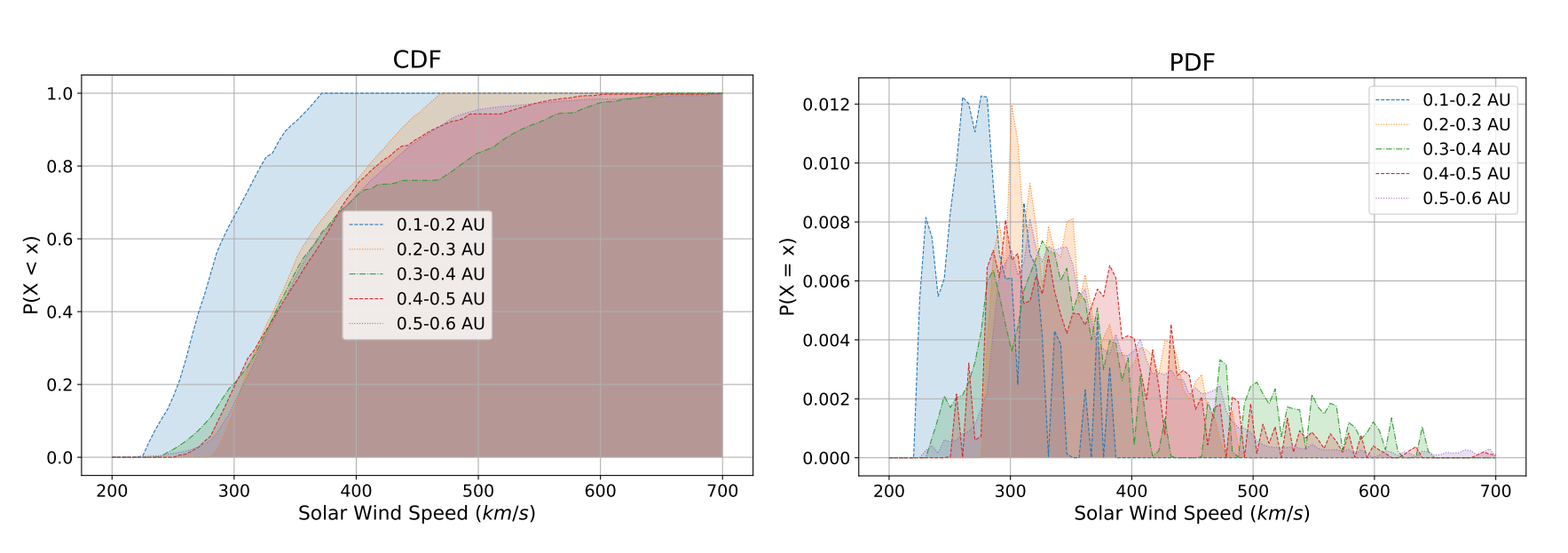
Proton thermal speed ranges from 4km/s to 109,900km/s, with a median of 95. 4km/s, aligning with typical conditions in the inner heliosphere. Detailed analysis of solar wind speed distributions between 0. 1 and 0. 6 AU reveals that speeds are lower closer to the Sun, consistent with previous coronal measurements, and exhibit increased variability at 0.
3 AU, potentially linked to transient events or dynamic coronal structures. Bivariate distributions of solar wind speed versus proton density consistently demonstrate a hyperbolic inverse relationship, where increasing speed correlates with decreasing density. Measurements show a reduction in both maximum solar wind speed and maximum proton density as distance increases from 0. 3-0. 4 AU to 0.
4-0. 5 AU, consistent with the expected rarefaction of the solar wind. By combining distributed computing techniques with quantum-inspired Kernel Density Matrix methods, scientists efficiently estimate distributions of key solar wind parameters and establish anomaly thresholds, revealing characteristic trends in the inner heliosphere.
👉 More information🗞Scalable Machine Learning Analysis of Parker
🗞 Scalable Machine Learning Analysis of Parker Solar Probe Solar Wind Data
🧠 ArXiv: https://arxiv.org/abs/2510.21066




See today’s quantum computing news on Quantum Zeitgeist for the latest breakthroughs in qubits, hardware, algorithms, and industry deals.