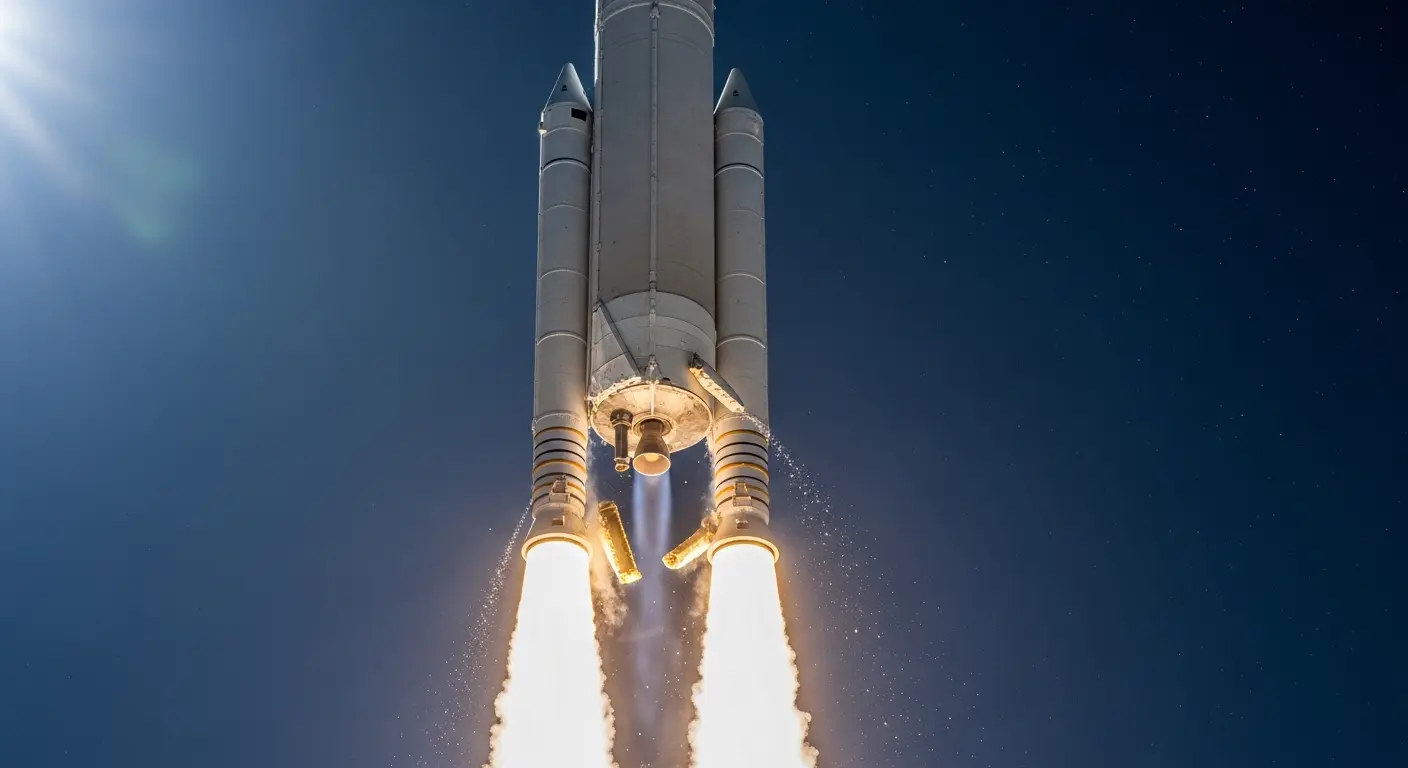
Georgia Tech researchers, led by Assistant Professor Spencer Bryngelson, have advanced spacecraft simulation techniques, achieving a significant breakthrough in computational efficiency and realism. The collaborative project, involving NVIDIA, Oak Ridge National Laboratory, Advanced Micro Devices, Hewlett Packard Enterprise, and the Courant Institute of Mathematical Sciences at New York University, has been selected as a finalist for the Association for Computing Machinery’s 2025 Gordon Bell Prize. This advancement centers on a novel mathematical technique called Information Geometric Regularization (IGR), which allows for the accurate modeling of complex fluid flows, specifically, the “base heating” phenomenon impacting multi-engine spacecraft, without sacrificing computational speed. By preventing potential mission failures through virtual testing, this work promises to dramatically shorten research and development cycles and optimize resource allocation in the rapidly evolving field of space exploration.
Simulating Spacecraft Exhaust for Safer Launches
Researchers at the Georgia Institute of Technology, NVIDIA, and Oak Ridge National Laboratory are advancing spacecraft launch safety through high-fidelity simulations of rocket exhaust plumes. This work, a finalist for the 2025 Gordon Bell Prize, focuses on modeling the complex fluid dynamics created by multi-engine spacecraft configurations. These simulations are crucial for understanding and mitigating a phenomenon called “base heating,” a potentially catastrophic issue arising from clustered engine exhaust. The ability to accurately predict booster behavior before physical construction represents a significant leap forward in aerospace engineering.
The core of this research lies in simulating compressible fluid flows around spacecraft with a large number of rocket engines, mirroring the designs currently under development by SpaceX. Base heating occurs when the hot exhaust from multiple engines reflects back towards the rocket’s tail, potentially damaging critical components. The team’s simulations allow engineers to test complex engine layouts, such as the 33-engine Super Heavy booster, without the enormous expense and risk of physical prototypes. Obtaining time on the world’s largest supercomputers is a competitive process, and this project’s selection highlights its potential impact on resource efficiency and safety.
This computational approach offers substantial benefits, enabling faster design iteration and shortening the research and development timeline for new spacecraft. Instead of building and testing each new design physically, engineers can now rely on simulations to predict booster behavior and identify potential issues. According to Spencer Bryngelson, an assistant professor and researcher at the School of Computational Science & Engineering at Georgia Tech, simulations offer a safe and rapid method for testing alterations; a failed simulation simply restarts in seconds, allowing for quick refinement of variables. This capability is especially valuable for complex systems like multi-engine rockets, where physical testing is both expensive and inherently dangerous.
“Our team has run simulations on many different computers. In this case, it was Jupiter, Europe’s new fastest supercomputer located in Germany, and CSCS, Alps in Switzerland, which both use NVIDIA Grace Hopper architecture.”
Assistant Professor Spencer Bryngelson, School of Computational Science & Engineering at Georgia Tech
“We’d run on one or a couple of nodes to see the simulation evolve. And then we would take that algorithm to one of the other large computers we had access to, and we could start the process there.”
Assistant Professor Spencer Bryngelson, School of Computational Science & Engineering at Georgia Tech
Refining Simulations with Advanced Supercomputing Tools
Building on this advancement in spacecraft simulation, researchers at Georgia Tech, NVIDIA, and Oak Ridge National Laboratory focused heavily on optimizing computational efficiency. The project achieved a peak performance of 6.5 exaflops, a measure of a computer’s processing speed, on the Frontier supercomputer at ORNL, demonstrating a significant leap in the scale of simulations possible. This level of performance was enabled by employing advanced algorithms and data structures specifically designed to minimize memory usage and maximize parallel processing capabilities, allowing for a far more detailed and accurate representation of complex fluid dynamics. The team meticulously refined the simulation code to improve its scalability, ensuring it could effectively utilize the massive parallel processing power of Frontier.
NVIDIA played a critical role in this optimization process, providing access to its latest generation of GPUs and collaborating with the research team to tailor the simulation code for optimal performance on these architectures. According to reports, the simulation leveraged a hybrid approach, combining CPU and GPU processing to balance computational load and maximize overall efficiency. Furthermore, the researchers implemented techniques like asynchronous data transfer and memory coalescing to reduce communication bottlenecks and improve data throughput. This careful attention to detail resulted in a substantial reduction in simulation runtime, enabling the team to explore a wider range of design parameters and scenarios.
The implications of this work extend beyond spacecraft design, offering valuable insights for other fields requiring high-fidelity fluid dynamics simulations. The techniques developed to optimize the simulation code are applicable to areas such as aerodynamics, weather forecasting, and materials science. Spencer Bryngelson, an assistant professor and researcher at the School of Computational Science & Engineering at Georgia Tech, emphasized the importance of sustainable computing practices, noting that reducing the computational cost of simulations is crucial for enabling scientific discovery and innovation. By pushing the boundaries of supercomputing technology, this project paves the way for more efficient and impactful research across a wide range of disciplines.
“The use of Grace Hopper chips is very important. A big part of the reason that we were able to do these very large simulations was due to the time we spent refining them on NCSA and sister machines.”
Assistant Professor Spencer Bryngelson, School of Computational Science & Engineering at Georgia Tech
International Collaboration Drives Efficiency & Access
The success of this spacecraft simulation project hinges on a robust international collaboration, demonstrating how shared resources and expertise accelerate scientific discovery. Researchers at the Georgia Institute of Technology partnered with NVIDIA, Oak Ridge National Laboratory, Advanced Micro Devices, Hewlett Packard Enterprise, and the Courant Institute of Mathematical Sciences at New York University to achieve these results. This collaborative spirit allowed the team to leverage specialized hardware and software, ultimately maximizing computational efficiency and minimizing development time for this complex undertaking.
Building on this foundation, the project benefited significantly from access to cutting-edge supercomputing resources provided by multiple institutions. According to Spencer Bryngelson, an assistant professor and researcher at the School of Computational Science & Engineering at Georgia Tech, this access is critical for tackling problems of this scale. NVIDIA contributed its advanced GPU technology, while Oak Ridge National Laboratory provided access to its powerful supercomputers, enabling the team to perform simulations with unprecedented detail and accuracy. Advanced Micro Devices and Hewlett Packard Enterprise also played a key role, offering their expertise in high-performance computing architectures and infrastructure.
This collaborative approach not only accelerates research but also promotes sustainability in computational science. The ability to accurately simulate complex systems, like a multi-engine spacecraft, before physical prototyping reduces the need for costly and resource-intensive hardware tests. The Courant Institute of Mathematical Sciences at New York University contributed vital algorithms and modeling techniques, enhancing the precision and reliability of the simulations. This commitment to efficiency and collaboration demonstrates a forward-thinking approach to scientific advancement, potentially reshaping how complex engineering problems are addressed in the future.
This successful simulation, a finalist for the Association for Computing Machinery 2025 Gordon Bell Prize, showcases the power of collaborative research involving Georgia Tech, NVIDIA, and Oak Ridge National Laboratory. By accurately modeling complex multi-engine spacecraft exhaust, the team addressed the critical issue of base heating, a phenomenon impacting rocket design and safety. The implications extend beyond immediate aerospace applications, as advanced computational fluid dynamics benefit numerous engineering disciplines.
For industries relying on complex simulations, this work demonstrates how efficient supercomputing can save substantial resources. This could enable more rapid prototyping and optimization of designs, reducing both development time and costs. Building on this success, researchers can now explore even more intricate systems, pushing the boundaries of what’s computationally possible and ultimately fostering innovation across multiple scientific fields.




See today’s quantum computing news on Quantum Zeitgeist for the latest breakthroughs in qubits, hardware, algorithms, and industry deals.