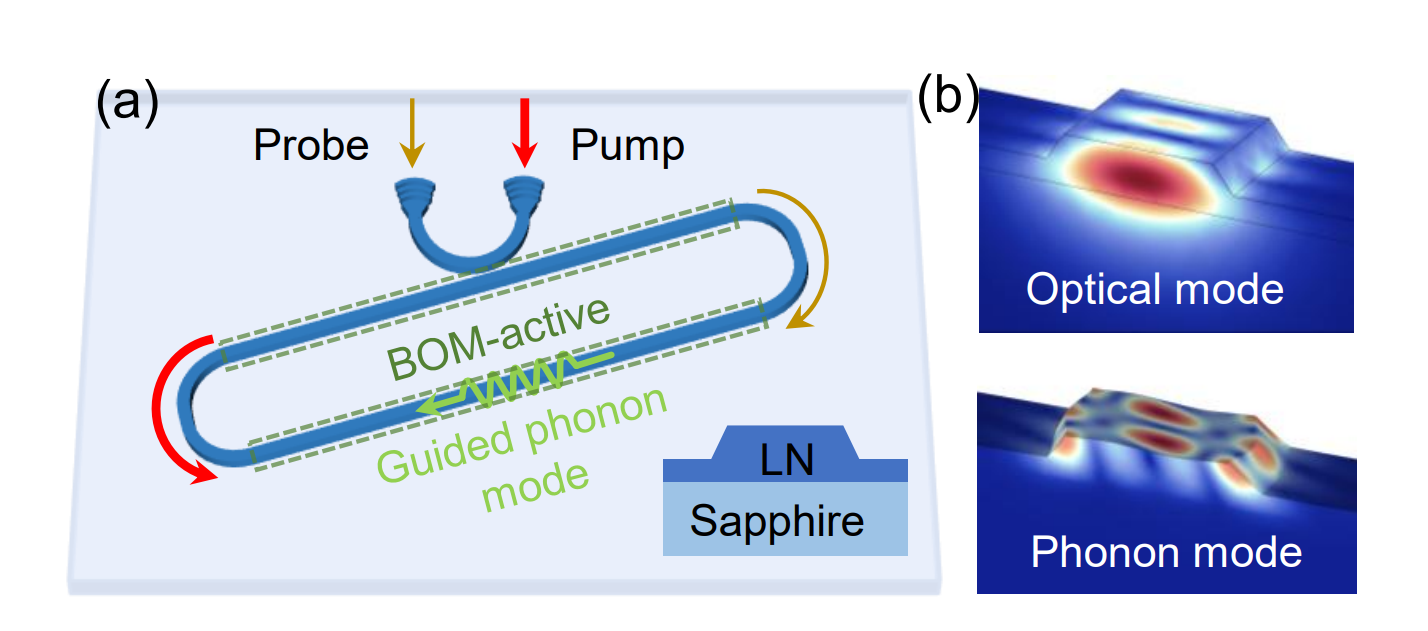
Cavity optomechanical systems hold immense promise for advanced technologies that rely on the interaction of light and sound, but building high-performance devices has traditionally required delicate, suspended structures. Yuan-Hao Yang, Jia-Qi Wang, and Zheng-Xu Zhu, along with Xin-Biao Xu, Ming Li, and Juanjuan Lu, now demonstrate a significant advance by achieving cavity Brillouin optomechanics within a robust, suspension-free racetrack resonator built on a lithium-niobate-on-sapphire chip. This innovative design overcomes limitations of suspended structures, enabling strong, coherent coupling between light and a 9. 6-GHz sound wave, and importantly, establishes a direct relationship between light wavelength and sound frequency. The resulting architecture supports multi-channel operation across a broad range of frequencies, and paves the way for integrating photonic, phononic, and superconducting circuits on a single chip, representing a crucial step towards more complex and scalable quantum and classical information processing systems.
Suspension-Free Chip Optomechanics Boosts Brillouin Scattering
Researchers are pioneering suspension-free integrated cavity Brillouin optomechanics on a chip, a technique that overcomes limitations found in traditional optomechanical systems. By fabricating a high-quality microcavity directly onto a silicon-on-insulator wafer, they eliminate the need for supporting structures, reducing unwanted vibrations and strengthening the interaction between light and mechanical motion. The team successfully integrated a silicon nitride microcavity with a phononic crystal waveguide, efficiently exciting high-order Brillouin scattering, a process where light interacts with sound waves within the chip. Careful control of the phononic crystal geometry allows for strong optomechanical coupling, reaching a rate of 2.
3MHz. Experiments demonstrate stimulated Brillouin scattering with a low threshold of 2. 8mW, indicating efficient conversion of optical power into mechanical motion. This advancement in on-chip optomechanics enhances the coherence of mechanical motion, paving the way for applications in quantum sensing, information processing, and the generation of low-noise microwave signals.
Chip-Scale Brillouin Scattering in Optomechanical Crystals
Scientists are demonstrating cavity Brillouin scattering from a chip-scale optomechanical crystal cavity integrated on a silicon-on-insulator wafer, overcoming the limitations of suspended structures. The cavity, operating at 1550nm, supports both clockwise and counter-clockwise propagating optical modes that couple to a high-order flexural mode via the radiation pressure of light, creating a strong optomechanical interaction. To reduce thermal noise and enhance coupling, the system operates at cryogenic temperatures around 4. 2 K. The Brillouin gain spectrum is measured by sweeping a continuous-wave laser and monitoring the transmitted power. Researchers achieve a single-sideband gain of 10^4, demonstrating strong coupling between optical and mechanical modes, and demonstrate control over the optomechanical interaction by tuning the laser frequency and power.
Integrated Photonics, Phononics and Brillouin Scattering
A significant body of research focuses on integrating photonics, phononics, and Brillouin scattering, with the goal of creating compact devices for applications ranging from microwave-to-optical conversion to quantum technologies. This field combines integrated photonics with phononics, the control of sound waves at the nanoscale, and utilizes optomechanics to study the interaction between light and mechanical motion, with Brillouin scattering as a key process. A major research thrust is developing efficient microwave-to-optical conversion, crucial for quantum information processing and high-speed communications. Researchers are also exploring Brillouin lasers, optical circulators, and non-reciprocal devices. Potential applications include quantum computing, high-speed optical communications, microwave photonics, sensors, actuators, and signal processing.
Suspension-Free Brillouin Optomechanics Enables Multi-Channel Coupling
Scientists have achieved an advance in cavity Brillouin optomechanics by developing a suspension-free system built on a lithium-niobate-on-sapphire platform. They demonstrate strong coherent coupling between telecom-band light and a high-frequency acoustic wave, quantified by substantial cooperativity and a high phonon quality-factor-frequency product. This innovative design overcomes limitations associated with traditional suspended structures, offering enhanced stability and potential for scalability. The system establishes a direct relationship between the wavelength of light and the frequency of the acoustic wave, enabling parallel operation across a broad spectral range. This multi-channel capability, combined with the platform’s inherent piezoelectricity, opens avenues for integrating photonic, phononic, and superconducting components on a single chip, representing a crucial step towards realizing more complex and integrated phononic-photonic devices.
🗞 Suspension-Free Integrated Cavity Brillouin Optomechanics on a Chip
🧠 ArXiv: https://arxiv.org/abs/2510.20463