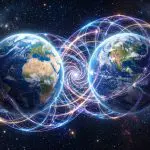
The fundamental question of how gravity interacts with quantum entanglement receives fresh scrutiny in new work challenging the idea that classical gravity alone can link distant quantum systems. Chiara Marletto and Vlatko Vedral, both from the University of Oxford, demonstrate that entanglement arising solely from local gravitational means requires specific, and previously unrecognised, features within the gravitational field. This research refutes a recent claim suggesting that massive objects in superposition could become entangled through classical gravity alone, and importantly, establishes conditions necessary for gravity to mediate entanglement between distant masses. By clarifying these requirements, the team advances our understanding of the interplay between gravity and quantum mechanics, and highlights the limitations of purely classical explanations for entanglement.
Recent proposals aim to detect quantum effects in gravity by utilising Gravitationally Induced Entanglement (GIE) between massive probes, indirectly suggesting that gravity itself possesses non-classical features. These proposals rest on the principle that creating entanglement between quantum systems locally requires non-classical characteristics in the mediating force, in this case gravity. A recent paper presents a counterexample, proposing a local Hamiltonian, described in their work, which they claim can generate GIE between two interfering masses. This Hamiltonian represents the gravitational field within the linear regime and details its coupling to the masses involved.
Disproving Classical Gravity’s Role in Entanglement
Analysis Disproves Classical Gravity’s Entanglement Role
Hamiltonian Analysis Disproves Gravitational Entanglement Claim
The research concerns a detailed analysis of claims regarding gravitationally induced entanglement, specifically addressing a recent proposal that classical gravity can mediate entanglement between massive particles. The authors demonstrate that a previously published Hamiltonian, designed to support this claim, actually violates the conditions necessary to demonstrate quantum gravity through the proposed entanglement protocol. The initial Hamiltonian, transformed through a mathematical procedure, yields a new form which introduces a direct interaction between the two masses. The authors highlight that this direct interaction, absent in the original protocol’s requirements, invalidates the claim of demonstrating entanglement via local classical means.
The resulting Hamiltonian, while capable of creating entanglement, does so through a non-local interaction, contradicting the assumptions of the entanglement protocol. They explain that a classical field, by its very nature, cannot simultaneously perturb itself in two different locations, a requirement for mediating entanglement locally. This impossibility, they argue, is not specific to any particular formalism but is a fundamental information-theoretic principle. The analysis demonstrates that the previously published interpretation of gravitationally induced entanglement is invalid and does not present a counterexample to the validity of entanglement as a witness of non-classicality in gravity. Observing entanglement between massive particles mediated locally through gravity, as originally proposed, remains a strong indicator of the quantum nature of the gravitational field. This research was supported by the Gordon and Betty Moore Foundation and the Eutopia Foundation.
Why Local Interactions Cannot Create Entanglement
Chiara Marletto and Vlatko Vedral argue against a recent claim suggesting classical gravity can generate entanglement between massive objects through local means, arguing for the necessity of quantum features for gravitational entanglement. The work directly addresses and rebuts misconceptions presented in a prior publication, demonstrating that while a classical Hamiltonian can be manipulated to appear to generate entanglement, this requires a non-local transformation, effectively masking a direct, non-local interaction. Researchers established that the resulting Hamiltonian, despite superficially satisfying the requirements of gravitational induced entanglement (GIE) protocols, fundamentally lacks the local interaction claimed by the opposing argument. The team rigorously demonstrated that any attempt to create entanglement via a purely classical mediator is impossible if locality is to be maintained, highlighting a critical limitation of classical systems.
Specifically, a mass existing in a superposition of two locations would require a classical field to be perturbed simultaneously in both locations, a feat inherently beyond the capabilities of classical systems which cannot exhibit such non-local behavior. This impossibility, scientists emphasize, is not dependent on any specific formalism but represents a fundamental information-theoretic truth, transcending the details of any particular quantum field theory implementation. Experiments and analysis confirm that observing entanglement between two masses mediated locally through gravity serves as definitive evidence of quantum effects within the gravitational field itself, as previously proposed in related studies. The research underscores the power of information-theoretic tools in probing the foundations of quantum gravity, solidifying the understanding that genuine gravitational entanglement necessitates quantum mechanical principles.
Quantum Effects are Necessary for Entanglement
Quantum Effects Are Necessary for Entanglement
Quantum Entanglement Requires Genuine Quantum Effects
This research successfully refutes a recent claim that classical physics can account for entanglement between massive objects through local gravitational interactions. The team demonstrates, through information-theoretic arguments, that genuine gravitational induced entanglement requires quantum effects, arguing against the proposed classical mechanism presented by other researchers. This finding reinforces the understanding that observing entanglement between distant masses via gravity serves as evidence for the quantum nature of the gravitational field itself, a concept previously proposed and supported by this analysis. The study highlights the fundamental limitations of classical explanations when attempting to describe phenomena reliant on quantum principles, specifically in the context of gravity. Future work, the authors suggest, will continue to refine these information-theoretic tools and explore the implications for laboratory-based tests designed to probe quantum effects in gravity.
🗞 Classical Gravity Cannot Mediate Entanglement by Local Means
🧠 ArXiv: https://arxiv.org/abs/2510.19969

See today’s quantum computing news on Quantum Zeitgeist for the latest breakthroughs in qubits, hardware, algorithms, and industry deals.