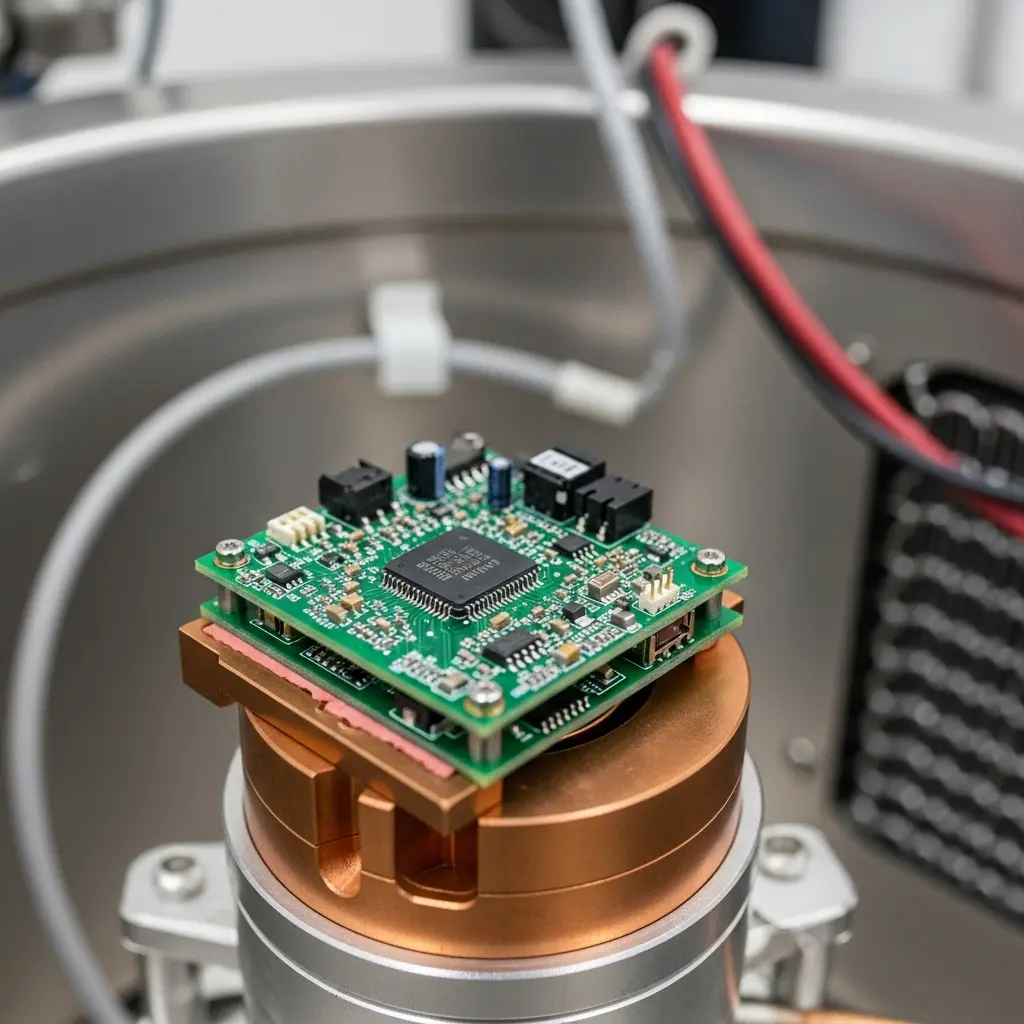
Understanding the behaviour of interacting quantum systems remains a central challenge in modern physics, and researchers are increasingly turning to quantum simulators to model these complex phenomena. Troy Losey, Jin Zhang, and S. -W. Tsai, from the University of California, Riverside and Chongqing University, now demonstrate a solid-state platform for building such simulators, utilising implanted spin centres to create a system analogous to an interacting Kitaev chain. Their work introduces a tunable model capable of exhibiting a range of exotic phases, including floating phases and symmetry-breaking transitions, and crucially, the team develops novel methods for calculating a key parameter, the Luttinger liquid parameter, which characterises the system’s low-energy behaviour. These new computational techniques offer a more efficient way to identify critical transitions, such as the Berezinskii-Kosterlitz-Thouless transition, than existing methods, representing a significant advance in the field of quantum simulation and offering new avenues for exploring strongly correlated quantum systems.
Luttinger Parameter Determination in Kitaev Chains
This research introduces a solid-state platform for building quantum simulators using implanted spin centers, enabling the investigation of fundamental many-body physics in a controllable manner. The focus lies on the one-dimensional interacting Kitaev chain, and accurately determining the Luttinger liquid parameter, a crucial quantity that characterises the low-energy behaviour of these interacting systems. By precisely measuring this parameter, scientists gain deeper insight into the emergent properties and collective excitations within the quantum simulator. This solid-state platform represents a significant advancement in quantum simulation, offering a pathway to explore complex quantum phenomena with unprecedented precision.
Researchers build upon the proposal for a spin-1 chain of spin centers coupled through magnetic dipole-dipole interactions and subjected to an external magnetic field as a quantum simulator for critical floating phases. They introduce another magnetic field and map the system to the interacting Kitaev chain, a setup tunable through the applied fields and the orientation of the spin centers within the crystal. This exhibits a variety of rich quantum behaviour, notably including floating phases, a Z2 symmetry-breaking phase, and lines of both Berezinskii-Kosterlitz-Thouless and Pokrovsky-Talapov transitions.
Simulating Kitaev Chains with Diamond Qubits
This research proposes a method for building a quantum system using nitrogen-vacancy (NV) centers in diamond, aiming to simulate and study complex quantum phenomena, particularly those related to the interacting Kitaev chain. The core idea involves utilizing NV centers as qubits, the fundamental building blocks of a quantum computer, due to their relatively long coherence times and potential for scalability. The primary goal is to create a platform to simulate the interacting Kitaev chain, a model system in condensed matter physics known for hosting Majorana fermions and potential applications in topological quantum computation. The system is designed to facilitate long-range interactions between qubits, crucial for accurately representing the interactions within the Kitaev chain.
Researchers explore using magnons, quantized spin waves, to mediate interactions between NV centers, allowing for tunable and long-range coupling. They focus on characterizing the entanglement properties of the system, particularly around quantum critical points, to understand its topological order and potential for quantum computation. Simulating the Kitaev chain could lead to advancements in topological quantum computation, which is more robust against errors than traditional quantum computation, and provide insights into the behaviour of strongly correlated electron systems and other complex materials.
Simulating Quantum Phases with Implanted Spins
This research demonstrates a solid-state platform for quantum simulation, utilizing implanted spin centers and their magnetic interactions to model complex physical systems. The team successfully designed a one-dimensional chain of these spin centers, demonstrating its ability to simulate the interacting Kitaev chain and exhibit a range of quantum phases, including floating phases, symmetry-breaking phases, and both Berezinskii-Kosterlitz-Thouless and Pokrovsky-Talapov transitions. This achievement establishes a novel approach to exploring critical phenomena in condensed matter physics.
Furthermore, the researchers developed and tested new methods for calculating the Luttinger liquid parameter, a key indicator of quantum phase transitions, and found these methods to be more efficient than traditional techniques. While acknowledging that their calculations may be affected by approximations near certain transitions, the team suggests these limitations could potentially be utilized to more precisely identify those transitions. Future work will focus on strengthening and extending the range of interactions between spin centers, paving the way for the creation of more complex two- and three-dimensional quantum simulators.
🗞 Calculating the Luttinger liquid parameter for an interacting Kitaev chain quantum simulator
🧠 ArXiv: https://arxiv.org/abs/2510.19189




See today’s quantum computing news on Quantum Zeitgeist for the latest breakthroughs in qubits, hardware, algorithms, and industry deals.