

Pi-conjugated covalent organic frameworks offer exciting potential for creating new quantum materials, but realising this requires precise control over the behaviour of electrons within their structures. Yuyi Yan, Fujia Liu, and Weichen Tang, alongside colleagues at the University of California, Berkeley, now demonstrate a new strategy for building these frameworks, specifically focusing on diatomic Kagome lattices constructed from aza-triangulene building blocks. Their work reveals that carefully designed molecular connections within the lattice induce a phenomenon called orbital-phase frustration, leading to the formation of ‘flat bands’, electronic states with unique properties. This achievement establishes a general principle for controlling electron behaviour in organic lattices and paves the way for creating COF-based materials with potentially revolutionary correlated electronic properties.
This innovative material provides a versatile platform for designing quantum nanomaterials with exotic properties, stemming from the precise control of electron behaviour within its artificial lattice structure.
Aza-Triangulene Covalent Organic Framework Synthesis and Properties
This research details the creation and characterization of ATCOF, a material built from aza-triangulene molecules linked together to form a two-dimensional network. The core building block, aza-triangulene, provides both rigidity and unique electronic characteristics to the framework. By connecting these units with covalent bonds, the team created a Kagome lattice, a specific arrangement of atoms known for its unusual electronic properties. The resulting material exhibits Dirac cones, indicating the presence of massless electrons that contribute to high carrier mobility, and Van Hove singularities, which enhance the density of electronic states.
Crucially, the electronic properties of the ATCOF can be tuned by altering the linker molecule used to connect the aza-triangulene units. The ATCOF is synthesized directly on a gold substrate through a process of on-surface synthesis. Specific molecular precursors, containing the aza-triangulene and linker components, are deposited onto the gold surface and then heated to induce polymerization and the formation of covalent bonds. This self-assembly process results in the creation of the desired two-dimensional ATCOF network. Researchers explored various linker molecules, including buta-1,3-diyne and hexa-1,3,5-triyne, to create ATCOFs with differing properties and even cyclic structures.
The team employed several advanced characterization techniques to confirm the structure and properties of the ATCOF. Scanning tunneling microscopy (STM) provided atomic-scale images of the Kagome lattice, while scanning tunneling spectroscopy (STS) revealed the presence of Dirac cones and Van Hove singularities in the electronic band structure. Conductive atomic force microscopy (nc-AFM) mapped the electronic properties with high spatial resolution, and spectroscopic mapping visualized the electronic structure and momentum-resolved features. These experimental results were supported by theoretical calculations using density functional theory (DFT) and a simplified tight-binding model, which accurately predicted the observed electronic behaviour.
This research demonstrates the successful synthesis of a stable two-dimensional ATCOF with unique electronic properties. The observation of Dirac cones and Van Hove singularities, coupled with the ability to tune these properties by changing the linker molecule, opens up exciting possibilities for applications in high-mobility electronics, optoelectronics, energy storage, and catalysis. The ability to control the material’s properties at a molecular level represents a significant advance in the field of two-dimensional materials.
Orbital Frustration Creates Kagome Flat Bands
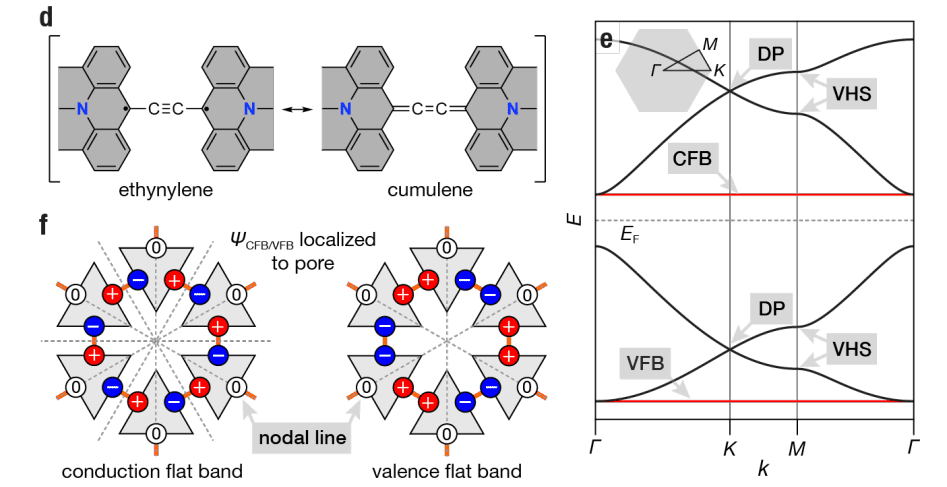
Scientists have achieved a breakthrough in materials design by creating aza-triangulene covalent organic frameworks (ATCOFs) that exhibit unique electronic properties. This work establishes a modular strategy for constructing diatomic Kagome lattices from aza-triangulene nodes linked by ethynylene groups, resulting in a two-dimensional crystalline structure. Detailed calculations and scanning tunneling spectroscopy reveal the formation of a sixfold degenerate set of edge-localized Wannier functions within the unit cell, giving rise to non-trivial flat bands induced by orbital-phase frustration. The team demonstrated the creation of phase-frustrated Kagome flat bands within the ATCOF framework, based on a nearest-neighbour tight-binding model.
Calculations predict that the electronic ground state of the aza-triangulene core is an open-shell doublet, stabilized by hybridization between edge-fused AT cores and cumulenic resonance structures. This stabilization restores a set of three single-occupied frontier orbitals per lattice node, essential for the formation of the desired electronic structure. Analysis of the resulting band diagram confirms the presence of valence and conduction band complexes characteristic of a Type-II diatomic Kagome lattice, with flat bands appearing at lower energies. Experiments revealed distinctive signatures of Kagome flat bands near the Fermi level, consistent with both theoretical simulations and Wannier function analysis.
Interference patterns, arising from destructive wave function overlap, localize wave functions along the inner circumference of the lattice pores, creating two phase frustration-induced Kagome flat bands, one each at the bottom of the conduction and valence band complexes. The team successfully synthesized the ATCOF material through on-surface synthesis, utilizing a molecular precursor derived from a Ramirez reaction with carbon tetrachloride. This highly modular approach paves the way for exploring strongly correlated and higher-order topological phases in exotic carbon-based quantum materials.
Aza-Triangulene Kagome Lattices Enable Flat Bands
Researchers have successfully designed and synthesized a new class of two-dimensional covalent organic frameworks (COFs) with a unique diatomic Kagome lattice structure. This achievement centres on aza-triangulene building blocks, carefully linked to create a framework exhibiting specific orbital interactions. Through a combination of theoretical calculations and scanning tunneling microscopy, the team demonstrated the formation of flat bands within the material, arising from frustration in the arrangement of electron orbitals. This work establishes a general principle for controlling orbital behaviour in organic lattices, opening avenues for creating COF-based quantum materials with tailored electronic properties. The researchers confirmed the successful bottom-up synthesis of these COFs on a gold surface, verifying the structural arrangement through detailed imaging techniques. Further research is needed to fully explore the potential of these COFs for applications in quantum electronics, with future work likely focusing on manipulating the electronic properties of the material and integrating it into functional devices.
👉 More information
🗞 Engineering phase-frustration induced flat bands in an aza-triangulene covalent Kagome lattice
🧠 ArXiv: https://arxiv.org/abs/2510.16126