The very earliest moments of the universe, immediately after the Big Bang, remain a profound mystery in cosmology, and current models face increasing scrutiny from new observational data. Ruolin Liu, Jerome Quintin, and Niayesh Afshordi, from the University of Waterloo and the Perimeter Institute for Theoretical Physics, investigate a compelling alternative to prevailing theories of cosmic inflation, proposing a model rooted in quadratic gravity. Their work demonstrates how this approach naturally evolves from a mathematically consistent ultraviolet completion, a theory describing physics at extremely high energies, into the standard inflationary paradigm observed in the early universe. Crucially, the team’s calculations reveal a pathway for this theory to smoothly transition into general relativity, the cornerstone of modern cosmology, as the universe expands and cools, offering a potential resolution to long-standing questions about the connection between quantum gravity and the observable cosmos.
Running Gravity and Quantum Scale Relativity
Scientists are exploring Quantum Scale Relativity (QQSR), a theoretical framework reconciling quantum mechanics and general relativity, focusing on the idea that the strength of gravity changes with energy scale. This running of the gravitational coupling has implications for understanding the very early universe and a period of rapid expansion called inflation, aiming to explain how inflation began and the conditions present in those first moments. The team investigates how scale invariance, suggesting physics remains the same at different scales, is broken to generate the observed dynamics of the cosmos. The calculations involve deriving a potential governing a scalar field driving inflation, influenced by the running of the gravitational coupling and mechanisms breaking scale invariance. By calculating slow-roll parameters describing the potential’s flatness, scientists can predict key cosmological observables, including the spectral index, tensor-to-scalar ratio, and scalar amplitude, then compare these predictions with observational data to test the QQSR model. The results demonstrate that the QQSR model offers an alternative to standard inflationary theories, potentially providing new insights into the fundamental nature of gravity and the early universe, predicting specific relationships between the running gravitational coupling, scale-breaking mechanisms, and observable cosmological parameters, allowing for testable predictions compared with data from the cosmic microwave background and other cosmological observations.
Quadratic Gravity and Early Universe Inflation
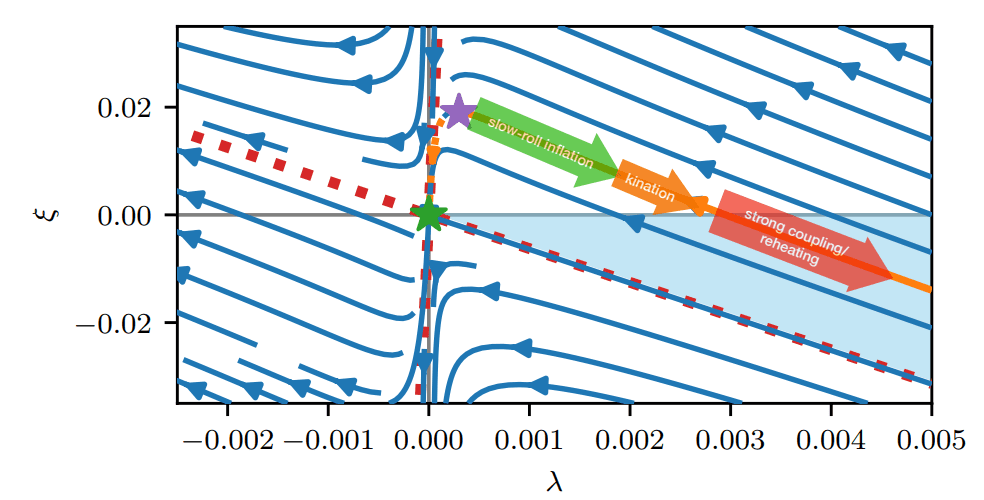
Scientists have developed a new approach to understanding the early universe by investigating quadratic gravity as a potential ultraviolet (UV) completion of general relativity, exploring whether a theory incorporating quantum corrections to gravity can accurately describe the inflationary epoch and the subsequent transition to the standard radiation era. Researchers modified the standard Einstein-Hilbert action, adding terms involving the square of the Ricci scalar and the contraction of the Weyl tensor, creating a higher-derivative theory with new fields, focusing on the behavior of pure quadratic gravity at extremely high energies to address potential instabilities. The study involved a detailed analysis of the renormalization group (RG) flow of quadratic gravity, calculating how the theory evolves with energy scale, incorporating contributions from various types of matter fields. These calculations revealed that the theory is well-behaved at extremely high energies, exhibiting asymptotic freedom, deriving equations describing how the couplings within the theory change with energy scale, finding trajectories exhibiting both UV asymptotic freedom and IR tachyon-free behavior, a crucial condition for a viable inflationary scenario. The results demonstrate that successful inflation can occur in a specific regime where a key coupling is decreasing, but before it reaches an instability, transitioning into a kinetic-dominated phase as inflation ends, with quadratic gravity approaching its strong coupling scale, ultimately giving way to general relativity, identifying a “reheating surface” at the end of this kinetic phase, representing a connection between the quadratic gravity and general relativity regimes.
Quadratic Gravity Dynamically Drives Inflationary Cosmology
Scientists have demonstrated a pathway for inflationary cosmology originating from a fundamental theory of quadratic gravity, achieving a scenario compatible with recent cosmological constraints that challenge simpler models like Starobinsky inflation. This work reveals how quantum effects dynamically induce slow-roll inflation as the universe evolves from an initial ultraviolet regime toward lower energies, finding that the inclusion of a large number of matter fields significantly enhances the running of couplings within the theory, allowing for phenomenologically viable spectral indices and tensor-to-scalar ratios. The research demonstrates that as inflation concludes, the theory approaches a strong coupling regime, necessitating the emergence of general relativity as an effective field theory to facilitate reheating and the transition to a standard radiation-dominated era, predicting a minimum tensor-to-scalar ratio of 0. 01, establishing a lower bound for observable gravitational waves from this inflationary scenario, providing a concrete connection between a fundamental ultraviolet completion, quadratic gravity, and observable cosmological dynamics, including reheating and precise cosmological observations. The beta functions governing the theory admit solutions that are asymptotically free at high energies and remain tachyon-free at lower energies, ensuring stability and allowing for a viable inflationary phase, discovering that successful inflation occurs in a regime where a key coupling is decreasing, but before it reaches a tachyon divide, indicating a specific range of energy scales where inflation can be sustained, confirming that as inflation ends, the universe enters a kinetic-dominated phase, known as kination, before approaching the strong coupling scale of quadratic gravity.
Quantum Gravity Resolves Inflationary Constraints
This research presents a new model of inflation, termed quantum quadratic gravity, successfully addressing recent cosmological constraints that challenge the established Starobinsky model, linking the physical renormalization scale to curvature, constructing a framework yielding a slow-roll inflationary potential, aligning predictions with current observations of the cosmic microwave background, predicting a spectral index and tensor-to-scalar ratio consistent with data, particularly when a large number of matter fields are present. Importantly, the team demonstrated that to remain within a controlled, perturbative regime, the model predicts a minimum tensor-to-scalar ratio of 0. 01, offering a viable alternative to existing inflationary models and providing a connection between ultraviolet completion of gravity and observable cosmological parameters, acknowledging that results are most reliable when the ’t Hooft-like coupling remains below unity, indicating the approach to a strong coupling regime.
👉 More information
🗞 Ultraviolet Completion of the Big Bang in Quadratic Gravity
🧠 ArXiv: https://arxiv.org/abs/2510.18733