

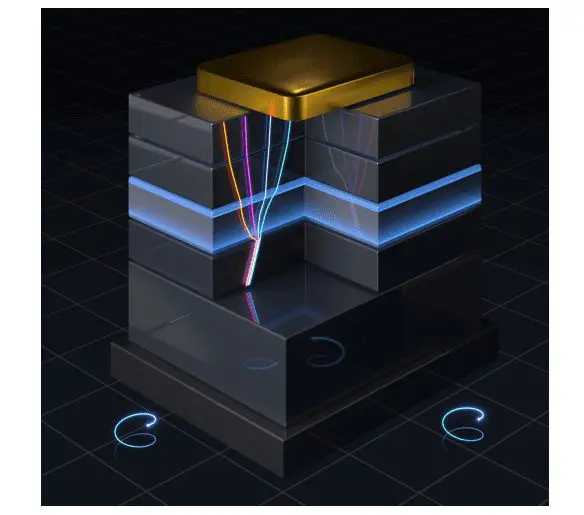
The behaviour of electrons in materials with very narrow, broken, or inverted band gaps presents a significant challenge to materials scientists, as even small electrical influences dramatically alter their fundamental properties. Maximilian Hofer, Christopher Fuchs, and Moritz Siebert, along with colleagues at their institutions, now demonstrate a robust method for accurately modelling these complex systems. Their work overcomes the limitations of conventional approaches by employing a full-band envelope-function technique, implemented in the freely available software package kdotpy, to achieve numerically stable and quantitatively accurate results. By successfully modelling experimental data from thick, topologically inverted mercury telluride wells, the team provides a powerful new tool for investigating a wide range of narrow-, broken-, and inverted-gap materials and promises to accelerate progress in this important field.
Gate Control in Topological Heterostructures
Researchers have developed a comprehensive model to investigate how gate voltages control the electronic properties of heterostructures with narrow, broken, or inverted band gaps, particularly those exhibiting topological characteristics. This approach combines calculations of electrostatic potential with a quantum mechanical description of electron behaviour, allowing for a detailed understanding of charge distribution and current flow. The method accurately predicts how band bending, charge accumulation, and screening effects influence device performance, and enables detailed analysis of electron density, transmission probabilities, and electrical conductance as a function of applied voltage. The team validated the model by simulating various heterostructure configurations, including those based on indium arsenide/gallium antimonide quantum wells and topological insulator/semiconductor interfaces.
Simulations reveal a strong relationship between electrical conductance and gate voltage, with clear evidence of quantum confinement and resonant tunnelling. Researchers observe that the gate voltage effectively controls the energy levels within the quantum well, significantly altering how electrons transmit through the structure. The model accurately predicts the formation of accumulation and depletion layers, and the resulting screening effects are crucial for determining overall device performance. Furthermore, the study explores the impact of imperfections at the interface between materials on electrical conductance, demonstrating a significant reduction in conductance with increasing disorder.
Researchers find that interface roughness broadens resonant peaks and suppresses overall transmission probability. The model provides valuable insights into the limitations imposed by material imperfections and highlights the importance of interface quality for achieving high-performance devices. By accurately capturing the interplay between electrostatics and quantum transport, it serves as a powerful tool for designing and optimising novel heterostructure devices with tailored electronic properties, applicable to a wide range of materials and configurations. A quantitative understanding of these systems often necessitates a self-consistent Hartree approach, which accurately accounts for interactions between electrons. In these systems, valence and conduction band states strongly hybridize, making it difficult to distinguish between electrons and holes. Consequently, simpler approaches often fail, making the full-band envelope-function method a more accurate description of electron behaviour.
HgTe Quantum Wells and Gate Voltage Control
Researchers have conducted a detailed investigation into the electronic properties of mercury telluride quantum wells, focusing on how the band structure, particularly the topological surface states, is affected by applied gate voltages and the thickness of the quantum well. The study combines experimental measurements, such as oscillations in electrical resistance at low temperatures and magnetic fields, with theoretical calculations based on a self-consistent k·p Hartree method. This approach allows for a comprehensive understanding of the relationship between material properties, external control parameters, and observed electronic behaviour. The study demonstrates that the band structure of HgTe quantum wells can be significantly manipulated by applying a gate voltage, influencing the topological surface states and the bulk conduction/valence bands.
The behaviour of the topological surface states and the overall electronic structure is strongly dependent on the thickness of the HgTe quantum well, with thinner wells exhibiting different screening behaviour. The theoretical calculations accurately reproduce the experimental observations, validating the model and providing insights into the underlying physics. Researchers identified four distinct transport regimes based on the gate voltage and carrier density, corresponding to different occupancy of energy levels and dominant transport mechanisms. The researchers addressed the origin of the finite intrinsic carrier density observed in the samples, suggesting the role of trap states, interface dipoles, and work function differences. Detailed analysis of the experimental data and calculations for quantum wells of different thicknesses demonstrate the consistency of the theoretical model and experimental observations, providing a comprehensive and detailed analysis of the electronic properties of HgTe quantum wells.
Robust Simulations Validate Topological Insulator Model
By modelling the evolution of energy levels in HgTe quantum wells under applied gate voltage, researchers have demonstrated the accuracy and numerical stability of a self-consistent Hartree method implemented within a full-band envelope-function approach. This method successfully addresses limitations found in conventional approaches when applied to very thick, topologically inverted layers. The team’s calculations closely match experimental data, validating the approximations used in the model and establishing a robust framework for investigating these complex materials. The openly-available software implementation, kdotpy, is expected to significantly advance research into narrow-, broken-, and inverted-gap materials, with potential applications in quantum cascade lasers, electrically-driven topological band inversion, efficient terahertz generation, and optoelectronic modulators.
While the current model considers a one-dimensional system at zero magnetic field, the researchers acknowledge that extending the calculations to include multiple spatial dimensions or magnetic fields would require substantial computational resources. Ongoing work focuses on incorporating these features into kdotpy, with initial results suggesting that any resulting corrections to the current findings would likely be minor. The team also plans to expand kdotpy’s capabilities to accommodate crystal structures beyond the zinc blende structure currently supported.
🗞 Self-Consistent Model for Gate Control of Narrow-, Broken-, and Inverted-Gap (Topological) Heterostructures
🧠 ArXiv: https://arxiv.org/abs/2510.18778




See today’s quantum computing news on Quantum Zeitgeist for the latest breakthroughs in qubits, hardware, algorithms, and industry deals.



