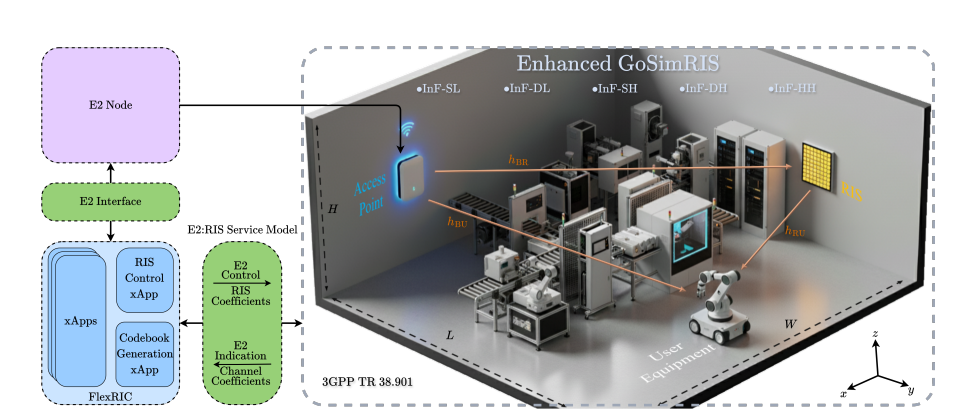
The demand for highly reliable, low-latency connectivity in modern smart factories presents a significant challenge for conventional wireless systems. Sefa Kayraklik, Ali Fuat Sahin, and Onur Salan, from Koç University and HISAR Lab. of TUBITAK-BILGEM, together with their colleagues, address this need by introducing a novel methodology, ORIX, for orchestrating reconfigurable intelligent surfaces (RIS) with xApps. This research presents a complete system that integrates RIS technology into open radio access network (O-RAN) architectures, offering a pathway to meet the stringent demands of industrial wireless communication. ORIX features a dynamic configuration service, a realistic channel simulator based on 3GPP indoor factory models, and practical optimisation strategies, ultimately providing a platform to evaluate and refine RIS deployment and control before real-world implementation, and paving the way for next-generation wireless connectivity in industrial environments.
The core aim is to connect theoretical advancements in RIS technology with practical industrial deployment. ORIX offers O-RAN compliance, enabling interoperability and leveraging the benefits of disaggregation and virtualization. The framework incorporates a realistic channel model, based on 3GPP standards, extended to accurately represent the unique characteristics of industrial environments, crucial for reliable simulations and performance evaluation.
A dedicated RIS simulator allows researchers and engineers to model and test different RIS configurations and deployment strategies. ORIX also includes optimization techniques for RIS control, focusing on maximizing performance within factory settings. This system supports integration with the O-RAN RAN Intelligent Controller (RIC), enabling intelligent control and automation of RIS deployments, and leverages the GoSimRIS channel simulator for detailed and accurate modeling of RIS-aided communication. Furthermore, ORIX supports the development of AI-driven applications, called xApps, for continuous monitoring, learning, and optimization of RIS configurations.
The research demonstrates that RIS significantly improves wireless communication performance in various factory environments, analyzing scenarios like InF-HH, InF-SH, InF-SL, and InF-DL. The work highlights the importance of balancing factors like the number of RIS elements, phase shift resolution, and operating frequency to optimize performance, and confirms that accurate channel modeling is crucial for effective RIS deployment and optimization. The results suggest that AI-driven xApps can enable dynamic adaptation of RIS configurations to changing factory conditions. Ultimately, ORIX provides a comprehensive platform for researchers and engineers to simulate and evaluate RIS deployments in realistic factory environments, develop and test innovative RIS control algorithms, and integrate RIS into existing O-RAN infrastructure, accelerating the adoption of RIS technology in smart manufacturing. Future research will focus on closed-loop optimization frameworks for dynamic adaptation of RIS configurations, integration of RIS with emerging technologies like Integrated Sensing and Communication (ISAC), cell-free MIMO, and digital twins.
ORIX Framework for Smart Factory Wireless Control
Scientists developed ORIX, a novel framework for orchestrating reconfigurable intelligent surfaces (RIS) with applications within the open radio access network (O-RAN) architecture, specifically for smart wireless factory (SWF) environments. This work addresses the need for highly flexible, low-latency, and reliable connectivity in dynamic industrial settings. ORIX integrates RIS technology into the O-RAN ecosystem, enabling fine-grained control and adaptation to rapidly changing wireless channel conditions. The team engineered a system architecture comprising three core components, beginning with an O-RAN-compliant RIS service model that facilitates dynamic configuration and control of the RIS.
This model provides an open interface, allowing seamless integration with the O-RAN framework and enabling external applications to manage the RIS parameters. Researchers then created a detailed RIS channel simulator, supporting 3GPP indoor factory models and multiple industrial scenarios, to accurately emulate wireless propagation within complex factory environments. This simulator accounts for realistic channel characteristics, including reflections, diffraction, and scattering, to provide a realistic testing ground for RIS deployment strategies. Furthermore, scientists implemented practical RIS optimization strategies with finite-resolution control, acknowledging the limitations of real-world hardware.
The team developed algorithms to determine optimal RIS configurations, considering the number of reflecting elements, quantization levels of phase shifts, and operating frequency, to maximize signal quality and network performance. The complete system delivers a realistic end-to-end emulation platform, allowing researchers to evaluate RIS placement, control strategies, and performance gains prior to actual deployment in a factory setting. This approach enables the exploration of trade-offs among key RIS design parameters and identification of deployment strategies that balance system performance with practical implementation constraints.
ORIX Framework Boosts Factory Wireless Performance
Scientists have developed ORIX, a new framework integrating Reconfigurable Intelligent Surfaces (RIS) into Open Radio Access Network (O-RAN) ecosystems for smart wireless factories. This work addresses the need for highly flexible, low-latency, and reliable connectivity in modern industrial environments, going beyond the capabilities of conventional wireless solutions. ORIX combines an O-RAN-compliant RIS control interface, a 3GPP-based indoor factory channel simulator, and practical optimization strategies to enable realistic modeling and evaluation of RIS-assisted deployments. Experiments utilizing the InF-DH channel model demonstrate the performance of various RIS optimization methods.
Iterative and quantized methods achieved very similar results, delivering a rate of 2. 00 bps/Hz for near user equipment (UE) locations and 2. 77 bps/Hz for far UE locations, significantly outperforming the codebook method which achieved 1. 18 bps/Hz and 0. 81 bps/Hz respectively.
The codebook approach, while less performant, offers advantages by eliminating the need for continuous feedback or precise channel estimation. Further analysis reveals the impact of key RIS parameters on data rate. Increasing the number of RIS elements directly improves performance, with the near-UE scenario benefiting more significantly. A phase shift resolution of just three bits nearly converges to the performance of continuous phase control, demonstrating a practical trade-off between hardware complexity and performance gains. Simulations across various InF scenarios show that the InF-HH scenario exhibits the highest performance gains at low transmit power, while scenarios like InF-SL and InF-DL demonstrate superior performance at higher power levels due to rich multipath links. These results provide valuable insights for optimizing RIS designs and deployment strategies in complex industrial environments.
🗞 ORIX: Orchestration of RIS with xApps for Smart Wireless Factory Environments
🧠 ArXiv: https://arxiv.org/abs/2510.17462




See today’s quantum computing news on Quantum Zeitgeist for the latest breakthroughs in qubits, hardware, algorithms, and industry deals.