Replicating artificial intelligence research presents a significant hurdle for automated agents, and current methods often fall short due to incomplete understanding of underlying technical details. Yujie Luo, Zhuoyun Yu, and Xuehai Wang, along with colleagues at Zhejiang University, address this problem by introducing Executable Knowledge Graphs, or xKG, a new system that automatically builds a structured knowledge base from scientific papers. xKG integrates technical insights and code snippets, enabling more effective retrieval and reuse of information than previous approaches, which struggle with hidden details and lack granular knowledge representation. The team demonstrates that incorporating xKG into several agent frameworks yields substantial performance improvements, up to 10. 9% with one model, on a challenging benchmark for AI research replication, establishing xKG as a versatile and extensible solution for automating this critical scientific process.
Current systems struggle with complex reasoning due to insufficient background knowledge and the limitations of retrieval-augmented generation methods, which often fail to capture crucial technical details hidden within referenced papers. Integrating xKG into three agent frameworks with two different large language models demonstrably enhances performance on tasks requiring detailed technical understanding and reasoning.
Extracting and Linking Research Knowledge with xKG
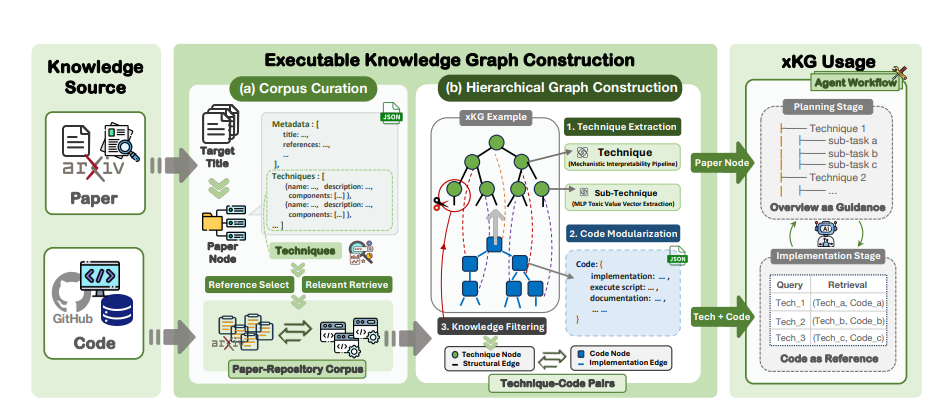
The study pioneers Executable Knowledge Graphs (xKG), a novel knowledge representation designed to facilitate automated AI research replication. Researchers constructed xKG as a hierarchical, multi-relational graph automatically extracted from arXiv papers and GitHub repositories, focusing on capturing both conceptual relations and runnable code components. The process began with careful selection of relevant papers and code, then progressed to hierarchical graph construction, organizing knowledge into nodes representing papers, techniques, and code. The team extracted techniques and their descriptions from papers, identifying key components within each technique, and then linked this information to corresponding code snippets, creating a network of interconnected knowledge.
Researchers modularized code, ensuring each component was readily executable and documented, and implemented knowledge filtering to refine the graph’s accuracy and relevance. The resulting xKG structure organizes knowledge into a hierarchy, with techniques branching into sub-tasks and linked to specific code implementations. Experiments involved integrating xKG into three distinct agent frameworks, BasicAgent, IterativeAgent, and PaperCoder, to evaluate its impact on automated replication. The team employed PaperBench as a benchmark, assessing the functional correctness of generated code repositories against a defined evaluation rubric, allowing them to quantify replication success by measuring the proportion of criteria met.
The design of xKG is modular and extensible, facilitating its adoption and expansion across diverse research domains, and the team released the code to enable further research. The study demonstrates consistent and significant performance gains, with xKG achieving a 10. 9% improvement when used with the o3-mini agent on the PaperBench benchmark. This improvement highlights the effectiveness of xKG as a general and extensible solution for automated AI research replication, enabling agents to retrieve, reason about, and assemble the precise artifacts needed for faithful reproduction.
Executable Knowledge Graphs Replicate AI Research
The work presents Executable Knowledge Graphs (xKG), a novel approach to automatically replicating artificial intelligence research. Researchers addressed the challenge of reproducing results from scientific papers, which often lack crucial implementation details or complete code repositories. The team developed a system that automatically integrates technical insights, code snippets, and domain-specific knowledge extracted directly from scientific literature, creating a structured and executable knowledge base. The core of xKG is a hierarchical graph composed of paper nodes, technique nodes, and code nodes, linked by structural and implementation edges.
This design allows the system to connect specific techniques described in papers with their corresponding executable code, enabling agents to retrieve, reason about, and assemble the necessary components for faithful reproduction. The construction process begins with automated corpus curation, identifying core techniques from target papers and expanding the knowledge base through reference-based selection and technique-based retrieval. Experiments demonstrate substantial performance gains when xKG is integrated into three distinct agent frameworks, BasicAgent, IterativeAgent, and PaperCoder. The team measured a 10.
9% improvement on the PaperBench benchmark when using xKG with the o3-mini language model, demonstrating its effectiveness as a general and extensible solution for automated AI research replication. The system’s modular design and automated pipeline facilitate scalability and expansion across diverse research domains, offering a significant advancement in the field of automated scientific reproduction. Scientists developed xKG as a modular knowledge base that integrates technical insights, code snippets, and domain-specific knowledge extracted from scientific literature, addressing limitations in existing retrieval-augmented generation methods. When incorporated into multiple agent frameworks alongside different large language models, xKG demonstrably enhances performance on the PaperBench benchmark, achieving gains of up to 10. 9% with one model configuration. The team’s work transforms agents from simply scaffolding solutions to systems capable of generating complete implementations, enriching information granularity and enabling the reuse of verified code.
This improvement stems from xKG’s organization of knowledge, allowing agents to accurately generate critical details and build upon existing, functional code. While acknowledging the inherent variance and cost associated with evaluating the PaperBench task, and the current limitations when reference papers are unavailable, the researchers suggest future work will explore the transferability of this code-based knowledge organization to other tasks. They also note ongoing research in the field, including related projects such as ExeKG, while highlighting the fundamental differences in approach and focus.
🗞 Executable Knowledge Graphs for Replicating AI Research
🧠 ArXiv: https://arxiv.org/abs/2510.17795
See today’s quantum computing news on Quantum Zeitgeist for the latest breakthroughs in qubits, hardware, algorithms, and industry deals.