Maintaining stable laser frequencies is paramount for the accurate detection of gravitational waves in space, and Yongbin Shao, Xinyi Zhao, and Long Ma, alongside Ming Xin from Tianjin University, have made significant progress in bolstering the reliability of these crucial systems. Their research addresses the inherent vulnerability of ‘arm-locking’, a technique used to minimise laser noise, to unpredictable changes in operating conditions. The team developed a new analytical framework that precisely maps the limits of stable operation, revealing critical boundaries beyond which the system becomes unstable, and importantly, they designed a controller that actively compensates for these fluctuations. This robust controller demonstrably maintains stability and suppresses laser noise even when faced with parameter perturbations, representing a vital step towards more sensitive and dependable gravitational wave detectors.
Combining D-subdivision theory with the Semi-Discretization method, they successfully mapped the system’s stability regions and identified critical operating boundaries. This detailed analysis revealed that arm-locking systems operate near a stability limit, making them vulnerable to multiplicative perturbations that can compromise measurement accuracy. To counter this vulnerability, the team designed a robust controller incorporating a high-pass filter. Both theoretical analysis and time-domain simulations confirm that this controller maintains stable operation and effectively suppresses laser frequency noise, even when system parameters vary. This advancement contributes to the development of more sensitive and accurate gravitational-wave detectors, enabling the observation of faint signals from distant astrophysical sources.
Arm-Locking Stability Near Instability Boundaries
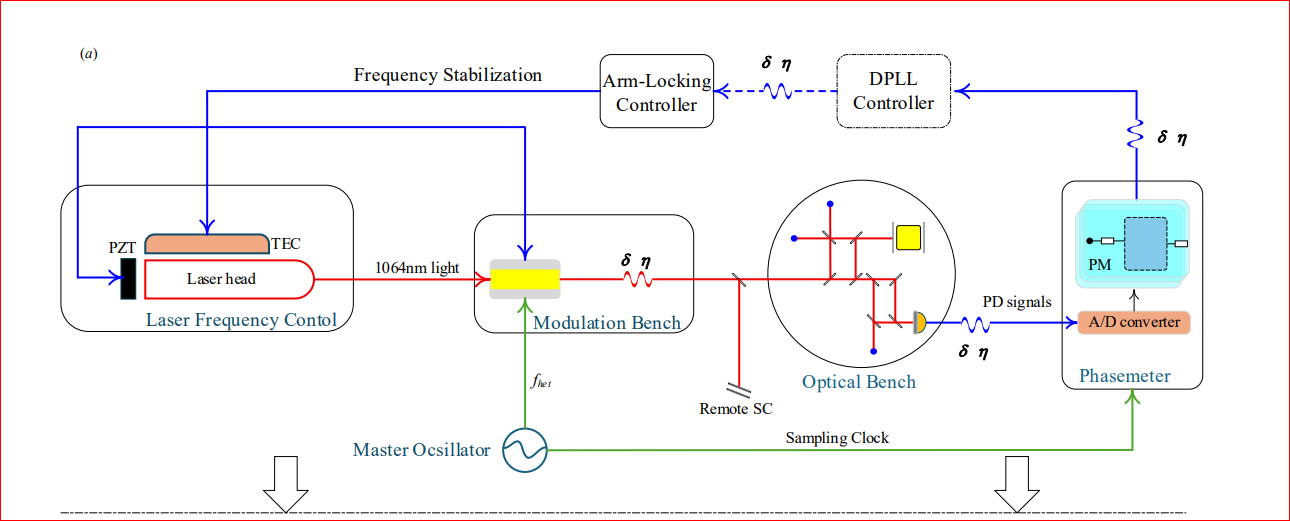
This research investigates the stability of arm-locking systems used in space-based gravitational-wave detectors, focusing on the challenges posed by operating near instability boundaries. Arm-locking is a crucial technique for enhancing detector sensitivity by stabilising the interferometer arms and reducing noise. However, these systems are inherently susceptible to perturbations, small changes in operating conditions that can lead to instability and degrade performance. The study highlights the particular impact of multiplicative noise as a significant source of instability. Researchers established a framework for analysing stability based on variations in system parameters, allowing them to identify critical parameters and their tolerance limits.
They employed advanced mathematical techniques, including D-subdivision and Semi-Discretization methods, to model the complex dynamics of the arm-locking system and account for its inherent nonlinearities. The analysis led to the development of a robust controller incorporating a high-pass filter, designed to attenuate low-frequency noise and stabilise the system. Simulations and theoretical analysis confirm that this controller maintains stability despite the presence of perturbations, improving the reliability and performance of gravitational-wave detectors.
👉 More information
🗞 Robustness Analysis and Controller Design of Arm-locking System in Space-based Gravitational Wave Detectors
🧠 ArXiv: https://arxiv.org/abs/2510.17468