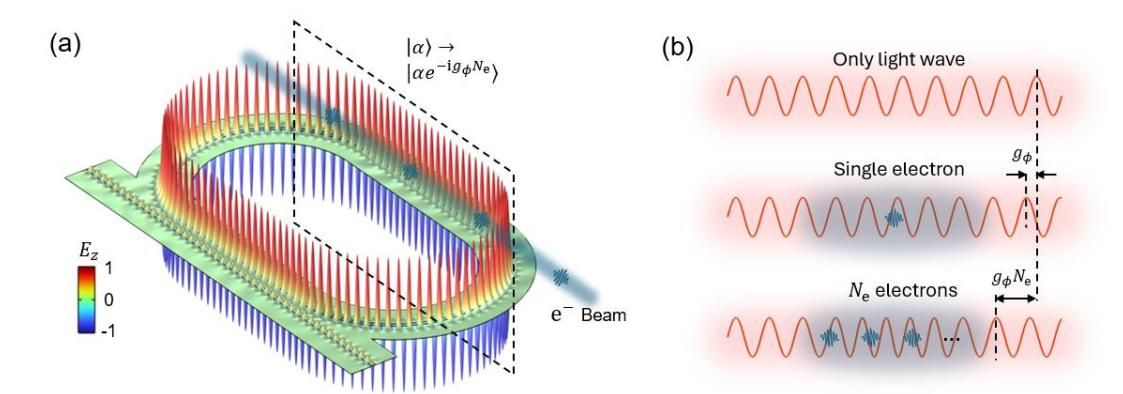
The interaction between light and matter fundamentally shapes how we observe the world, and recent work explores a particularly subtle connection between free electrons and photons. Dingguo Zheng and Ofer Kfir, both from Tel Aviv University, investigate the elastic coupling between these particles, revealing that an electron moving through a confined light field alters the field’s phase. This effect, quantified as a refractive index for a single electron, demonstrates a pathway for counting electrons in a beam without disturbing their properties. The research establishes a new dispersive Hamiltonian for electron-photon systems, potentially enabling sub-shot-noise imaging at the atomic scale within electron microscopes and opening new avenues for high-resolution observation.
Light-Electron Interactions and Beam Manipulation
This extensive collection of research papers details a fascinating and cutting-edge field: the interaction of light and electrons, with a focus on quantum effects and applications in microscopy, acceleration, and quantum technologies. The work explores how light, especially coherent light from lasers, can manipulate electron beams, and vice versa. Key areas of investigation include optical modulation of electron beams, where light alters beam properties like momentum and spin, and electron-induced optical effects, such as squeezing optical modes. Researchers are also deeply investigating the role of quantum vacuum fluctuations in these interactions.
This research extends to advancements in electron microscopy and quantum microscopy, aiming to improve resolution and sensitivity through spin squeezing and quantum non-demolition measurements. Scientists are also exploring electron acceleration techniques, utilizing light and microstructures to create compact and efficient accelerators. Furthermore, the work applies these interactions to build quantum devices and explore fundamental quantum phenomena, including the generation of quantum states of light and electrons, and the enhancement of squeezed light sources. Investigations also encompass the use of micro and nano-scale optical structures, like microresonators, to enhance light-electron interactions and confine light.
The research relies on robust theoretical foundations, employing mathematical tools like the Magnus expansion, Zassenhaus formula, and geometric phase to describe these interactions. The collection includes a broad range of studies, from theoretical work establishing the mathematical framework to experimental investigations exploring specific applications. This is a rapidly evolving field with ongoing discoveries. The research highlights an interdisciplinary approach, drawing from physics, optics, materials science, and engineering. The work has the potential to revolutionize microscopy, particle acceleration, and quantum technologies.
Key researchers in this field include F. J. García De Abajo, known for his work in plasmonics and nanophotonics, and V. Di Giulio, who frequently collaborates with García De Abajo on electron-induced optical effects. I. Kaminer is also prominent for his research on spin squeezing and quantum effects in electron microscopy, alongside teams working on dielectric laser acceleration and microresonators.
Electron Counting via Light-Matter Interaction
Scientists have developed a novel method for counting electrons in a beam without altering their state, by harnessing the interaction between free electrons and photons within an optical microresonator. The core principle is that traversing electrons induce a quantifiable phase shift onto the confined photonic mode of the cavity, effectively giving the free electron a refractive index. This technique involves monitoring energy leakage from the resonator, directly linked to the phase shift caused by each electron passing through the cavity. The team analyzed changes in circulating and output light fields, focusing on timescales defined by the cavity’s round-trip time and lifetime.
Experiments employed a Gaussian-shaped phase shift, simulating a single electron, inducing a temporary decrease in circulating power and a corresponding increase in output power, creating a measurable signal. Calculations reveal that a single 100-electron volt electron induces a net energy output of approximately 1. 5x 10⁻¹⁹ joules for a high-finesse microresonator, equivalent to roughly two photons per passing electron. While challenging to detect amidst noise, this energy output provides a pathway for precise electron counting. Investigations extended to various photonic states, including squeezed vacuum states, where free electrons can rotate the squeezing direction via the elastic interaction.
Even with complex states like cat states or Fock states, the interaction results in predictable phase shifts or rotations, demonstrating the versatility of the method. Furthermore, the research establishes a connection to classical phenomena, reproducing the known Kapitza-Dirac effect and laser-based Zernike holography in the limit of a strong laser field. Scientists derived an expression for the effective refractive index of the free electron, linking it to the integrated optical field and the classical radius of the electron. The team formulated the elastic electron-photon coupling, revealing that this interaction can be described by a quantum non-demolition electron counting operator.
Numerical examples illustrate this effect across various photonic states, including coherent, squeezed, and Fock states, suggesting the possibility of quantifying electron number by monitoring the resulting phase shift. The findings indicate potential for significant advancements in electron microscopy, offering a pathway towards surpassing the standard quantum limit and achieving superb signal-to-noise ratios. While current calculations do not yet reach single-electron sensitivity, the researchers highlight that increasing circulating power, extending interaction time, or exploring alternative systems could enhance the effect. They emphasize that this interaction differs from inelastic processes, conserving the initial quantum states of both electrons and photons, and opening possibilities for enhanced quantum measurements with electrons alongside atomic resolution imaging.
🗞 Elastic Quantum Coupling Between Free Electrons and Photons
🧠 ArXiv: https://arxiv.org/abs/2510.15584


See today’s quantum computing news on Quantum Zeitgeist for the latest breakthroughs in qubits, hardware, algorithms, and industry deals.