The pursuit of stable quantum bits, or qubits, faces a persistent challenge from environmental noise, and researchers continually seek methods to protect these fragile states. Lionel E. Martínez from Universidad de Buenos Aires and University of Southern California, Ignacio García-Mata from Instituto de Investigaciones Físicas de Mar del Plata and CONICET, and Diego A. Wisniacki from Universidad de Buenos Aires now demonstrate a fundamental limit to a promising approach using ‘cat-code’ qubits. Their work reveals that increasing the protective nonlinearities within these qubits inadvertently introduces chaotic states, which then facilitate unwanted transitions between the qubit’s encoded states through a process called chaos-assisted tunneling. This research establishes the first evidence of this effect in cat-code qubits and importantly, identifies a previously unrecognised boundary on how effectively these qubits can maintain coherence, offering crucial insight for future quantum technology development.
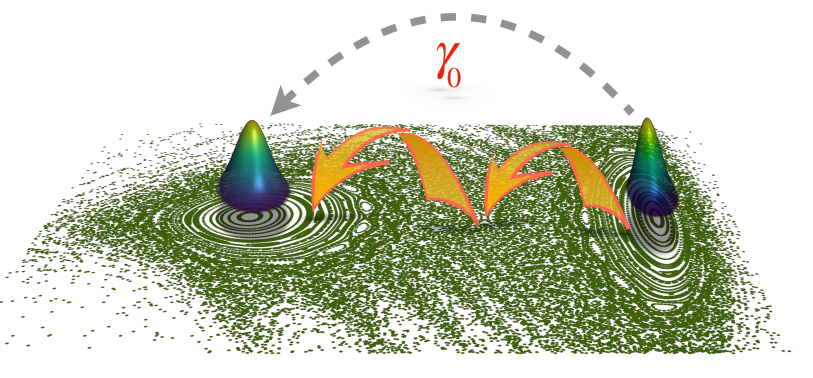
Researchers demonstrate that chaos-assisted tunneling (CAT) imposes an intrinsic limit to the protection of Kerr-cat qubits. In a static description, tunneling between the qubit’s states can be exponentially suppressed, ensuring long lifetimes. However, detailed analysis reveals that as the strength of the qubit’s nonlinearities increases, chaotic states emerge and mediate tunneling between these states, producing large quasi-energy splittings. The team computed tunneling rates using both full quantum simulations and semiclassical calculations, finding strong agreement and confirming that these splittings are directly linked to the presence of chaos. These results provide the first evidence of CAT in the Kerr-cat qubit.
Chaos Accelerates Tunneling in Kerr-Cat Qubits
Scientists have demonstrated that chaos-assisted tunneling (CAT) fundamentally limits the coherence of a specific type of superconducting qubit, the Kerr-cat qubit (KCQ). The research reveals that while static models predict exponentially suppressed tunneling between qubit states, increasing the strength of the qubit’s nonlinearities introduces chaotic states. These states then facilitate unwanted tunneling, resulting in large quasi-energy splittings. Experiments employing both full quantum simulations and semiclassical calculations confirm strong agreement between these methods, establishing a direct link between chaos and tunneling rates.
The team investigated the KCQ, which encodes logical states in coherent-state superpositions stabilized by two-photon driving and Kerr nonlinearity. They found that the static effective model, which predicts vanishing splittings, fails to capture the full dynamics. By analyzing the driven system using Floquet theory, researchers observed a clear transition in the quasi-energy splitting as chaos develops, demonstrating a sharp increase mediated by chaotic states. Measurements confirm that the tunneling rate is directly influenced by the degree of chaos present in the system. The research establishes that the KCQ’s Hamiltonian can be factorized, providing hardware-efficient protection against bit-flip errors, but this protection is not fundamental. The team identified a potential with a double-well structure, where stable states are separated by a barrier, and demonstrated that detuning can improve protection and create tunable parity-protected degeneracies. This constitutes the first quantitative evidence of CAT in a superconducting qubit, identifying chaos as a fundamental mechanism that limits the protection of cat-code architectures.
Chaos Limits Kerr-Cat Qubit Coherence
This research demonstrates a fundamental limit to the coherence of a promising type of quantum bit, known as the Kerr-cat qubit, arising from a phenomenon called chaos-assisted tunneling. While previous work suggested these qubits could be protected from errors through specific dynamic controls, this study reveals that increasing the strength of these controls introduces chaotic states. These states then facilitate unwanted tunneling between the qubit’s logical states, effectively limiting how long coherence can be maintained. The team confirmed this effect through a combination of detailed quantum simulations, alongside semiclassical calculations commonly used in chaotic systems, achieving strong agreement between the two approaches. This work establishes the first direct evidence of chaos-assisted tunneling in a superconducting qubit, identifying chaos not as a broad destabilizing factor, but as an intrinsic error channel that emerges even before the qubit’s states become fully mixed. The findings constrain the achievable coherence times and, consequently, the design parameters for scalable quantum computing architectures based on cat-code qubits.
🗞 Fundamental Limits to Cat-Code Qubits from Chaos-Assisted Tunneling
🧠 ArXiv: https://arxiv.org/abs/2510.15175
See today’s quantum computing news on Quantum Zeitgeist for the latest breakthroughs in qubits, hardware, algorithms, and industry deals.